Declarative relationships, and the promise of social media interactions

A few months ago, I finally ‘Facebook friended’* someone with whom I’d been friends for some time. Writing on his wall in the days after, I made note of the fact that our friendship was now ‘real’ because it was publicly declared; a kind of symbolic nod to our relationship that was now visible to anyone who chose to look. The connection between us had become declared; an explicit rather than implicit thing. It sort of felt like the relationship counted a little more then, because it could be counted.

Now, I’m being marginally facetious with this notion that a Facebook relationship could matter more than one established outside or beyond social media, but not much. I’ve started to think often about the kind of identity performing that takes place on social media platforms, and how these kinds of declarative identity statements offer opportunities not just to take action or align yourself with an idea, but also to be seen doing so. Or, as Nathan Jurgenson writes, ‘Social media surely change identity performance. For one, it makes the process more explicit.’

In a 2008 paper on identity construction on Facebook, Zhao, Grasmuck, and Martin note that:

The construction of an identity is therefore a public process that involves both the ‘‘identity announcement” made by the individual claiming an identity and the ‘‘identity placement” made by others who endorse the claimed identity, and an identity is established when there is a ‘‘coincidence of placements and announcements” (Stone, 1981, p. 188).

There are so many avenues of communication available to us now, all with different levels of visibility and publicness, that the choice between making an action observable and public (say, openly Tweeting someone), or choosing instead to operate in a less visible backchannel (a DM, an email), is not just about task appropriateness, but often also involves the decision to perform an act of communication in public, or not; to make the discussion open or closed; to declare a relationship, or sentiment, or inclination in a way that can be seen by anyone, or to keep it hidden.

But the decision to make public an act of communication can also play a role in that endorsement or lackthereof of identity, too, because the other party to whom a communication is directed can then publicly respond, or appear to snub. In the third of our (awesome) Museopunks sessions at MCN2013 recently, Beck Tench makes the observation that with the capacity to measure interactions, ‘reputation is quanitifible, in a sense, and it’s also democractic.’ I’m not sure that I agree that reputation has become more democratic, because it is just as easy to visibly snub someone on social media as it is to talk to them in public. But this idea that we can measure or see relationships and identity performance is interesting to me, and does put a new emphasis on the declarative value of social media relationships. Maybe, counterintuitively, they really might be more important than meatspace relationships, for some things at least.

This has, I think, some interesting implications for us working in the museum sector, both as professionals, and in terms of dealing with our publics. The first is in terms of how we act as professionals, and how and where we choose to perform our professional identities using these kinds of public or semi-public platforms for connection; particularly if we consider how interactions with others can help embed or endorse that claimed professional identity, or otherwise. The declaration of being active on social media as a professional, too, now seems to have increasing impact on how one will be viewed professionally, but that definitely complicates notions of professional identity and the boundaries of work and ‘not work’ in a networked world. As danah boyd asked earlier this year, ‘what does labor mean in a digital ecosystem where sociality is monetized and personal and professional identities are blurred?’

But I also wonder about the declarative value of people ‘liking’ a museum on Facebook etc. In a lovely piece on Aeon Magazine recently, Patrick Stokes observed that ‘the online identity that most of us use is, to borrow a phrase from the American philosopher Stanley Cavell, our ‘next self’. Dress your avatar for the life you want, not the life you have.’ Similarly, in the aforementioned paper by Zhao, Grasmuck, and Martin, the academics considered how people act in nonymous, online environments and proposed that they have become a place where people tend to express their ‘hoped-for possible selves.’ In this light, the urge to ‘like’ a museum or any other group or activity on Facebook or a social networking site acts as a kind of ‘identity statement’, through which the individual can “stage a public display of their hoped-for possible selves that were unknown to others offline.” (Zhao et al. 1820)

I sometimes see people disparage the number of people who are actively ‘engaged with’ museum social media groups; that an institution’s page might have huge numbers of likes, but only a tiny proportion of those in interaction. Rob Landry, for instance, recently argued for museum websites as a space for connection, over and above social media, because the large numbers of likers don’t mean much:

With social media it’s easy to be deceived by large numbers that don’t mean a lot.  For example, we spot checked the Facebook page of a major museum and found that they over the last several days they’ve had, on average, 716.4 likes, 184.8 shares and 8.4 comments per post.  Looks pretty good, until you realize that they have nearly a million fans.  In that context, 0.07% of fans liked posts, 0.018 fans shared and an infinitesimal 0.0000823% of fans commented, on average.

Here’s something to think about: would the fans who are engaging be the folks who would be buying tickets anyway even if Facebook had never been invented?  And are you strengthening connections or just giving people who are already avid fans a nice way to interact?

But for me this ignores the value that comes from someone associating their ‘next self’ or the person they want to be (or want to be perceived to be) as someone who is connected to your museum. In the same MCN Museopunks session mentioned above, Nancy Proctor described a study that Silvia Filipini Fantoni did of Tate’s bookmarking system (I think this one), in which people were sent an email record of their visit to the museum to extend the visit, and even though many didn’t actually click on the links, they kept the email in their rainy day files. In this, Nancy saw a kind of promise to themselves that someday they would reconnect with the museum, even if they had not taken that action yet. And it’s here that I see something interesting in the notional promise of social media, and its declarative performance of identity, and museum audiences. Is there a gap between the people who like an institution on social media, and those who actually visit the institution? And if so, what lies between those two impulses; the association of someone’s ‘hoped-for possible self’, and their actual actions? (Has anyone studied this?)

I was thinking about all of this during MCN2013, when I finally emerged from the dark place of PhD-land, where social media contact is minimal, and re-entered the bright world of #musetech discussions online. I’m aware that this isn’t a wash-up report from MCN2013, but there are so many issues that I want to get into from this conference that I thought I’d dive straight into blogging the stuff that’s been on my mind lately. Meanwhile, if you are keen to find out more about the conference, you should check out these reports from my professional spirit animal Jeff Inscho and the ever-great Ed Rodley.

Of course, I’d love to know what you think. How do you decide which platform to communicate an idea, or connect with a person, when there are so many available now? And does the level of publicness or otherwise of those interactions weight into your decision? And do you think your digital version of self is accurate or aspirational?

*I love/am fascinated by this idea that friending is now a verb.
“I like your old stuff better than your new stuff.” On 3D mashups, appropriation, and irreverence.

I just happened to stick my head up from the books for a moment to catch a wild discussion taking place on Twitter about whether 3D mash-ups of masterpieces are ‘sacrilege’ or merely ‘winking irreverence’. Arts journalist Lee Rosenbaum Tweets that the ‘@MetMuseum‘s digerati should serve the curators, not the other way around’, and is clearly troubled by moves within the museum to enable artists and others to create new types of art from the digital bodies of old ones.

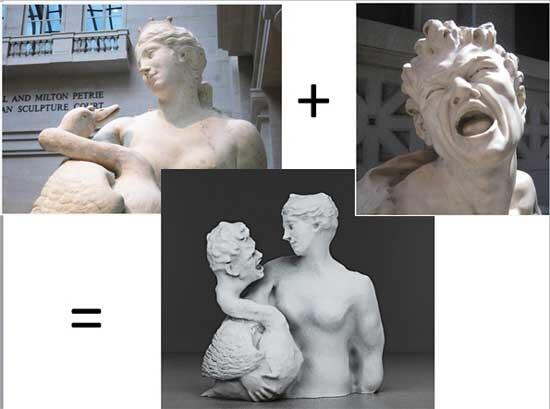
A stake are mashups like this version of Leda and the Swan hacked together with Marsyas, by Jon Monaghan (which I have to confess that I love, and am terrified by).

I am so glad Rosenbaum has raised these questions, because to me they are actually about very core issues at the heart of contemporary museology, and no doubt speak to bigger issues than one short Twitter conversation. Is the museum’s core role and responsibility to protect sacred cows from those who question them (even though questioning can equally be an act of exaltation as irreverence)? Or is it to enable humankind to draw on those ideas and objects from the past considered worthy of recognition, protection, and value, in order to create something new, and to come up with new ways of asking questions and seeing the world? Are museums about now, and responses to a changing world, or an attempt to freeze in time as much as possible those things which are from a world that has already shapeshifted away? Is it more disrespectful to a work of art (and the artist who once created it) to enable these kinds of digital mash-ups that bring the work into a contemporary context and conversation, or to prevent them? And does a 3D mash-up of multiple works of art actually lesson the relevance or importance of the original work? Is Leda and the Swan now less magnificent for the fact that it has been reimagined through a new technology, and with a new face?

Liz Neely and Miriam Langer published a useful paper at Museums and the Web this year, on the emergence of 3D printing and scanning, in which they argue that the act of 3D modelling offers museum visitors the capacity to gain insight into an object:

To create a 3D model of the object, the visitor must photograph it from every angle, requiring a close examination and consideration of the object’s form. To create a really good 3D scan without massive distortion, the photographer must look carefully at the artwork, think about angles, consider shadows, and capture all physical details. This is just the kind of thought and ”close looking” we want to encourage in the museum. When a photogrammetric model is unsuccessful, even this failure can initiate a point of dialogue. What caused this failure? Was it a missed angle? Are areas lost in shadow? Is the shape too amorphous? The failed model may provide a surprising launch pad from which to celebrate a derivative “glitch” creation. Glitches and other unintended transformations are prevalent because the freely available 3D creation tools are young and evolving.

This perspective would position the fun of 3D absolutely in support of the original object, even if later results aren’t faithful to its prototypical intentions.

In some ways, I think that the technology question here is a bluff; a distraction. Haven’t artists always questioned the work of other artists, simultaneously nodding at their importance and interrogating it? Isn’t this, in fact, part of what makes art such an interesting (and often insidery) game; these long-running conversations about materiality and culture, that utilise the same objects and symbols from one generation to the next; that pull apart the ideas of one another in a critique? Is not art, after all, as much about a response to its own history as to the conditions that surround it?

Sherrie Levine, Fountain (after Marcel Duchamp: A. P.) (1991) Walker Art Center, 1999

Or is the problem the fact that it isn’t just artists making these works; that it might be a museum technologist who asks questions of the work, just as much as another artist? Or a programmer with no traditional artistic background or impulse? I am perhaps as concerned about the notion that a museum’s ‘digerati’ should serve the curators, not the other way around as I am about the privileging the masterpiece over new creation. Firstly, it imagines that somehow a 3D mashup of a work of art necesssarily does not serve the curators (or artist). But it also creates a false dichotomy through which to think through the relationship between the curator and digital technologies.

Digital technologies are becoming more and more knit into not just how we operate online, but how we perceive and experience in the world far more broadly. I met an artist last year who photographs her paintings every time she works on them, not as a way to track their progress, but so that she can see what they look like when viewed digitally via a screen, since that will primarily be the way her works are experienced. Her artistic processes are driven and changed in response to the digital context through which art and ideas are communicated. This is the circumstance in which culture now exists. And just like artists, curators themselves do and must serve digital demands as much as physical ones. The relationship is not hierarchical.

And I wonder if this isn’t at the crux of this whole discussion; about the shift in the balance of power as traditional artforms and positions are interrogated. I’ve been writing a lecture this morning on art and digital technology, which led me to revisit Will Wiles’ 2012 piece on The New Aesthetic. In it, he speaks of how the intent of The New Aesthetic was to draw attention to the fluctuations in power relationships, in response to ‘the riotous spread of new technologies of seeing.’ He includes a quote from James Bridle, that seems pertinent here (though you should go and read it in context too):

‘The programmers have a huge amount of agency in the world, because they can deconstruct, reverse engineer and write and construct and create these systems. People who can’t, don’t, and they have less power in the world because of it.’

I wonder whether what’s at stake is not so much the interrogation of the art object, but the agency of those who do and don’t have the power to participate in these discourses?

What do you think? Is the concern about irreverent mashups of important works of art simply a response to shifts in power, and reduced agency, or does it speak to a genuine problem about the sacredness of art? What am I missing in thinking through this issue? I’d love your thoughts.

Note: Koven beat me to this discussion with his own short piece. Check it out here.

Cooperative conservation? On Cooper-Hewitt’s acquisition of a ‘living object’

On 27 August, the Cooper-Hewitt made public news of an interesting acquisition: its first piece of code. If you haven’t yet heard about the acquisition, let me fill you in with the briefest of details: Planetary is an iPad app. The Museum has acquired the app itself, and its source code. In itself, this feels important; an attempt made to combat the rushing waters of time that seek to drive apart software and the hardware that once supported it by holding onto at least the record of what was; the thought processes behind it. But that’s just the beginning…

Where things get compelling for me is what the Cooper-Hewitt has done with that code. They’ve made it public, releasing the source code on GitHub under an open source license, and putting the graphical assets online under a Creative Commons (non-commercial) license. In so doing, the Museum is treating the acquisition as a kind of ‘living object’. As Clive Thompson puts it:

Geeks worldwide can then download and modify it—visualizing collections of books, perhaps, or a constellation of genomes. Public-minded nerds years from now will be able to create “emulators”—software that runs on modern computers but emulates today’s iPad, so people eons from now can see how Planetary appeared in 2013.

Why has Cooper-Hewitt taken this approach? To preserve it. As Seb Chan and Aaron Cope describe in their post about the acquisition, the Museum hopes that making Planetary‘s source code open, it will encourage developers, scholars and enthusiasts to help develop new versions of the app, which can work on different operating systems.

Open sourcing the code is akin to a panda breeding program. If there is enough interest then we believe that Planetary’s DNA will live on in other skin on other platforms. Of course we will preserve the original, but it will be ‘experienced’ through its offspring.

This move, and the associated language used by Chan and Cope to describe it, makes me wonder whether this is the first example in a museum context (beyond zoos, acquaria or other natural living collections) of ‘cooperative conservation’? In an environmental context (which seems appropriate, given the panda metaphor employed by Chan and Cope), cooperative conservation has been defined (by George Bush in a 2004 Executive Order) as:

actions that relate to use, enhancement, and enjoyment of natural resources, protection of the environment, or both, and that involve collaborative activity among Federal, State, local, and tribal governments, private for-profit and nonprofit institutions, other nongovernmental entities and individuals.

Cooperative conservation, then, is a form of collaborative action taken by various entities and individuals with the aim of conserving a species. A cooperative conservation program is:

a breeding and/or management program that aims to conserve a species (in the wild or in captivity, or both) and applies best practice to the management of husbandry, genetics, biology and behavioural needs of the species. The program’s objectives must be based on the conservation status and needs of the species, and the program must not be detrimental to the survival of the species in the wild.

This language feels almost applicable to the Cooper-Hewitt’s decision to conserve Planetary as a physical object (a copy of the source code is also preserved in a machine-readable font on archival paper), and their tag-and-release program, which has seen the code re-enter the wild. The institution has taken the approach to tackle the needs of the species as a living object. Ideally, this will mean that the code can be adapted to suit different purposes and environments, preserving Planetary not simply as app, but as ‘an interaction design that found its ‘then-best manifestation’ in the iPad.’

This raises a few questions, including who exactly is going to be responsible for participating in this cooperative venture, and under what conditions. How will individuals be recruited to invest their time and energy in this kind of cooperative conservation project, and what will compel them to remain part of the Museum’s efforts to preserve Planetary and future projects of this kind?

This morning, I’ve been reading Mathieu O’Neil’s Cyberchiefs: Autonomy and Authority in Online Tribes, in which O’Neil describes the relationship between authority on the Internet and autonomy. In a section on distributed or cooperative production in free-software projects, O’Neil notes (p44)  that:

The availability of source code makes it possible for an unlimited number of individuals to collaborate in its development. This, in itself, it not enough to guarantee that it will be developed: the possibility must be realised by a community of people willing to invest their time and energy. The capacity of project leaders to successfully attract and retain participants and integrate their contributions is crucial for the survival of the project.

Similarly, there is an interesting piece in the Frontiers in Ecology and the Environment journal, on The Promise and Challenge of Cooperative Conservation, which has relevance here. Terrie Klinger and Virginia Dale observe that cooperative conservation has some inherent difficulties in its application, due to the challenges in moving from a system dominated by top-down, regulatory processes to one motivated by shared goals and accomplished through cooperative action. They write:

Efforts will be idiosyncratic, and likely will be motivated by the desire to conserve iconic species, restore special landscape features, or avoid federal regulation. Successes will be patchy in time and space, and there will be mismatches in scale between conservation action and ecological process.

Successful action will depend on the leadership of a few strong actors; consequently, outcomes could be driven by special interests, and the predictability and repeatability of successful action could be low. Durability of successful outcomes will depend on the sustained engagement of interested parties.

Effective vertical integration will be difficult to achieve.

Scientific and technical expertise will often be limiting in projects that rely on volunteers or community groups.

Coalition building and cooperative action will take time and the temporal scale required for cooperation may not match the scale of the threat.

Global climate change will add a new and difficult dimension to all efforts and may overwhelm or undo short-term successes.

Cooperative action will not eliminate conflict, but will change the manner in which conflicts are resolved. Unresolved conflicts will delay action and could accelerate loss or degradation of the resource of interest.

Take out the words ‘ecological’ and ‘climate’ here, and substitute in ‘technological’, and I think these challenges may be similar to the ones that the Cooper-Hewitt and other institutions that take this kind of approach to conserving born digital objects might face. This is not to suggest I don’t think this project will work. Conversely, I think that sites such as Wikipedia demonstrate, there is indeed a hunger for these kinds of participatory projects, and this makes Cooper-Hewitt’s willingness to experiment in this area all the more exciting. However, there is a much higher bar for participation in a project that requires people to hack source code than for someone to make a correction on Wikipedia, or to add a tag to a museum collection, so I wonder whether museums tackling these kinds of acquisitions will need members of staff to take on deliberate roles as online project leaders or focal points for such cooperative ventures.

A few weeks before Cooper-Hewitt made this acquisition public, I wrote a post on museums curating the digital world. In the comments, Nicole Cama and Penelope Hyde from the Australian National Maritime Museum drew attention to the fact that curators working in a digital space might have to negotiate roles including Digital Exhibition, Engagement Curation, and Digital Content Curation, while Koven Smith suggested that in a context where objects are essentially nonrivalrous ‘the curator role [might actually be] a collectivist role (as the ‘editor’ role essentially is with Wikipedia), rather than a specialized one contained within a single person’. Maybe what these kinds of acquisitions and community conservation projects might require is not a curator per se (with the top-down knowledge connotations that come along), but an enabler and engager?

Regardless of these questions, I’m really, really excited by this move by the Cooper-Hewitt. As Seb and Aaron write in their post:

Museums like ours are used to collecting exemplary achievements made manifest in physical form; or at least things whose decay we believe we can combat and slow. To that end we employ highly trained conservators who have learned their craft often over decades of training, to preserve what would often be forgotten and more quickly turn to dust.

But preserving large, complex and interdependent systems whose component pieces are often simply flirting with each other rather than holding hands is uncharted territory. Trying to preserve large, complex and interdependent systems whose only manifestation is conceptual – interaction design say or service design – is harder still.

It’s wonderful that the museum is tackling this question head on. This is a project to watch.

There’s still much to be unpacked here (and in my dissertation!), but I’d be really interested in hearing your reflections on Cooper-Hewitt’s acquisition, and this idea of ‘cooperative conservation’. Do you think that born digital acquisitions can be conserved cooperatively? Is this an apt metaphor? And if so, what do you think might be necessary to make such projects successful?

#drinkingaboutmuseums – Sydney – 4 September 2013

Today Seb Chan and Aaron Cope dropped news of one of the coolest things I’ve heard in musetech circles in some time. The Cooper-Hewitt has acquired Planetary – it’s first piece of code – to be preserved as a living object. This is such an interesting idea, and one that fits right into my own ideas about what museums need to be doing and confronting in an era of networked knowledge. I am going to spend a few days sitting with their post and thinking through its implications further before I respond fully, but this is a perfect excuse for plugging next week’s #drinkingaboutmuseums in Sydney, because Seb himself is going to be in appearance. This also means that if you haven’t been to a #drinkingaboutmuseums in a while, it will be a really great one to attend.

So, if you’re a museum/art gallery/culture professional – or student – located in or near Sydney, you should come along. If you haven’t been to a #DAM event before, get in contact with me and I’ll send you my phone number so you can locate us. Or you can follow the #drinkingaboutmuseums hashtag on Twitter for updates in the lead-up to the event.

#drinkingaboutmuseums
When: Wednesday, 4 September 2013
Time: From 5.30pm
Where: Down the Rabbit Hole (a totally appropriate choice following Seb’s most recent immersive theatre experience.)
Who: You!!

The Cooper-Hewitt’s decision to acquire their first piece of code is a really important one, and bound to spark a significant amount of conversation in the sector. This is a great opportunity to talk about it. It’s also a chance to build stronger internal networks within the museum community here in Australia, which is so important.

Earlier tonight I attended the Sydney Open Research meeting and launch of the Open Knowledge Foundation Network Australia – a really important organisation doing great work to open up knowledge. I’ll talk more on this later, but being in the room tonight with a group of passionate, interested people all working on great projects left me really inspired, and renewed my appreciation for the value of informal connections and networks. It’s one of the reasons I’m so excited about the fact that #drinkingaboutmuseums has becomes something of a regular thing. So do come along.

And as always, a quick note about the nomenclature… Despite it’s somewhat US-centric name, #drinkingaboutmuseums is not just about object-based museums. It definitely includes art people, or anyone interested in the GLAM and cultural sectors. Hope to see you there!

What are the ethical implications of musetech work?

There was an interesting article in the NYTimes Sunday Review yesterday. Unlike that article about museums and high culture, this one isn’t about museums. It’s about who should bear the moral responsibilities of new technologies:

Adapting to a new technology is like a love affair, said Ellen Ullman, a software engineer and a writer of essays and novels about the human element of computing. The devices, apps and tools seduce us, she said, and any doubts or fears we had melt away.

…But we cannot rely on the makers of new technology to think about the moral and privacy implications, she said. “There is not a lot of internal searching among engineers,” she said. “They are not encouraged to say, ‘What does that mean for society?’ That job is left for others. And the law and social norms trail in dealing with the pace of technical changes right now.”

Like the best articles, this one made me start to ask some questions. Like what are the ethical and moral implications of different emergent technologies in or from museums, such as various mobile apps or new kinds of data-gathering membership programs? There are obvious ones about concerns of violating privacy, but what about the less obvious ones? Does the display of high-res scanned works of art bring us too close to the art, as art theorist James Elkins proposes? Does digitisation of collections create new problems of inequity of representation, when particular objects are prioritised over others for digitisation? Is it more ethical to open content as the Getty has just done (yeah!) or to protect it as much as possible? (I think you can guess where I sit on this one.)

And then there are whole questions about collecting and curating (elements of) the Internet, and what happens if museums do, or don’t. Aaron Straup Cope, in his usual perceptive way, recently posted notes from a panel on innovative approaches to digital stewardship which included this little thought bomb:

…sometime around 2008 the then-and-current head of the NSA asked, reasonably enough it should be added, “Why can’t we collect all the signals all the time?” and so now we have among many others like it the Utah Data Center located just across the field from the Thanksgiving Point Butterfly Garden and Golf Club in Bluffdale Utah. This is, we’re told, where all the signals will live.

I mention this because it exposes a fairly uncomfortable new reality for those of us in the cultural heritage “business”. That we are starting to share more in common with agencies like the NSA than anyone quite knows how to conceptualize.

New technologies do prompt new kinds of ethical quandries. One of the most memorable snippets of conversation I’ve had in the last year or so was with a member of a museum’s senior executive who mentioned how important it was to have someone with a strong ethical compass in the leadership role, since almost all decisions about the museum needed to consider the long term ethical impacts of action. But that makes me wonder about whether it is just leaders who are or should be thinking about this stuff. Are those who work in museum technology roles responsible for trying to consider and anticipate the ethical and moral implications of their work/creations in advance, or does that just create unnecessary hesitation for things that will resolve themselves in time? Is this something you see as being part of your job, or is it something that others in the museum (such as executive or curatorial staff) are responsible for?

In her most recent post, MIa Ridge reminds us of the intellectual contributions that technologists (being those who have a domain knowledge of technology) make, even though they aren’t always encouraged to write about their work in the same way that scholars are. What I’m curious about is the ethical contributions that those working with new technologies make, and how much they play a role in guiding their institution’s approaches to such questions. Do these conversations, which are taking place cross-sector, permeate into individual institutions? And do they even need to, or is it enough that someone is talking about them?

What do you think? What ethical questions do new technologies in the museum context prompt for you? And whose responsibility is it to think about these questions?

How do you decide what to trust on the Internet?

I often hear people comment that one thing that museums should do as educators in the digital age is teach people how to critically assess the information they encounter on the Internet. Superficially, this sounds pretty smart. But if I’m honest, I don’t think I know for sure how to judge the validity or otherwise of information I come across online. There have been many times when I’ve believed something that wasn’t true, but sounded like it could be. There is enough amazing/crazy/surprising stuff in the world, how can I know which particular example is not – especially when it falls outside an area in which I have a certain level of domain knowledge. I’m sure I’m not the only one who has erred in judgement.

So this is what I want to know: How do you decide what to trust on the Internet? And how much faith do you have in your own capacity to judge veracity and legitimacy?

Openness, creativity, and reflections on my PhD process

In recent weeks, I’ve made a major shift to my PhD process. After 2.5 years of exploration, I’ve moved into a period of consolidation. In other words, I’ve started writing in a far more formal capacity, with the hope of finishing my dissertation early next year.

Following this change in approach, there has been a certain fallowness here on the blog. I have struggled to find inspiration of the kind that has come so easily until now. It has been harder to pull myself out of the PhD in order to write on tangential subjects. It is not exactly that I am lacking in ideas. It is just that all of those ideas now seem to weave in and out of my other writing, and I don’t know exactly how to parse each into their own space.

This change in my writing habit has prompted me to reflect on my creativity, and its relationship to openness. From my amateur reading of psychology papers, I know that openness to experience is one of the Big Five personality traits, and that there has been a correlation found between openness and creativity. But what I hadn’t realised is that there are interesting qualifications to that correlation. One of them, as discussed in Kaufman and Sternberg (p121) is that:

‘creative behavior was highest if very open participants were given tasks that were open and somewhat undefined. In other words, highly open people are not creative in all work environments. They are most creative when the situation and task is ambiguous and not well defined.’

People high in openness are more creative in unstructured environments. The kind of writing and thinking that takes place when in an exploratory phase of research and open to new ideas is different from that which occurs when trying to close down avenues, and stabilise an argument. The shift in my PhD working process is forcing me to push some of my ideas, to develop those that are or were only lightly sketched in my mind. There is a sense of maturation, both in my ideas, and in my self-concept of what it means to be a researcher. But there has also been a drop in my externalising of problems. I have been looking in more, and out less.

The process of the PhD has involved much more personal change than I imagined from the outset. Research necessarily involves a lot of time spent inside your own head. There are many times that it’s just you and the screen, and nothing else to distract from that reality. There have been times when I’ve noticed my thinking patterns changing; when I’ve discovered a greater capacity for focus than I’d once had, or learned to have faith in my capacity to be creative. There have been times when I have felt so entirely at sea I never imagined making it back to land. I am sure there will be many more such times between now and the end.

This blog has given me a much-needed sense of connection to the ‘outside’ many times. As I move further into this next phase of research, I am going to try to remember that, in order to keep producing and pushing myself here. In the meantime, a short note of thanks to all of you who read, who comment, who participate. It matters more than you’d likely suspect.

As my blogging diverges in this more personal direction for a moment, I’d love to know if you’ve ever taken on a project (research or otherwise) that changed you. What was it, and what did you learn in the process?

Continuing the conversation about museums and curating the digital world

Curating has become an accidental obsession of mine in the last few months. I’m not a curator. I’ve never been a curator. But lately I find myself thinking (and talking) about curation often; paticularly about whether museums should be curating the digital world, and what that process might look like. This obviously picks up from the paper that Danny Birchall and I wrote for Museums and the Web earlier this year, but it’s a discussion with a lot more juice in it yet.

In response to that session, Koven Smith wondered whether “digital curation” is emerging as another or new curatorial discipline, one that ‘deals with “objects” that are neither unique or scarce. It has its own practices, as does film curation or arms & armor curation (to use two random examples)…’ Yet in another post he continues, asking if ‘the fact that the raw “stuff” of digital curation is not in any way scarce (or unique) eliminates the need for specialized people (i.e., “curators” in the traditional sense) to do the work of curation.’ (Emphasis mine.)

I don’t think it does, but it’s an interesting question. Does it matter if the ‘stuff’ that is being curated in a digital sense is nonrivalrous? What exactly should museums be looking to curate from the plethora of stuff online? Is it just that which relates directly to the existing collection? Or should the goal be broader than that? If museums were to invest time and resources in curating the digital world, what are the unique features that doing so would have in a museum context? Should it be for long or short-term purposes? Timely or timeless? What sensibilities would be involved? And how could museums use a curatorial mindset to connect their collections and objects, their exhibitions, their missions to online conversations happening beyond their walls?

For me, the answer to that final question is the reason all these other questions are worth asking. This is about how museums connect their content, their information, their stories to that which is happening elsewhere; and is about bringing those rich discussions happening elsewhere into contact with our stuff. It’s not just about output; about feeding what we have into the world. It’s about connection.

The Tate’s Digital Strategy starts with a short provocation from Nicholas Serota:

The future of the museum may be rooted in the buildings they occupy but it will address audiences across the world – a place where people across the world will have a conversation. Those institutions which take up this notion fastest and furthest will be the ones which have the authority in the future … the growing challenge is to … encourage curatorial teams to work in the online world as much as they do in the galleries.
Sir Nicholas Serota 20091

If Serota is right, if the growing challenge is to encourage curatorial teams to work in the online world as much as they do in the galleries, then I think these questions will continue to emerge within the sector. Is there a role for museums to curate the digital world, as Danny and I have proposed there could be? And if so, what should or could that job look like? And what skills would a curator of the digital need to have? Would they need to be able to write code, or just to locate and contextualise relevent content, whether produced inside or outside the museum? Is this the natural extension of a social media or a web manager’s role, or is it something different altogether?

I’d love to hear your thoughts on this subject.

Computer Club awesomeness: An interview with IWM’s Carolyn Royston

One of the coolest ideas that I picked up at Museums and the Web this year was the Imperial War MuseumsComputer Club; an “informal club for all staff that aims to provide a hands-on experience with technology.” It was so cool, in fact, that I’ve asked Carolyn Royston, Head of Digital Media at the IWM, to tell us a bit more about it.

Carolyn Royston, IWM

Carolyn, first up, can you tell me what Computer Club is and how it all works?

Computer Club is a new museum-wide initiative that we launched in May. The Digital Media department runs informal monthly lunchtime sessions that aim to develop digital awareness and skills across the museum. It’s open to everyone and we run the club across all of our five sites. We want to introduce staff to new digital things in a very practical hands-on way, perhaps try something they normally wouldn’t get an opportunity to do in their job and hopefully just get excited about digital. We have specifically made it informal and non-museum focussed so that people will come along and just have fun in a relaxed and friendly environment.

The initial sessions you’re running cover topics like Twitter, Facebook, Xbox and gesture control, and movie making on an iPad. How did you decide what topics to cover in the first instance? Were these choices a response to particular institutional needs, or were the subjects chosen for another reason?

My team came up with a list of initial ideas based on what we felt would be of most interest and use to staff. In the first instance, we thought that most people would know about Twitter and Facebook but not necessarily have accounts, or know how they work, or not necessarily know how to get the best from them. So for the Twitter session, we give people the opportunity to set up their own account, show them how to follow organisations or people they are interested in and everyone sends a tweet. It’s just a taster really but it gives people the chance to have a go and see what it’s all about. We have a long list of ideas but have only suggested six so far as we want to ask staff what sessions they would like us to run. We want Computer Club to be as user-focussed as possible.

Have you held your first session yet? How did it go?

Yes we ran our first session on how to use Twitter at our London site last month. We had a great response – fifty people from across different departments (including two directors) signed up. We want the sessions to be totally hands-on and we provide the equipment. We had to run the session three times so each person could have their own tablet and ensure the group was small enough for the team to provide help and support. There was a mixture of experience from people who already use Twitter and wanted to learn more about it to someone who had never held a tablet before and didn’t even really know what it was.

We also learnt an awful lot about the practicalities from the first session like dealing with wifi issues, trying to support sixteen people signing up for a Twitter account at the same time and just running out of time to get through everything we wanted to cover. A session is only an hour long and it’s surprising how quickly the time goes so we have learnt very quickly to limit the number of people per session to a max of 16 and keep the content very simple so there’s more time to play and experiment. We realised that we could always run a more ‘advanced’ session later on if people wanted to learn more.

We have just run the first of our second sessions on making a movie trailer on an iPad using iMovie. This is very different to the Twitter session as we ask people to work in small groups, give them a genre for a trailer, and let them go off for twenty minutes to make a trailer using iMovie. A member of the Computer Club team goes along to help them. They then get to do a very limited amount of editing and we upload the trailer to YouTube and watch each group’s trailer together. It’s a fun session that gets people collaborating, introduces them to the video camera on an iPad and shows them how easy it is to make a film and put it on YouTube. Hopefully, they will be encouraged to go off and try making a movie for themselves. Again, we’re thinking of running a more advanced session later in the year that focuses more on iMovie editing and shows what’s possible for those people that might want more than just a taster.

One of the things I love about the program is that you actually recognise people’s achievements with stickers and rewards of different kinds. Do you think this kind of recognition is important for other units seeking to run internal training sessions?

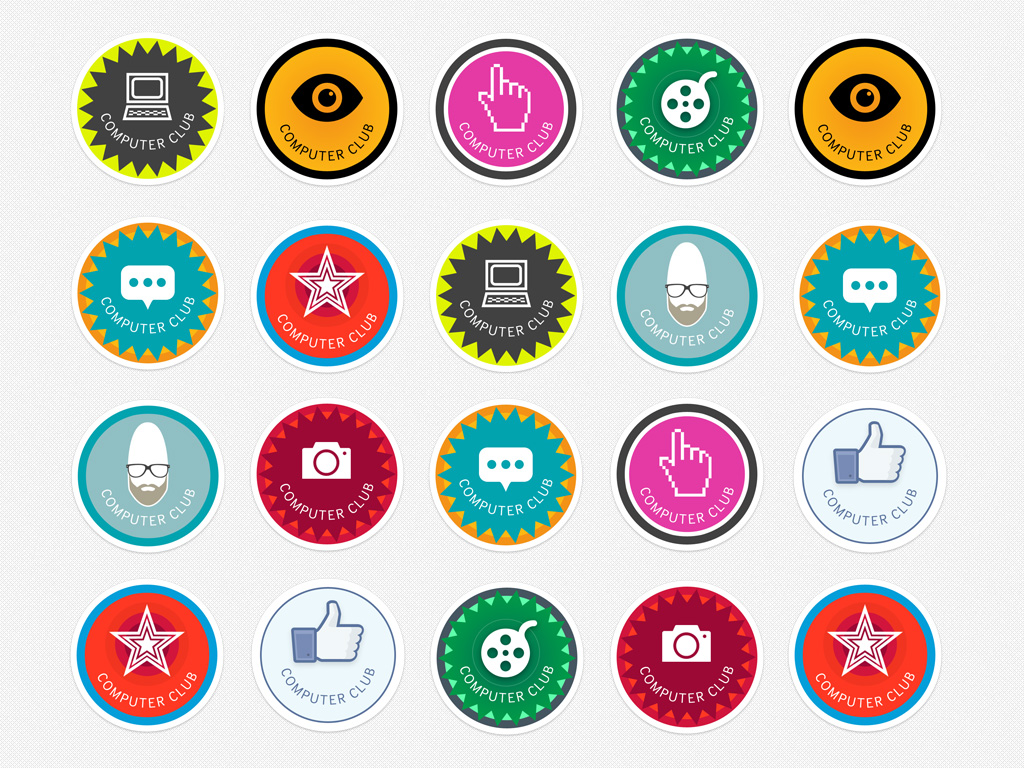
Firstly, I should say that every single person that has come to Computer Club has wanted a sticker at the end. I think the stickers are a really important part of the Club. Everyone, no matter what age, loves a sticker! – It’s recognition that a person has come along to Computer Club in their lunch hour to have a go at something digital. We have designed several different stickers and we give out a different one depending on the content of the session. It would be great if in the future we could build in rewards and other badging ideas perhaps when we have a more established programme. We got some nice tweets from staff after the first session and I have started to see stickers proudly displayed on people’s computers and staff badges. It’s great to see people really engaging with Computer Club and the stickers definitely help with that.

I really think there is scope to think about recognising people’s achievements in this way in other areas of staff development. For some reason as we get older, learning and development seems to become more and more boring and predictable in its delivery. It’s hard for me to think of one really interesting training course that I have been on since I entered the museum sector. I think Computer Club has caught people’s imagination partly because its different to anything else that staff have been offered before at the museum and also that it’s not tied to more formal training. It’s light touch sessions that people come along to because they’re interested and want to learn more about an area that perhaps they don’t feel very confident about. You come for a fun taster session that lasts an hour, get a sticker to say you’ve attended and then go back to work. Why can’t that approach be adopted for other areas of skills development? Ultimately, my aspiration is that Computer Club stickers are recognised by managers as a form of achievement. The more stickers a person gets, the more it shows their interest in digital. If this is recognised, then perhaps it can lead to people taking on digital leadership in their area of work and provide further opportunities for people to develop their digital interest and skills. This has to be of benefit to the organisation.

IWM Computer Club stickers
Computer Club stickers

In the piece you wrote for Sarah Hromack and John Stack’s Institutional Strategy Digest, you mention that that IWM’s digital strategy has “at its heart an aspiration – to develop the confidence, initiative and digital capabilities of staff at all levels, so that they embed digital media instinctively in their work.” I think this is the sort of aspirational ideal that digital staff at most institutions would love to see in their own museums. How do you intend to build this sort of digital confidence and competence into your institution? What role do you expect Computer Club to play in this process?

This relates to my answer above. I firmly believe that in order for the museum to transform into a modern digital organisation we must raise the digital skills of staff. Computer Club is just one part of this strategy and is firmly about reaching the widest number of people and introducing them to digital possibilities. However, there are three other key strands to this strategy that support that approach and are designed to increase the confidence and digital capability of staff in a more sustained way:

One is identifying ‘transformational’ projects that have a strong digital component and will move the museum to where it needs to be more quickly. These projects are classed as ‘priority projects’ and provide an opportunity to work in ways more suited to digital development, illustrate good practice as a model for others, and enable us to demonstrate the difference and value that this approach brings if investment is made in this area.

Secondly, to support working in this way, the role of the Digital Media department will need to evolve into more than just providing digital project delivery. We need to mentor and coach project teams working on transformational projects, giving them the confidence and support to ‘own’ their projects, better embed them into their overall programme of work and show initiative when thinking about future development and planning in this area. This requires the Digital Media team to develop their skills in coaching and facilitation.

Finally we are introducing a new set of digital competences and digital leadership roles across the museum. These are applicable to Directors, Heads of Departments and all staff members. The digital competences will be applied to job descriptions, annual job plans and appraisals as well as newly advertised roles. The introduction of these new competences sends a very clear message about the importance of digital skills, about the need for on-going development and training in this area and raises expectations about what is required and expected from all staff in terms of digital skills and knowledge in their areas of work.

My goal is that through this strategy we will start to see a more digitally capable museum. This could be expressed in a number of different ways:

  • Staff are excited about all things digital and displaying an appetite for doing more and taking initiative in this area
  • Staff feel more confident in using digital tools in everyday work
  • Staff are more skilled in managing public participation projects and using social media
  • Computer Club continues to grow and staff are actively involved in choosing topics
  • Digital competences are implemented and digital leadership from staff at all levels starts to emerge across the museum

What do you think the challenges will be in running Computer Club?

There are definitely logistical and capacity issues trying to run Computer Club across our five different sites. Successful delivery relies on everyone in my department being involved in some way – from brainstorming session ideas to designing sessions, to leading and supporting their delivery. This obviously becomes a big challenge for the department from a capacity point of view as at the moment we are doing this in addition to our normal workload. The team have been brilliant in taking this idea on and making it happen and I hope that once we have a developed programme of sessions it will become easier to manage. However next year, if Computer Club is successful, then I want to ensure that it is built it into our overall programme of delivery and not seen as an add-on.

You’ve committed to run the program for a year initially, to have time for evaluation. What will Computer Club success look like for you? What would you love to achieve with the program?

I think there are a number of success criteria including the number of people that we’ve reached across the organisation over the year – looking at how many attended multiple sessions, range of departments and types of work they do. We also want to run some surveys over the year to get some qualitative feedback as a measure, and also find out which sessions were the most popular and useful. I think we need to look at the how the Club develops over the year; we have changed things after just one session so I imagine that they will continue to evolve and improve as the year goes on. There are also practical operational considerations – is it sustainable for the Digital Media department to run the sessions across five sites?

I will also evaluate how Computer Club has contributed to the success of the digital strategy along with the other activity we are doing. Are there signs that we are raising digital capability in the organisation? Is digital leadership emerging, perhaps in surprising areas? Are we starting to see staff embedding digital media more instinctively in their work? Have our expectations changed around the digital skills and knowledge that we are expecting our staff to have?

The IWM is a pretty large institution, set over a number of locations. Do you think that a program like Computer Club can scale to suit institutions of different sizes and types?

Why not? There are lots of ways you can champion digital in your organisation. This could be anything from running a Club like we’re doing, to simply sharing links and ideas of things you’ve have seen and are excited by, to just talking enthusiastically about digital with colleagues. For me, it’s all about displaying digital leadership and positioning yourself (and your department) as the digital champion in your organisation – whatever the size. You just need to work out what’s right for your organisation, what skills and knowledge the staff need to have to make the organisation more digitally capable, how you can contribute to raising the digital agenda so its seen as important, and who in the organisation can help you to achieve this. Start small with like-minded colleagues and aim for some quick wins!

Is there anything else you’d like to tell us about Computer Club?

Just that I’ve had a really positive response from the museum community since I announced Computer Club at Museums and the Web. I’m really interested to see if, in the future, it’s a model that can be replicated or adapted in other organisations.


Carolyn Royston is Head of Digital Media at Imperial War Museums and is responsible for the strategic development, delivery and provision of all public-facing digital outputs across the museum’s five branches: IWM London, Churchill War Rooms, HMS Belfast, IWM Duxford and IWM North. Carolyn’s work spans web, in-gallery multimedia, mobile and social media. She has transformed the museum’s approach to digital engagement so that it is now central to organisational thinking and planning. She is a skilled digital project leader and manager with over 15 years of experience working in the cultural and education sectors. Prior to joining the museum in 2009, Carolyn was project director of the National Museums Online Learning Project where she was responsible for co-ordinating and managing the needs of the nine national museums and galleries to create a range of educational resources. Prior to this, she was Head of eLearning at Atticmedia, a top 25 UK digital agency, where she led several large web projects in the education and cultural sectors. Before moving into digital media, Carolyn was a primary school teacher.

Thank you so much Carolyn! Now I’d love to know what you think. Does your museum have anything like Computer Club for internal staff development? Could you see an approach like this working in your institution?

#drinkingaboutmuseums – Sydney – Tuesday 9 July

Next Tuesday afternoon, George E. Hein, author of the seminal book Learning in the Museum and more recently Progressive Museum Practice, will be in Sydney to present on the future of learning and education in cultural institutions. Learning in Museums is taking place at the Australian Museum from 3.00pm-4.00pm. Since those who attend will likely to have lots to talk about and digest afterwards, we thought it would be the perfect excuse for #drinkingaboutmuseums.**

If you’re a museum/art gallery/culture professional – or student – located in or near Sydney and can get to Hein’s talk, you should. But if not, come along to the Lord Roberts Hotel afterwards, and we’ll fill you in. If you haven’t been to a DAM event before, get in contact with me and I’ll send you my phone number so you can locate us. Or you can follow the #drinkingaboutmuseums hashtag on Twitter for updates in the lead-up to the event. I’ve posted all the details below.

Learning in Museums
Where? Australian Museum | 6 College Street, Sydney 2000
When? 3.oo-4.00pm. Tuesday 9 July 2013

#drinkingaboutmuseums
Where? Lord Roberts Hotel | 64 Stanley Street, East Sydney 2010
When? From 4.30pm
Who? You! Come along.

**BTW – although in Australia, we tend to call art museums ‘galleries’ rather than ‘museums’ this is an event that is definitely, definitely open to people from the art world. Hope to see you there.