Speaking trumpets: blowing the museum’s horn

I am reading Ken Arnold’s Cabinets for the Curious: Looking Back at Early English Museums at the moment. Arnold uses a comparative approach to consider contemporary museums in context of the founding principles of museums of the 17th century.

He discusses “three dominant strategies for knowledge creation in museums… the telling of stories, the use of objects, and the imposition of order upon them” (Arnold 2006, 4). As I’ve been reading the book, it has really struck me that, online at least, museums seem to be renegotiating these key strategies – moving away from both the use of objects to construct knowledge and away from strict taxonomies (since the Internet is much more rhizomatic than hierarchical). Instead there seems to be a renewed interest (also here, and here too) in the telling of stories as a primary driving force for knowledge creation online, and in making that relationship dialogic, rather than unidirectional.

Therefore, it was with interest that I read this paragraph in Arnold’s (2006, 90) book (emphasis mine):

The urge to tell stories in museums can only be understood once the role of people as well as the object within them has been fully grasped, and this is crucially on both sides of the collector/curator – visitor/audience divide. Museums have always been places for people’s discursive lives: spaces for teaching and learning, but also quite simply for sounding off. This is why it was quite natural for the sixteenth-century naturalist Athanasius Kircher to equip his museum with speaking trumpets, ensuring that curators and visitors were audible to each other – as if the significance of the spoken word was too great simply to be left to the vagaries of the unaided voice.

I love that almost 500 years ago the creators of museums were grappling with – and finding solutions to – the same questions that we ponder today.

Kircher’s speaking trumpets, from the Special Collections and University Archives of Stanford University Libraries

For a more contemporary take on Kircher’s speaking trumpets, the Scapes exhibition/app created by sound artist Halsey Burgund for deCordova Sculpture Park and Museum in Massachusetts seems like a pretty cool way of inviting interactivity and story-telling into the museum environment. From the description, Scapes:

creates a two-way audio experience for museum visitors influenced significantly by their physical location on deCordova grounds. Participants will use handheld wireless devices and headphones to listen to audio and also to make their own recordings which will be immediately assimilated into the piece for everyone to hear.

Check out the below video to get a better sense of it, or read reviews by Nancy Proctor and Ed Rodley.  


Scapes Intro from Halsey Burgund on Vimeo.
Review: Artfinder.com

An interesting start-up caught my eye today when featured on Mashable (although it turns out the company was at Museums and the Web – so it’s a shame I didn’t see them there). Artfinder combines a website, an artwork-identifying smartphone app, and a pile of iPad apps. According to their website, the company is:

partnering with a growing number of large and small galleries, museums and picture libraries worldwide, in particular with Bridgeman Art Library and Cabinet UK. On the Artfinder website, consumers can create their own personal ‘art gallery’, collect their most-loved artworks, and share them with their friends via Facebook, Twitter and email. Additionally, Artfinder’s innovative ‘magic tour’ helps consumers discover art whilst also exploring works that are recommended by friends and passionate experts.

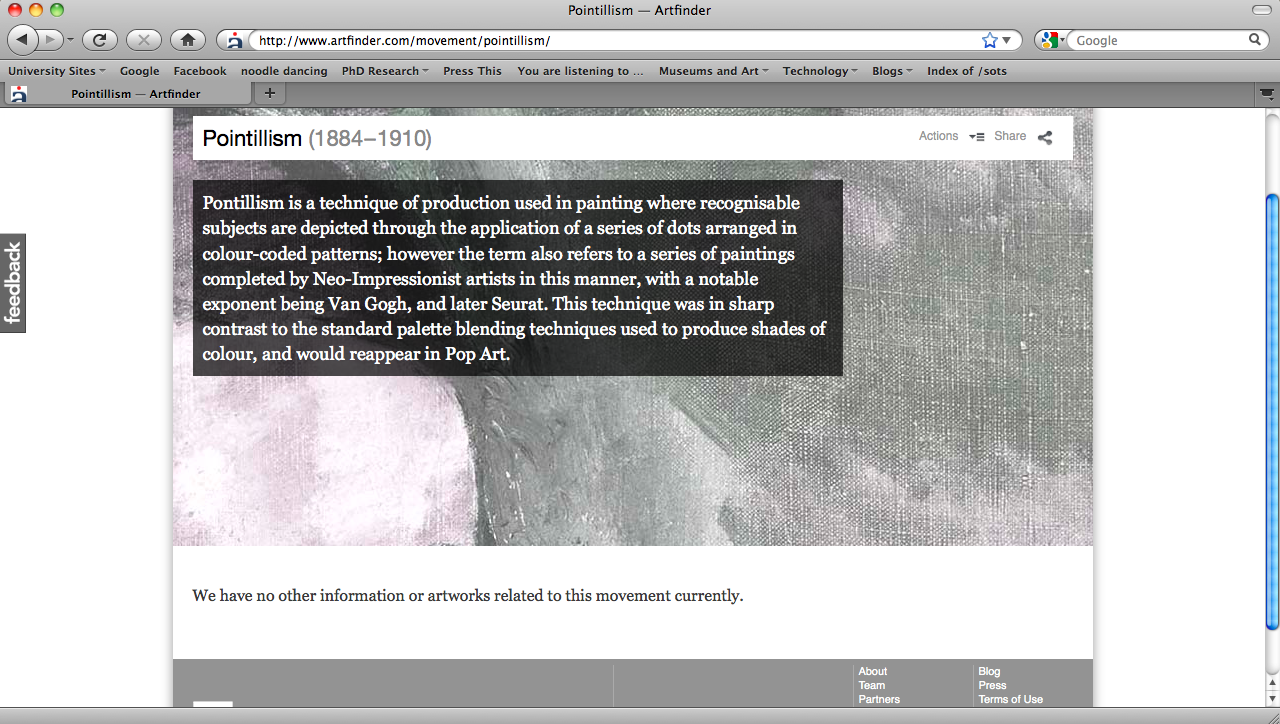
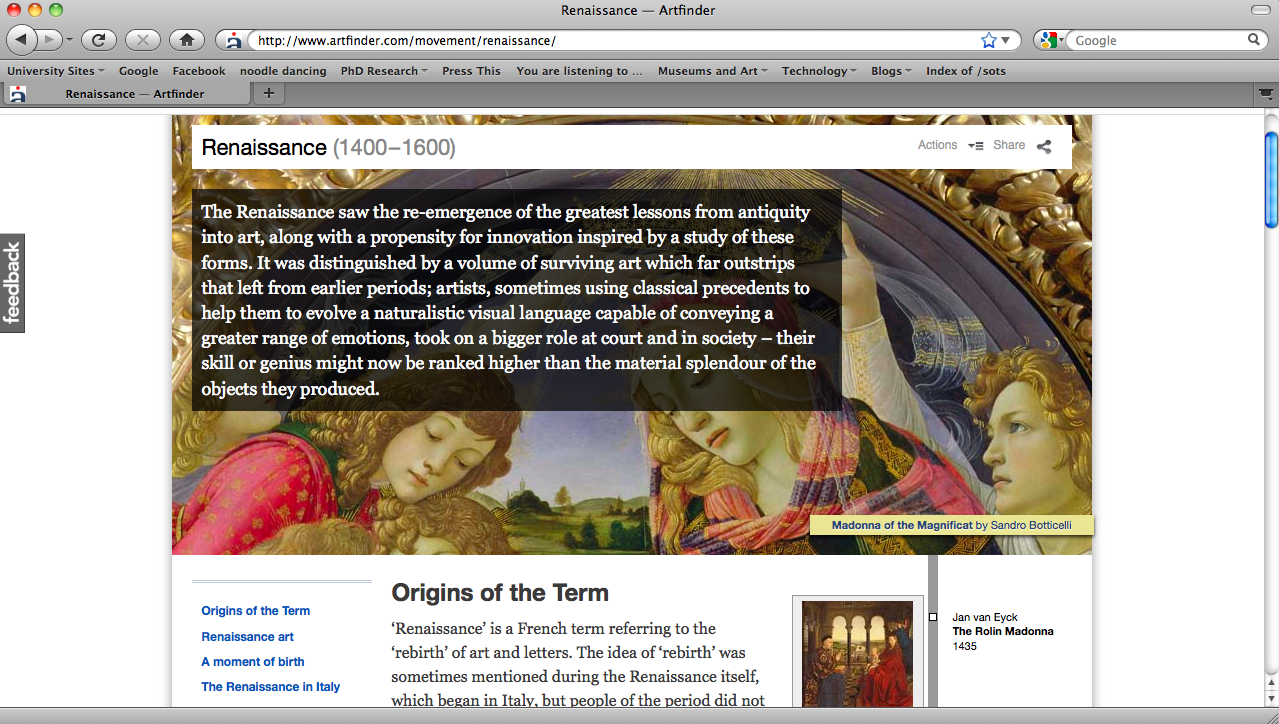
Options for interacting with the site include an Art Shuffle option and the aforementioned Magic Tour (although the ‘choose your favourite’ images that the tour used to decide which path to send you down seemed a bit limited in range, and I wasn’t actually very excited by the art I was recommended – but the idea was fun). Each work of art on the site links to its originating gallery, and can be shared via Twitter or email and ‘Liked’ on Facebook. On the bottom of each work of art, there is a discussion question (How does this make you feel? What do you think about this artist?) which again links to Facebook. And in the Art Guides there are short descriptions of art movements, like the Renaissance (below).


But I think the really interesting thing about the site is that the works of art have been commercialised, with visitors given the opportunity to buy a copy of the artwork. According to the stats on Mashable, the Gallery currently has over 500,000 works of art, and has partnered with about 6,000 galleries, and this gives those galleries an interesting new opportunity for gaining a bit of commercial profit for merchandising – not to mention a new way to find out which works of art in their collections are the ones that people really want to buy. Imagine if the Bridgeman Art Library discovers that hundreds of people all want to buy one work of art they’ve never even considered merchandising… it could be a pretty interesting way to get some market research on the demand for merch for the collection.

One of the co-founders of the website used to be COO at Last.Fm, and I think that there are some obvious cross ideas at play conceptually… the notion of discovering and sharing art in this context isn’t too far from the idea of musical discovery on Last.fm. But unlike Last.fm which has a lot of great current and contemporary music on it, most of the art currently on Artfinder seems to be from a previous era (one where copyright has lapsed, I imagine)… The page on Postmodernism doesn’t seem to include any links to art – although some key artists are profiled – and there seems to be little discussion taking place about what’s happening within current art conversations. This is something I think could make the site more interesting, and is no doubt something that will come with time.

So what do I think of it as a site? Artfinder has some cool ideas, but I do think it is missing the expertise and authority that museums can and should have. I don’t necessarily trust the Artfinder brand to teach me about art in the same way I would a more established museum (rightly or wrongly).

The site still operates as a silo. It might link works of art across lots of galleries – which is cool because it brings together disparate collections into one place – but the information contained on the site seems to be entirely derived from within, rather than linking to external information sources and leading to a more interesting and serendipitous journey of discovery. There also doesn’t really seem to be much narrative accompanying the site/works, and it would be nice to have great sense of a story when looking at interesting art.

But possibly my biggest criticism of the site is that it asks nothing of me. I can flick through the pretty pictures, but there’s nothing compelling to really engage me – yet (though maybe as more people interact with the works online, that will change). As Jonathan Jones writes, in his review of the site, “Artfinder is another fine way of skimming the surface of art history. What the web needs next is a deeper exploration of great art.”

I’d be interested in hearing other people’s thoughts on the site. Have you used it? Would you use it? Did anyone see their demonstration at MW2011? And if so, what impressions did you get?

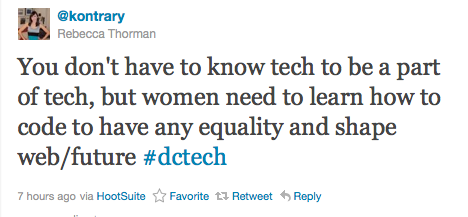
Girls: get coding.

Nancy Proctor RT’d this Tweet yesterday, and it caught my attention for a couple of reasons. The first is that at MW2011 (maybe the first place I’d been where awesome tech nerds convened en masse), I’d come to realise just how much of the technical side of the web passes me by completely. And that meant that when people would talk about how something did or didn’t work (rather than simply the ideas behind it), I couldn’t participate in those discussions at all… which I think is problematic if I want to spend my career working in digital heritage.

The second reason it caught my attention is that it suddenly struck me that being able to code is the modern day equivalent of being able to fix your own car – or at least change your own tyre. And as the original Tweet says – if women want to have any opportunity to shape the world and even just to be self-reliant in a world that is built on code – then we need to learn that language. This is maybe even where the next feminist battle should be taught – in equipping women to participate fully online.

I wasn’t the only one whose imagination was similarly captured by the idea of organising a “girls get coding” space, or some workshops. There are obviously a bunch of us who have felt this yearning to get in on the conversations, so I think this is something that will progress beyond here.

In the last couple of moments, a few excellent fellas have been sending us links to great places to begin – so I’m going to post their recommendations here, and will drop back into the blog with more info as this develops. Very exciting.

PHP 101: PHP For the Absolute Beginner
Learn to Program: A Place to Start for the Future Programmer

Processing.org

http://scratch.mit.edu/

Thanks to Bruce Wyman and Matt Popke for their useful first links. And to Mia Ridge for volunteering to teach some handholding for webpage languages.

Girls – stay tuned for more updates, and let’s get coding!

The end of scarcity and the economics of everything (including knowledge)

Earlier today I read an interesting piece by James L. McQuivey on Mashable.com titled Why the End of Scarcity Will Change the Economics of Everything [OPINION]. In it, he asks:

what happens if the economics of scarcity are exchanged for the economics of plenty? For those industries that provide information or experience as a primary good, scarcity is rapidly evaporating. The media business is undergoing a similar change with the rise of citizen journalists, bloggers, and YouTube performers — all of which circumvent the traditional systems that once dictated production norms and processes. Most of these companies have sought to restore order by reinstating scarcity rather than celebrating its passing. It’s not a good sign of things to come.

McQuivey argues that companies like Facebook, Google and Twitter have staked their territories online precisely because they have given their product away. By creating unlimited potential for people to become invested in the product, these companies are renegotiating the rules on the economics of plenty. As he writes, “In their world, the costs to exploit scale revert to zero. The best ideas, no matter how small or underfunded, have the largest potential impact, and a company that gives its value away may stand to gain more value in return.”

Following on from this, McQuivey delivers a fairly bleak outlook for those industries like education that deal primarily in information in the context of an economy of plenty (emphasis added):

Education reformers have long predicted a world where top professors spread their knowledge across the globe through electronic tools. But the knowledge students need is not only located in those few professors’ minds. Once we digitize not just the distribution of knowledge but the production of it, the existing university system loses its raison d’etre. Why would people come to a single physical location at higher and higher costs when the knowledge it houses is no longer scarce?

Now, whether McQuivey’s predictions on the growing economy of plenty come to pass in the way he is imagining or not, it’s still something we should be considering as online museums in the twenty first century. Why would someone visit the Louvre’s website to find out about the Mona Lisa, when they could just click on the first link to pop up in Google? Even assuming they knew that the Mona Lisa was at the Louvre, what would compel them to invest time in learning how an unfamiliar site works, instead of just visiting Wikipedia?

Legona Lisa

In other words, what are we offering to our digital visitors that they can’t get elsewhere on the web? Is it expertise (or access to expertise)? Is it the curation of culture? In an economy that relies on scarcity, museums in their current format make a lot of sense. But what about one that doesn’t?

Examining the Rosetta Stone

As I was writing this post, Jasper Visser from the Dutch Museum of National History sent me a copy of the museum’s vision. The opening page simply states: THE NATIONAL HISTORY MUSEUM STIRS THE HISTORICAL IMAGINATION. Now that’s a pretty awesome goal, and might be just the sort of thinking that can translate to compelling digital content and context in the online museum. Maybe the goal of the digital museum in a content of plenty is not simply to provide content and information – which can indeed be gathered from almost everywhere – but to stir the historical (or scientific or artistic) imagination. Maybe rather than relying on the scarcity of their product, museums online can find a way to do what arguably they have always done extraordinarily well and get people to ask questions, instead of seeking simply to provide answers.

Addendum: I was thinking about this on the cycle home, and I started wondering about whether any museums do include information about what is still unknown about their collections, as well as providing known information. What I mean is, surely there are works of art or objects in the museum that still raise questions. And if so, would providing those questions in context with the work and the associated text give people a compelling reason to invest in museum collection websites? I am guessing that one reason Wikipedia became so popular is that it asked of investment of people’s knowledge, and gave them opportunity to contribute to the collected intelligence of the world. Maybe museums need to do a bit more of the same. Rather than simply allowing people to tag works of art etc, we should actively seek new expertise by opening up about the gaps in our collections, and in our knowledge. Solving puzzles is a pretty addictive thing to do. No doubt that’s why Google have just started their A Google A Day page… The difference is the puzzles on their pages have known answers. Maybe one of the sweet things about museums is that the answers to our puzzles have not yet been found. Just a thought…

But do I need an iPad?

At MW2011, I got some serious gear envy. I am iphone-less (although I have a ‘smart phone’ I intentionally bought a phone that I wouldn’t use online too much, so I could disconnect my life occasionally), I wasn’t carrying my laptop with me most of the time, and everywhere I looked, people were tapping away on tablets.

This, combined with the resounding cry that the future is mobile, and recent predictions from Cisco suggest that Tablets Will Generate 17 Percent of Mobile Wireless Data Demand by 2020, have got me considering whether an iPad has a place in my life (there was also some peer pressure from Tim from Museum Victoria)…

I am going to be taking the train to Sydney at least once a week for the foreseeable future, and I think the iPad would provide me with an easy way to do work whilst en route. But I think I mostly want it because it’s pretty, and I’m having a little fear of missing out.

If I get one, I could be just like this chick – see how happy and shiny she looks.
Do you have one? Would you recommend it? Or do you think this is just a case of unnecessary gear-related vanity?!?

On “The Museum of the Future”

The Atlantic recently unearthed a couple of rather sweet articles from its great archives (a reminder that everything we know now is connected to that which has been previously discovered).

One of the articles is Walter Lippman’s 1948 vision for The Museum of the Future. He makes a pretty lovely case for the importance of museums:

The experience of man, and the creations, inventions, discoveries of men throughout the ages and in an infinite variety of circumstances, transcend our personal lives and our immediate interests. This inheritance is worth collecting and preserving and using—whatever our transient hopes and fears… Without the accumulated achievements of the past to work upon, the freedom of men would be limited by the necessity of rediscovering and of repeating endlessly that which has already been discovered and experienced. And since life is short and art is long, not much would be discovered, and little would be created.

However, his sentiments are preceded in an article from 1893 by Edward S Morse, titled If Public Libraries, Why Not Public Museums? I find it fascinating to realise not much longer than a century ago, in America at least, the case for museums is not yet made… So what does Morse see as being the special role of the museum? He writes:

the building of a museum requires special gifts and special training. Besides, one thoroughly imbued with the spirit of a collector should have charge of a museum… The absence of a public demand for museums in the past has arisen from the methods of public instruction. Lessons from books, and not from nature, have been the tiresome lot of school children. Questions and answers, cut and dried, have tended to deaden the inquiring spirit.

Thomas Greenwood, the author of a special work on museums and art galleries, expresses his belief that “the museum of the future must stand side by side with the library and the laboratory, as a part of the teaching equipment of the college and the university, and in the great cities cooperate with the public library as one of the principal agencies for the enlightenment of the people.”… A museum seems as much an integral part of the public library as are the experiments part of a lecture on chemistry or physics. If the public library is established primarily for educational purposes, surely the public museum should come in the same category. The potency of an object in conveying information beyond all pages of description is seen in the fact that in the museum a simple label associated with a veritable object is often sufficient to tell the story at a glance; the eye seizes the essentials at once.

Taken together, we get a sense that the legacy of the museum is to enliven learning and to leave the traces of man’s experience writ large upon the world so that we can truly understand who we are, and how our world works (oh were it only so simple). But maybe these early visions can provide some perspective to the question that keeps popping up from those working in digital heritage: what would a museum look like if it was invented today?

Despite being written in 1948, Lippman’s vision seems almost slightly prescient of what the future could hold for museums as we move further into the digital age (emphasis added):

One can imagine, I venture to think, that the museum of the future will have two departmentsone the sanctuary where the unique objects, the irreplaceable relics, are preserved and exhibited for the veneration and the enjoyment of those who make the pilgrimage; the other department in effect a library for the student, the scholar, and the amateur, where they can find, as in any library, collected in one place and readily accessible to them various editions of the unique objects which are scattered in the sanctuaries all over the world.

Lippman’s vision for a museum of the future so articulated does not sound so different from the clearly delineated ‘departments’ we now find as museums move online, with the physical museum akin to Lippman’s sanctuary, the the digital collection likened to his library. How the second of these develops further is the next interesting question… So what will the museum of the future really look like?

Is content enough? What about wonder?

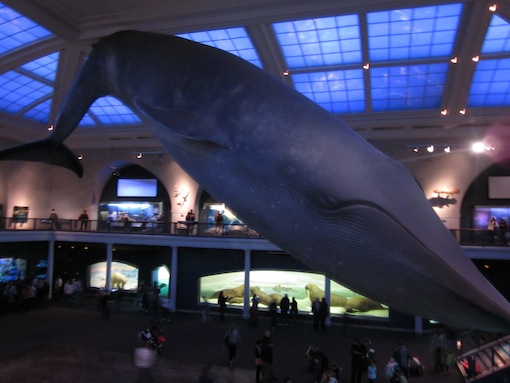
When I was in NYC earlier this month, I went to a pile of museums and galleries – the Met, MoMA, the Guggenheim, the Frick Collection, the American Museum of Natural History, the International Centre for Photography, the Pierport Morgan Library, the New York City Library and more. One thing that they inspired in common was a sense of wonder. I gaped, open-mouthed at the beauty, the history and the stories of the world. Sitting under the giant blue whale at AMNH, I felt a childlike reverence for the universe around me – the sort of feeling that opens your mind to learning, to trying to take everything in.

The blue whale at AMNH

It’s one of the most compelling reasons why people go to museums. Standing in context of something so impressive as the blue whale or a work of art by Pollack (I am a sucker for abstract expressionism) is a very physical and affective experience. It can be wondrous in the true sense of the word.

Jackson Pollock. Number 1A, 1948.1948. Oil and enamel paint on canvas, 68″ x 8′ 8″ (172.7 x 264.2 cm).
Purchase. © 2010 Pollock-Krasner Foundation / Artists Rights Society (ARS), New York

It’s something that I don’t think the AMNH website replicates or captures in any way – that sense of perspective, where you have an almost physical sense of your place in the natural world, in history, or in context of the lost lives and civilisations that have come before. I’m not sure of many museum websites that do yet.

But there are moments of wonder online. I experienced it most recently watching  this TED talk by Janna Levin, Professor of Physics and Astronomy at Barnard College/Columbia University in which she plays mathematical models of the sounds that black holes might make. It’s a long clip, but pretty imagination-capturing. (Although her work makes me wonder if Professor Farnsworth’s Smelloscope isn’t entirely far off…)

I also get it looking at the detail in this interactive 360 panoramic of the Strahov Library (though imagine how cool it would be if you could actually select a book from the shelf and look through it!), and from You are listening to Los Angeles – an amazing sound space that combines random drone tracks from Soundcloud with the feed from the LAPD scanner.

I was talking to a fellow museum/web geek yesterday about wonder, and he mentioned that it’s little things that bring him wonder, not big hit-you-in-the-face moments. He sent me to this beautiful site, and it reminded me that wonder and inspiration can come from simplicity too.

So what about museums? Can we, should we, seek to capture people’s imaginations online in the same way we can in the flesh? Do we put the museum collection online only so that it is accessible for its own sake, and so that people can explore it if they are motivated enough? Or is there a way to create that same sense of perspective and discovery that the physical museum invokes, so that the museum website becomes as exciting a place to explore as the museum proper?

Could something like this underwater diorama be developed to be as marvelous and informative as the actual ocean display at AMNH (with less glitchy looking animals)? Could you could click on the animals as they interact with each other, and get a grab of information about them, and explore hidden worlds through controlling where the viewer goes? Is this already happening? And could something like this, done well, inspire the sort of wonder and sense of exploration that the actual museum has?

On his blog, Koven recently asked

what things do museums do *exclusively* because of tradition? If you were building a museum from scratch, what would you do differently?

I’m almost interested in the opposite question. What do museums do awesomely? If you were building a museum from scratch, what things would you try to replicate? I reckon wonder would have to be part of that.

I don’t really know the answers, but I’d be interested in hearing whether there are any sites online right now that invoke wonder – museums or otherwise.

Wait! Is MY museum a Mac or a PC?

So, after my earlier post, I started wondering about my own institution… Are we a Mac or a PC at heart (according to the rad Hunch infographic)?!?


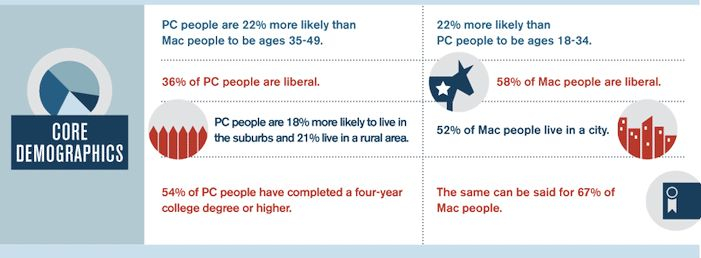
To start with the core demographics, PCs are 22% more likely to by aged 34-49, while Macs are more 22% more likely to be aged 18-34. According to the 2011 NSW Guess who’s going to the gallery? report 2/10 gallery visitors in NSW will be aged under 34, and 3/10 will be aged between 35-54. (PC 1 – Mac 0).

And what else? Well, PCs are 18% more likely to live in the suburbs and 21% live in a rural area, while 52% of Macs live in the city. In NSW at least 50% of people will live in the Local Government Area of the gallery that they are visiting… so, given that my gallery is located in a regional centre, I guess we don’t quite count as being a city… (so PC 2 – Mac 0).

Finally education… according to Hunch, 54% of PCs have completed a 4 year college degree or higher, whereas 67% of Macs have done the same. In NSW 55% of gallery visitors will have an undergrad degree or higher… which again means that PCs get one up. (PC 3 – Mac 0).

So we are looking pretty much as if we are a PC at my institution, if these basic stats for NSW hold true. But what about our fashion, taste and aesthetics?

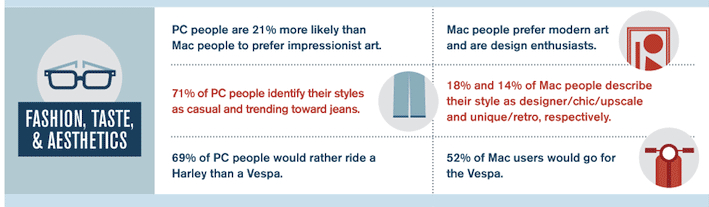
Well, PCs are 21% more likely to prefer impressionist art, whilst Macs prefer modern art and are design enthusiasts. I think our gallery sits well with both these areas… Some of our big exhibitions are more traditional, like the Hans Heysen exhibition. But CURIOUS COLONY A twenty first century wunderkammer was a huge hit, and the high school exhibition ARTEXPRESS is always popular. And our annual Look Hear art and design talks are always popular with a hip young crowd who would probably describe themselves as being designer/chic (even if they’re really just hipsters)… Not to mention that right now, visitors to the NRAG can buy raffle tickets to win a vespa decorated by a contemporary artist, which is the Mac vehicle of choice.

So I think once we include fashion we can get the rating closer to PC 3 – Mac 3… But when I look at the full list, I think that all things considered, my gallery really is a PC. No matter how fashionable and contemporary visitors to my gallery might look, those core demographics probably hold the truth of where my institution lies. So when we think about our audience and the web, it’s probably worth keeping in mind that our audience is less likely to be made up of computer savvy gear-heads and early adopters, and more likely to be those for whom the computer is less natural and intuitive. And that we probably can’t go wrong if we serve chardonnay at openings.

Is your Museum a Mac or a PC?

I came across this sweet infographic yesterday (below) on PC-vs-Mac people, compiled by the people at Hunch. I pretty clearly fit into the correct category as a vegetarian, liberal, retro-clothes-wearing modern art enthusiast… And I started wondering about where museums and galleries fit.

At MW2011, the room was filled with Mac products – macbooks, ipads, iphones etc. It seemed that everywhere you looked, there was a glowing apple symbol shining back at you (suffering from major technology envy, I almost purchased myself an ipad on a spur-of-the-moment visit to the Apple Centre in NYC… only my daily O/S limit on the card I was carrying prevented the purchase then, but it’s definitely still on the cards).

The same observation seems to be true of a lot of the mobile products appearing in the museum too – from MoMA’s interactive kiosks to Melbourne Museum’s Please Touch the Exhibit ipad app.

MoMA’s interactive kiosks

So, anecdotally it seemed to me that a lot of those working in this field (or at least, those who attended MW2011) are Mac users. Are we in touch with our audiences on this? At MW2007, Judy Haynes and Dan Zambonini, Box UK Ltd, UK presented a paper called Why Are They Doing That!? How Users Interact With Museum Web sites and found that:

the Museum visitor is five times as likely to be a Mac user (9.2%) than a Standard visitor (1.8%), and of the Mac users, five times as many use Safari (7.8%) than Firefox (1.4%).

Now things move pretty quickly in the world of technology and I’d guess the demographics are likely to have shifted a little. But I’m curious: do museums and galleries consider what type of technology they will use in-house based on their demographics? Would the audience at a more conservative museum feel more comfortable using a PC-style kiosk, and those in a contemporary space feel more at home using an iPad or Mac? Obviously these decisions are often driven by factors of cost, reliability, ease of development and implementation, how pretty the object is (after all, aesthetics is important in museums) and even whether the over-arching organisation (for instance, those galleries who work within the set up of a city council) uses particular products. But I wonder whether the type of visitor the museum has comes into consideration when choosing the most appropriate platform for digital/mobile interactions?

And conversely, if there really are two types of people in the world, can we use the below graph to get a decent sense of the demographics of our visitors based purely on the type of computer they use?

Arduino: inspiration

Ok, so one of the coolest things that I heard about at MW2011 was the Arduino – an “open source electronics prototype platform based on flexible, easy-to-use hardware and software.” It’s designed for d-i-y creativity, and is “intended for artists, designers, hobbyists, and anyone interested in creating interactive objects or environments.” Sweet!

Miriam Langer presented a cool mini-workshop on sensors & micro-controllers, in which she explored some of the possibilities for museums and galleries to use Arduino for sensing users in the gallery space. The Arduino can be hooked up to motion-detection sensors and similar and used to turn the gallery space into a more interactive playground.

My imagination was totally captured by Miriam’s talk, and the possibilities that the Arduino offers. I think it could work perfectly to turn the NRAG‘s “smART space” for kids into a far more dynamic area in the Gallery, and could also work well to bring some of Newcastle’s public art to life. However, as much as I am super-eager to get me an Arduino, I am not entirely sure that I have the right temperament for it… I often get inspired by things that require a bit of patience and tinkering, and then they end up sitting languishing on a shelf until they grow old and dusty. But I would love to hear about anyone who has been using it, and to know what they’ve done with it – particularly in a museum or art space context.

Having said that, when Miriam was talking I wanted to know about the possibility of using the Arduino to make musical instruments – those that used sensors linked to tones to make noise. And it turns out that this is precisely what a few people around the world have been doing… so although this is not entirely museum-specific, this is a totally cool use of the platform…

Fully functional laser harp