There is a man behind the curtain

In a couple of weeks, I’m giving one of my first ever lectures. The subject is Museums, Galleries and the Politics of Institutions, which is a thoroughly juicy and exciting topic. Colour me excited!

I’ve just started ‘building’ my lecture, but already I’ve had an unexpected realisation about both teaching and museums. Until now, it’s never really occurred to me the extent to which every class I’ve ever attended, and every museum I’ve ever visited, constructs the information and stories within. The message is not just built around what is important to say, but also on what will fit within the limitations of time and space; on what will make a compelling story; and on the personal whims and preferences of the information architect.

This observation is so obvious, I don’t quite understand how it hasn’t smacked me square in the jaw before. As much as I’ve ‘known’ that museums can never tell ‘truth’ since every story has innumerable sides, the reality of that situation had never occurred to me so starkly until I had to create a lecture on the subject.

You see, I want to give the students insight into the historical development of museums; to educate them about (some of) the myriad of ways that the choices made in museums are political; to equip them to start seeing museums and exhibitions through critical eyes; and, ideally, to inspire them and capture their imaginations. And I’ve only got an hour in which to achieve all this.

It’s a big ask. Due to the time limits, I will obviously have to leave out far more than I can include, and the things that I do decide to include will be those that are both relevant/important and that reinforce the narrative direction I decide to construct.

And that’s the kicker. The information that makes the cut will be the information that best helps me tell a compelling story – one that is logical, and memorable, and in which the whole is greater than the sum of its parts. The examples I use in the lecture will not necessarily be the most critical – they will be the ones that best help make my argument. I’ve looked at the examples used by the lecturer who gave the course last year, and they are entirely different from my choices. He and I used the same subject as a starting point, but each of us constructed a very different lecture – and a different story.

Yet most students will probably hear my lecture and believe that the information I give them is the canonical stuff that they need to know, simply because of the forum in which it is presented. In choosing works of art to focus on, I will be privileging those works and artists simply by drawing attention to them in the context of a lecture. It is a great responsibility. If I choose (intentionally or by neglect) only to talk about works of art by men, or European artists, or painters and sculptors but leave out video artists, then I too am guilty of neglecting to present a whole perspective about the subject… and yet I will have to make said choices because of the limitations of time. Therefore, my lecture is every bit as political as its focus.

Curators too are faced with these difficult choices. It is never possible to include everything when constructing an exhibition. Doing so would probably make the exhibition less clear and less impactful. But visitors don’t necessarily consider this. Most visitors will accept at face value that what is included is there because it was the most deserving – not because it best illustrated a point, or was the only appropriate work in the museum collection. This is precisely why museums are such political institutions.

I have known this at some theoretical level for years. I’ve taken dozens of courses at University and worked in museums for a little while. But it was not until constructing my own lecture on a subject that is so open-ended, with many possible paths that the journey could take, that I gained real insight into the extent that my own knowledge has been constructed around the ‘curatorial’ choices of my teachers. It’s been fascinating.

I think we have a responsibility when teaching people about history – or anything – to provide them with a story that is clear and legible. Without that, they are unlikely to learn at all. But I also think that we as teachers – whether in universities or in museums – have a responsibility to remind people that what we select for such a purpose is not the be all and end all of knowledge, and that the lecture or the exhibition is a great starting point but it should not be the final destination.

And I think this is the ultimate message that I am hope to get across to the students. I am going to use the process of constructing a lecture as a metaphor for the process of constructing an exhibition, and show them that there is a real person behind the choices that get made – and that those choices have real meaning. Thus, I think I will finish my lecture with a statement like this:

This lecture, like a museum exhibition and like every lecture you’ve ever sat in, does not tell the truth, the whole truth and nothing but the truth.
It weaves one story of the history of museums. It leaves out more than it includes.
It is not neutral. It is never neutral.

I hope they get the point.

geek speak with Lori Phillips

Hey! It’s time for the next round of geek speak – this time with Lori Phillips. Since geek speak is about journeys into museum tech, I am going to be featuring people at various stages of their careers – and I thought it might be nice to hear from someone who, like me, is just finding her feet in this field.

Lori got in touch with me via museumgeek a couple of months ago, and she and I have been in regular contact since then. She is doing some cool things with the GLAM-Wiki movement (something that I know has a lot of museum people interested), and has just joined the team at the Indianapolis Children’s Museum. Her story paints what is becoming a familiar picture to me when I talk to people in the sector – of joining seemingly disparate interests (ie museums and wikipedia) and producing something new.

Enjoy.


Lori and Liam Wyatt in The Children’s Museum of Indianapolis’ collection storage during a Wikipedia Backstage Pass event.

geek speak with Lori Phillips

As a graduate student I’ve had many opportunities to hear museum professionals share about their (often wayward) paths to the museum field, and I too always find them fascinating.  I still very much consider myself an “emerging museum professional,” so I hadn’t thought much about my own path to museums until Suse suggested I be her next Geek Speak guest. I’m honored!

I came into the museum world via social studies education.  I received my BA in History from George Mason University, which is also the home of the Center for History and New Media (the conveners of THATcamp, among a slew of other amazing projects.) Back then, I had my sights set on changing the world through the middle school history classroom, but I was always interested in digital history and social media and how these paradigm shifts in information-sharing would affect future historians.

While obtaining my Masters in Education, I realized that I was the only future-teacher in my class that cared more for the objects and primary sources than I did for creating ideal citizens. At the time I didn’t see this as a problem, but now I’m even more confident that museums are more suited to my interests than the classroom. Around this time I also had an opportunity to work with curators and museum educators at the Heinz History Center in Pittsburgh, where I found myself in awe of the behind-the-scenes world of museums. It wasn’t until my husband and I relocated from Washington DC to Indianapolis that I had an opportunity to reassess my career path and consider museums rather than the classroom.

Enter the IUPUI Museum Studies program and the incredibly vibrant Indianapolis museum community. When I started out in the program, my husband was pretty wary of this hazy path I was starting down. “But what will you do in museums?” I didn’t actually know. I started out being open minded about both Museum Education and Collections. I later discovered that collections was the place for me, especially because of my obsessively organized nature. I took this newfound knowledge and applied it to two internships:  as collections manager for an exhibit at a small historic house, and a year later, through environmental monitoring at Oldfields, the historic home on the campus of the Indianapolis Museum of Art. So,  history and collections? Check.

But during that time Wikipedia had also entered my life. I think that surprised me just as much as anybody. Wikipedia? Sure. People use it every day. But is it a viable collections management system? This was the central question in my Collections Care & Management course, which went on to establish WikiProject:Public Art. Through my continued involvement with WikiProject:Public Art, I met Liam Wyatt. Liam happened to be a historian who wrote his thesis on digital history and how Wikipedia (and article revision histories) will serve as a virtual palimpsest for future historians.  So Wikipedia was the answer to a question that had nagged me for years? I was more than intrigued.

In the past two years Liam has built up a community around GLAM-Wiki, an initiative that provides resources for Galleries, Libraries, Archives, and Museums to collaborate with Wikipedia in order to share resources. I’ve been lucky to be involved in this cutting edge project, all while Wikipedia continues to inspire my research interests in collections accessibility and digital literacy. I’ve now had the chance to work extensively with The Children’s Museum of Indianapolis and the Indianapolis Museum of Art on Wikipedia collaborations, both of which have opened a number of doors that would never have been possible without my involvement in GLAM.  My projects as Wikipedian in Residence at the Children’s Museum have allowed me to implement fresh ideas within a medium (Wikipedia) that’s becoming increasingly important for museums all over the world.

My job as Web Content Specialist has brought me full circle. I’m now able to apply Wikipedia as one component within overarching projects that share collections, garner audience participation, inspire digital literacy through museum programs, and disperse information through other social media platforms. In the end, all of my past interests in education, social media, collections, and now museum technology, have come together.

I’m now researching three overlapping topics:  interactive and open source digital collections, E-Volunteering, and further developing museum programs that use Wikipedia as a 21st century research tool. If you’re also interested in any of these topics, please get in touch!  I can be a very good idea sounding board – just ask Suse.

Lori is a museum studies graduate student at Indiana University-Purdue University of Indianapolis (IUPUI) and is heavily involved in the GLAM-Wiki initiative, an international group of Wikipedians who provide resources for museums wishing to collaborate with the encyclopedia.  Lori has interned at The Children’s Museum of Indianapolis, the largest children’s museum in the world, since August 2010, serving as the world’s second Wikipedian in Residence, following Liam Wyatt’s residency at the British Museum.

In June, Lori became the Children’s Museum’s Web Content Specialist. In this role Lori continues her work integrating Wikipedia into all facets of the museum, while also working with the technology, marketing, and collections departments to plan for interactive, web-based experiences for online and on-site visitors. She’s passionate about increasing access to collections through virtual platforms, and researches the role of Wikipedia as a tool for sharing museum resources while increasing digital literacy through museum programs.

Reflecting on museumgeek’s first three months

This blog has now been running for just shy of three months. In that time, I’ve written 31 posts, and received double that many comments (yep – you’re starting to talk back, which is awesome). Within a day or two, I should hit 2500 views, which is significantly more than I imagined I would have at the start (and even more surprising because my Mum has only read the site once – so it’s not just her!). I’ve been shocked (and excited) to find people responding to my ideas by writing entire posts of their own (and here), and have been honoured to discover my site listed in blogrolls of people whom I respect.

With all this, museumgeek has thoroughly exceeded my expectations.

What has surprised me is finding out the posts that get the most reads and reactions. When I started blogging, I thought I’d post a fair bit about technical innovation in museums. After all, that’s what the people whose blogs I read write about, and they’re always interesting to me.

What I quickly learned however is that the difference between those bloggers and me is that I’m not actually a tech geek. I might love technology and enjoy seeing the technological advances taking place in museums, but I have neither the background nor the mindset needed in order to best exploit the possibilities of technology.

Instead, it’s my more philosophical posts like Museum objects and complexity, Visualising the museum collectionWho owns the virtual space in your museum? and Who are you collecting for? that have drawn the greatest interest. Maybe I shouldn’t be surprised by this… museums are inextricably linked with philosophy, and my own bent of inquiry leans towards the existential. I probably write more passionately on these issues than on other things. Despite this, I didn’t expect that these would be the posts that would inspire the greatest response.

So there is that. In the last few days, this feedback has led me to start reconsidering the approach I was intending to take in my PhD. Although I need to discuss this with my supervisor, I’m starting to think that my research should be a philosophical inquiry, rather than a strictly “scientific” one. This is probably a silly idea… It will involve far more work, and be a lot harder. But I also think it will be a very interesting approach, and will certainly push me to look deeply into the issues. Hmm. I’ll keep you posted on this idea once I talk to my supervisor…

On a personal level, I’ve discovered that blogging is a lot of work, but very enjoyable. My writing muscles are growing stronger from regular use, and writer’s block is far less tyrannical than it was. Writing for an audience is great for helping me clarify my thoughts – although I still get scared every time I hit the “publish” button in case I’ve said something really stupid… although even if I do, hopefully you guys will take me to task for it so I can learn something new as a result.

In the mean time, thanks for reading and being part of my first three months!

Thoughts on the closure of the Dutch Museum of National History

My first guest geek Jasper Visser (don’t worry – there’s another geek speak coming soon) has just announced on his blog that his museum – the Dutch Museum of National History (INNL) – will no longer operate from 1 January 2012, following the announcement of funding cuts by Netherlands’ secretary of state responsible for culture.

This is a terribly disappointing – although not entirely surprising – thing to have happened. When I first met Jasper at MW2011, I spoke to him a little bit about the INNL network – the museum website that won the Best of the Web award for innovation – and at the time, he mentioned that it was possible that his institution could close at any time. I dismissed the possibility… coming from Australia, where our politicians are generally fairly centrist in action if not always in rhetoric, I didn’t really take seriously the threat that someone might close such an interesting and innovative project for seemingly political reasons.** And yet only months later, here we are.

A few weeks ago, I was talking to Seb about the INNL and he remarked how vulnerable it was, being a national museum in a politically unstable country, and moreso being a museum without objects. And its true. After all, our very concept of what a museum is and should be is grounded in the fact that museums are the places that house objects. In Cabinets for the Curious: Looking Back at Early English Museums, Ken Arnold writes (p4) that early museums had three strategies for creating knowledge, being “the telling of stories, the use of objects, and the imposition of order upon them.” The INNL did use objects – like the National Vending Machine, or selected objects through which stories could be told – but it did not house a permanent collection. Instead, it sought to excite people about Dutch national history through stories and projects. And with concepts like “The ‘Land of What If’, a room with alternative Dutch histories”, no wonder it was vulnerable at a time when cultural institutions were threatened by politics.

Despite – and possibly because of – its short life, the INNL raises lots of questions for me about the nature of museums, and what a museum is and should be. Can a museum preserve the past without objects? Does the provenance of a museum come from the provenance of its objects, or its people?

As much as I love and am captured by the ideas behind the INNL, I wonder whether it was always going to be a time-limited project. Reading the vision of the project, I always feel inspired – but without objects, a museum of this nature can only ever be as successful as the people who are behind it, and it is likely that with time and staff changes, a sense of inertia would gain hold.

Yet the fact that it was (or appeared to be) successful during its short life should absolutely inspire those of us working in museums with exhibits to consider how we too could excite people about what we do if we didn’t have our objects to rely on – if we were forced to find new and more creative ways to tell stories.

In the mean time, I’m not sure what Jasper plans to do – or if he will stick around in this field… He has something of the entrepreneurial/world changing spirit about him and I imagine he might want to move on. But I look forward to seeing what he turns his hand to next.

**NB: I’ve recently learned that funding has been cut for This is Not Art – an arts festival that runs annually in my home town. This year might be the first year in over a decade that it doesn’t run, and I am fairly sure that the reasons behind this are political as well… so maybe even in Aust, culture is never safe from politics.

New(castle) directions

My local museum has been closed for the last couple of years whilst undertaking a major move to a new site. Excitingly, it is almost ready to reopen in a new location, with new permanent exhibitions that should better showcase the region’s local history.

As a result, there have been a number of new positions advertised at the museum, but the most interesting one has just been announced… the museum needs a new Director! The current Director is retiring, and so Newcastle City Council is advertising for “an experienced operator to lead and guide the direction of the New Museum. Not just anyone, we need an ideas person. Someone who can visualise and implement. Someone who understands how a Museum operates at all levels.”

So first up, if you are (or know) someone amazing who would be great at this job, then (get them to) apply! With a new museum to play with, this could be a really interesting opportunity for the right person.

Having said that, I’m guessing that the right person is not going to be from Newcastle. One of the biggest challenges about living in this city (and I would guess, in any regional town) is that opportunities for career growth in the arts are pretty limited – and so most of the people who end up in high-end positions in our cultural institutions generally come from outside the city (and vice versa – most people have to leave to build their arts careers). Even the position selection criteria seems to imply for this, stating that applicants should have “Substantial experience in a Museum leadership capacity and demonstrated capacity to lead a small multidisciplinary Museum team” – something next to impossible to get within local area.

Yet today I was reading the AAM’s 2002 publication Mastering Civic Engagement: A Challenge to Museums. Ellen Hirzy’s report (p9) opens with the statement:

Every museum has a deeply rooted connection with its community that is uniquely its own. However far reaching its collections and scholarship or the diversity of its audiences, a museum’s particular community context anchors it, revitalizes its mission and sense of purpose, and enriches its understanding of what is possible to accomplish.

I can’t help thinking about how challenging the first months must be for a new director at a museum – particularly a local history museum – as an outsider. Not only does he or she have to try to establish him/herself in a new position, possibly within a new town, but he/she must also try to negotiate the ‘deeply rooted connection’ that the museum has with its community. Sounds like a big ask – but an interesting one. So here’s hoping that someone out there wants to come and lead at our New(castle) museum.

Who are you collecting for?

Who is your museum collection for?

This might seem like a strange (and even silly) question for a museum geek. After all, I really hope that on some level the objects in your collection are for me! But since last week, when I asked  “if you have objects in your collection that could be useful to human society – whether to a researcher or someone else – and they can’t find or access that information (even just at a basic level to know that the object is in your collection), does that object have any purpose?” I’ve been thinking about just who and what we are collecting for.

At the Art Gallery where I work, we might have at most 200 collection objects on the floor at any one time (and many times, far less than this). This is out of a collection of almost 6000 works of art, and so most of the collection once acquired and preserved is rarely seen. We seem to hold onto some wonderful art objects for no one to use or even see.

And so I want to know for whom this wonderful collection – and all the other great collections of art; of specimens; of useful and not-useful objects – has been created. Is it for the silverfish? Or simply for the annals of history, in the hope that some day someone will have a purpose for it?

I am not the only person asking this. The Centre for the Future of Museums recently held a Twitter chat on the Future of Museum ethics (discussed here), and one of the questions raised was:

“[What are] The ethics of museums having many artifacts in storage which are never shown and are “inaccessible”[?] … In the digital age, with all materials potentially accessible in some way via the internet, what are a museum’s ethical obligations to invest in such access?”

And yet even once people can access a collection online, we are uncomfortable about letting go of control over our objects and collections – something that runs counter to mash-up culture. In 2010, Kristin R. Eschenfelder and Michelle Caswell published research on Digital cultural collections in an age of reuse and remixes that explored the control of non-commercial reuse of digital cultural works, and found that there were three main motivations for cultural institutions to seek control over their collections. These were “Controlling descriptions and representations,” “Legal risks and complexities” and “Getting credit: fiscal and social costs and revenue.”

Each of these does presents a significant reason why museums might seek to control the way that people can use the digital objects in their online collections. Further, Nick Poole recently published an excellent post about the Europeana Foundation’s new licence agreements, which would allow the publishing of Europeana digital cultural content as Linked Open Data. A significant number of museums expressed concern about signing the agreements, and Poole writes on why he thinks this is so:

As a linguist, I am used to talking about the signified and the signifier – broadly, there is the thing itself and the word which points to and describes the thing. For museums, this connection is very significant – there is the object, the material artefact, and then there is the meta-information which describes the object (the object number and its corresponding catalogue record). But this meta-information is neither simply factual nor simply descriptive. It, and the artefact it describes are part of an integral whole, connected by the object number as a persistent identifier.

Ergo, our collections are not simply about the objects. They are also about the history of the object, and even the history of the object’s interpretation. And online, that collection is signified by the way it is presented and represented digitally.

And as such I imagine that many institutions would still be incredibly uncomfortable about a member of the public ‘remixing’ the digital simulacrum of their collection objects (even those objects which are no longer under copyright). Which leads me back to my original question. Who is your collection for? If we feel the need to prevent the public from being able to reuse the digital object in a very vital and contemporary way, then does this mean our collection isn’t for them? And if we are not collecting for the public, then whom are we collecting for? Academics and researchers? Other museum professionals? Abstract people who live in some imagined future iteration of our world?

Early collections started in private homes and to satisfy personal whims. Answering this question a couple of hundred years ago would have been incredibly simple. The answer would have been limited to an individual and his social circle. But I’m not so sure that this question is so straight-forward now, and particularly in light of the fact that we can now make museum collections available to the general public online.

Now, I am not calling for cultural institutions to cede control of their online collections. There are legal, fiscal and cultural implications to such action, and this is not the argument I am trying to make. I guess I’m just trying to work out exactly who it is museums are holding onto their objects for.

Oh – and BTW – if you do know who your collection is for, I’d love to know if that impacts on your online collection, and in what ways.

If a tree falls in a museum, and no one is there to hear it…

Australian IT policy advisor Pia Waugh has just posted the first of a series of four posts on online culture. This one, titled Unicorns and Doom, investigates some of the ways that the Internet is changing mainstream culture. As she writes

Using the Internet changes your expectations of the world around you, and importantly your expectations of how you can interact with the world.

The entire post is compelling, and I would recommend that everyone should read it. However, I am going to pull out a few of her key points now and dissect them a little bit for what they mean for museums.

Waugh argues that there are four expectations/behaviours that we develop when we engage online. These are the expectation that we can route around damage – or find new paths around any form of artificial interference; healthy skepticism – that we can examine and question information, particularly official information that doesn’t necessarily gel with other evidence; an expectation of transparency and accountability; and an expectation that through “do-ocracy” or people power, it really is possible to make significant changes to the world.

In her post, Pia expands on each of these ideas considerably. However, I’ll now just grab a couple of her ideas in brief for closer examination. She writes:

When we want to know about something, we automatically look it up online. We expect to be able to get information on any subject we choose and when information is not forthcoming we ask why.

This is one of the very real and compelling reasons why I do think that museum collections do need to be online… When Koven asked what’s the point of a museum website at MW2011, and again in his Ignite speech, my first answer was (and continues to be) that as we become more and more reliant on the Internet as the storage space for the sum of human knowledge and information (as seems to be happening) then if something is not online it will almost be as if it doesn’t exist. It’s the tree falling in the woods argument reframed… if you have objects in your collection that could be useful to human society – whether to a researcher or someone else – and they can’t find or access that information (even just at a basic level to know that the object is in your collection), does that object have any purpose? How can it tell us anything about ourselves/our past/culture if we don’t even know it exists?

Now this is a very different question of how we make that information useful and useable – and I think that is an entirely unresolved problem (see Mia Ridge’s post on death by aggregation). But as our social expectations regarding information change, it really is becoming the case that if information about something is not accessible online, then we look for other information. Even as a researcher, I will look online at my library’s collection to see what books they have that I might be able to use well before I make the trip into the physical location. That’s not to say that serendipity won’t guide my search once I’m there, but the initial impulse usually occurs when I’m not in situ – and my future actions are predicated on the information that I find online.

Waugh’s post continues:

The Internet has democratised both access to and “publishing” of knowledge. The control of knowledge has always been a power mechanism, and we are now seeing a significant struggle as traditional knowledge and power brokers find themselves continually flanked by individuals and communities.

This is something I’ve wanted to write about for a little while now. The publishing of knowledge, and control over information, is something that has obviously been important for museums historically. It was a key aspect of how museums maintained their authority, by making some claim to control over the objects of our past and the information about those objects, and therefore about our past.

However, authority online comes from (appearing to have) visibility of process, rather than from hiding behind safe institutional walls. This means that organisations need to be work harder to ensure consistency between what they say they do and what they actually do, since they will be called to account if people notice gaps between the rhetoric and the action.

Pia argues that the ease with which we can access, engage with and hold accountable anyone online makes it easier for people to make informed choices, and I would agree. This article by Richard Smith from the Journal of Financial Transformation provides an interesting perspective into transparency and trust in the ‘post-Gutenberg era’, or the era of social media (although focussed on business institutions and brands). He writes:

In the Gutenberg world, trust was institutionalized. Organizations worked to establish reputations such that people would trust anything and everything they did without feeling the need to interrogate it for themselves. This worked because it was efficient, from the organization’s perspective, and because individuals recognized that they could not (or could not be bothered to) comprehensively interrogate all the organizations they dealt with. They would accept an organization’s ‘institutionalized representation’ of itself (its brand) — provided they could have a level of reassurance that this representation was reasonably accurate.

Trust within social media is not vested in institutions, it is vested within visible processes. The best way to explain this is to look further at the Wikipedia example and its battle with Encyclopaedia Britannica. The Encyclopaedia Britannica is a classic example of institutionalized trust. You trust its entries based on your knowledge of the reputation for accuracy it has established and carefully nurtured over the years. You do not feel the need to look behind or interrogate this reputation in any way. Wikipedia is totally different. You trust its entries purely on the fact that it has made visible the way that entry was produced and refined. Even if you do not choose to examine the history of every entry, the simple fact that you can do this and there is a process in place which means somebody is doing this, gives you a level of trust. Critically, an element of this trust is based around the need for you to make your own assessment of the process and how much trust you will decide to allocate to it.

It is not that people are going to reject institutionalized trust, but the task of sustaining it is going to become much harder in the world of transparency brought about by social media. Organizations will, therefore, find that ultimately the only efficient way to maintain trust is to switch to a model based on process, which will mean creating the ability to see in much greater detail how an organization goes about its business.

As Pia’s post indicates, mainstream culture is changing as a result of the Internet. What this means for museums – particularly online – is still open to significant debate. But it is important to look at the significant and apparently lasting trends occurring within technology and the ways society is changing as a result to get a sense of how and where the museum website fits.

A very quick post on practising what you preach

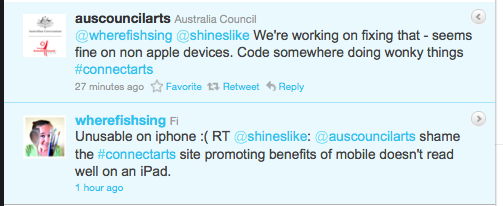
The Australia Council has just reached their new research report called Connecting:// art audiences online. I haven’t had a chance to have a full read of the report in depth just yet, but one thing leaped out at me this morning when I started looking through the website… The website, which contains pieces of advice like this:

The internet – and in particular, mobile technology, provides a range of opportunities for arts organisations to make it easy. Already, there’s strong adoption of mobile apps in relation to arts events, with strong interest in apps to support ticket purchases, program customisation, interaction and content sharing, to name just a few.

cannot be read fully on my iPad. I was flicking through the site first thing this morning, and was pretty frustrated to find that the text on the site would not scroll so that it could be read in its entirety. I could see the start of bar graphs, but not the important information at the other end of them. I thought the report was relevant enough that I would actually try to access it again from my laptop… but very easily I could have just dismissed it as inconvenient and not looked again.

If you are going to talk about the importance of mobile technology, then please consider how mobile audiences will access your information when designing your site.

FOLLOW UP: But here’s the nice thing about social media, and a demonstration of how to use it well…  OZCO responding to the problems mentioned above.

Cracking the social media network

I just noticed that Mashable has declared 30 June as Social Media Day, and asked people to write in and contribute their stories of how social media has changed their life. Their request is a timely one for me, as I had started drafting this post on the same issue a couple of days ago.

Since MW2011 my use of social media has changed a lot. Prior to the conference, my interactions on social networking sites like Facebook and Twitter had primarily been personal. Although I had some sense that there were online conversations happening in museum tech, I really didn’t know how to crack into the networks (this is something that Perian Sully talked wrote an excellent post about a few of months ago). I wasn’t sure what contribution of value I could make to the field, nor how to just start participating in a conversation that I hadn’t been invited into. In some ways, it felt like eavesdropping on a conversation at a party, and trying to interject… almost rude, and possibly unwelcome.

But at the conference I started to tap into the Twitter channels, and from there I started to feel a bit more confident entering into conversations in the blogosphere and so on. It turns out that it wasn’t so scary starting to join the conversation (even writing my own blog!)… most people are welcoming (even if they are still unlikely to interact closely with too many more than Dunbar’s number) and are often happy to interact. And thanks to overcoming those fears of joining in, I have now really started to tap into some great online networks – networks filled with great ideas and opportunities.

As a result of these new networks, I now read piles of interesting articles that I probably wouldn’t otherwise come across; I’m hoping to attending events like THATCamp Canberra and MCN2011; I’ve been participating in great cross-blog conversations (and here); and I’ve been meeting excellent new people – and even Skyping with museum techs across the other side of the planet. And I don’t doubt that in a couple of years time when I finish the PhD, and am looking for work, it is through these online networks that I will likely find it. It’s clear that in only a few months, social media has started to change my career landscape and helped me connect with like-minded souls from all over the world.

Despite this, I know a lot of people who work in museums – and other industries – who remain disconnected from the online social networks in their fields. For some, it is because they simply aren’t online, or aren’t looking for networks in the right places. For others, it is that they haven’t realised how beneficial such networks can be. And of course, there are people like me who know that the networks exist, but are uncertain how to tap into the opportunities or join the conversations.

But if you can locate those networks, they are definitely worth joining (you could start by commenting on my blog if you want). You might just find someone who’s passionate about the same things you are. And then another. And another…

In the meantime, if you are just starting out in museum tech or digital heritage and want to find out a bit more about the online community, Sheila Brennan’s Getting to know DH if you work in cultural heritage is a great starting place.

Who owns the virtual space in your museum?

Yesterday I crashed my first ever ARDevCamp @ the Powerhouse Museum. Despite being late (buses do not replace trains very effectively) and missing some of the morning talks, the afternoon provided plenty of inspiration and lots of think about. True to form, I used my spidey senses to find some incredibly interesting people to sit next to, and got into some great conversations – some of which will no doubt inform this blog over the next few days.

One of the most interesting questions that arose at the Camp was about digital space and augmented reality (AR). Rob Manson from Mob Labs spoke a bit about the question of who owns the digital space – an issue that will no doubt become more important as more companies and individuals start tapping into the AR potential, particularly for advertising (if this stuff interests you, it’s worth reading this article on Mashable). But it’s also an interesting question for museums to think about.

Last October Sander Veenhof and Mark Skwarek staged a guerrilla AR intervention at MoMA as part of the Conflux Psychogeoraphy festival. The exhibition not only took over the current six floors of MoMA, it created an AR sculpture garden on the “seventh” floor. Check out the video for a sense of the event.

WeARinMoMA seems more akin to performance art than anything else, in part because of the time-limited nature of the performance. But I’m interested in how museums – and I’m probably thinking about art museums in particular – would deal with more of these kinds of interventions. What if Sander Veenhof and Mark Skwarek decided that they wanted their exhibition to be permanent?

The Stuckists (talking about the Tate) argue that:

An act by an individual which interferes with an existing artwork is termed an “intervention” and the individual termed an “artist” if they are endorsed by a Tate curator or are dead. The same, or similar, act by an individual interfering with the same artwork (or even interfering with the interference to the artwork), if they are alive and are not endorsed by a Tate curator, is termed “vandalism”, and the individual termed a “criminal”.

So what would happen if someone painted an AR beard on the Mona Lisa? Would the Louvre try to prevent the intervention for being vandalism? It does not harm or interfere with the actual work, although may impact upon its interpretation. Could an artist be prosecuted for digital vandalism?

Or conversely, would the AR addition to the painting be recognised as an important part of the painting’s provenance? Could visitors delight in seeing the painting through another artist’s eyes, and comparing that to the original then and there? Would the interpretation be documented and preserved in the artist file? And how would it be done? Would there simply be videos and photos as per a performance, or would the documentation include recording lines of code as well? Could the AR art be collected, and if so, how? Does the long tail of this end with a curator of AR in the museum?

This guy floated over the Powerhouse @ ARDevCampSyd

The AR might not only take place within the Gallery. Yesterday a giant virtual Lego man stood above the Powerhouse Museum, welcoming visitors to ARDevCamp. This could be a great way for museums seeking redevelopment funding to get people enthused about the project, by projecting the architectural models over the physical building.

But what if the layer had been promoting a commercial product instead? While I can see all kinds of awesome applications for this for artists seeking a little notoriety (like emblazoning their own name on the wall of a Gallery), they might not be the only ones interested in claiming the digital space around museums and galleries. What if Coke decided to as well? Or a political party?

Of course, these are all hypothetical situations and will likely never eventuate. The questions that arise out of real world AR interventions in digital space are likely to be far more nuanced – and far more interesting. But these questions demonstrate just how little we can prepare to respond to technology until we know how it’s actually utilised. While the legal and ethical debates around these issues might be fun to think about, it won’t be until there are cases actually in the courts that the actual implications will become clear. After all, laws are made in response to actual events not hypothetical ones, and individual cases often require individual responses. But until then, it’s interesting to consider just who owns the virtual space in your museum – and around it.