Public Sphere: Museums 2022

This post is the first in a series over the coming weeks that will address some of the questions/issues being raised as part of the Digital Culture Public Sphere. This public consultation process is seeking input from the GLAM community in creating a vision for a long term sustainable vision for the sector, and so I am going to use my blog as a bit of an open thinking space in which to develop my own ideas (ultimately leading to comment/submissions in the online discussion). These are particularly interesting questions to be addressing now, given how quickly the world and technology are both changing.

These formative thoughts are not yet fully developed, but hopefully by writing – and inviting comment from you lovely readers – I will be able to clarify my own position.

So… what would I like to see for Australia’s digital culture ten years into the future?

Well, to start with, I’d like to see a lot more of Australia’s digital heritage online. As more and more information/communication/knowledge becomes based online, those things that are not online are at risk of being written out of history and becoming irrelevant. Obviously, museums and galleries will still have the physical objects in their collections – but what use are those things if no one knows they are there (after all, who are you collecting for?)? Already, many GLAM organisations have undertaken digitisation projects, but for others – particularly smaller institutions – time and resources have ensured that this is not a high priority (or, if it is a priority in intention, it does not always eventuate). I worry that if we leave our collection knowledge offline, it will lose its meaning. As Jennifer Trant writes, in Curating Collections Knowledge: Museums on the Cyberinfrastructure (p289, in Marty & Burton Jones, Museum Informatics: people, information and technology in museums 2008), “The vitality of collections derives from their use, interpretation, and re-interpretation.” I’ve asked previously whether a collection have any impact if no one interacts with it, and I think this issue will continue to be important for cultural institutions.

In the same book, Trant (p289) further argues that museum collection documentation should be curated just as museum objects are curated. She writes:

Reconceptualizing the role of museum documentation as active curation of collections knowledge created inside and outside the institution enables museums to fulfill a broader role in society… The museum information curator’s selection, arrangement, and care have as their object the cultural memory of the institution, a legacy to be guarded along with the physical preservation of objects themselves.

I agree with this. I think that for Australia to excel in this sector, we need to make the curation of collections knowledge a priority. However, this is something that would probably require the creation of new positions within our museums (which obviously takes funds).

Having said that, I’m not sure that simply putting collections online is enough to make them relevant to anyone… We need to find new models for our online collections to make them meaningful and easy to interact with for broader audiences than just those trained in museum language and conventions. If we do want people to interact with our collections online, then we need to lower barriers to entry and maybe even think of new ways of visualising collection knowledge, and I think that’s only something that can be done from inside the industry. That’s not something that can be done with better cultural policy, but is what the success of any movement towards digitising culture hinges on.

Similarly, we need to find a way to put our collections online in a way that allows others to find meaning in them, but also allows the museum to maintain its authority. I have spoken to curators who mention that they don’t use collection websites for authoritative information, since they are often inaccurate and untrustworthy. If we don’t trust the information from our own sector, how can we expect anyone else to do so? So in the coming decade, I’d like us to find a way to have online collection knowledge become something that’s useable, relevant and trustworthy – not a small task, I know.

There will no doubt continue to be difficulties associated with copyright in displaying/uploading images of works of art and certain other museum artefacts which cannot be resolved within the field, with the international legal implications involved (particularly since things shared online have no physical borders to prevent their spread). But these are issues that will impact the ability of many cultural organisations to make their collections available online in a meaningful way.

Internally, as a sector, we need to continue to confront the fact that opening our collections up to interaction will challenge the museum to reexamine the role it – and the role audiences/visitors/users – play in constructing collection knowledge, and that doing so may change the institution itself. It is these changes that I am exploring, at least philosophically, in my PhD research, but the sector as a whole will likely need to focus on and address what these changes mean on both a practical and theoretical level in the coming years. While there certainly are many in the field doing so already, there remain others for whom this is merely background noise, and who have not yet come to accept that museum websites in the information age might need to be about more than marketing. And I don’t think we as a sector will be truly relevant to anyone in the digital age until our online place is not simply to tell people how to find our offline presence.

What do you think? Where would you like to see digital culture – in any country – be in ten years time? How can we make it happen?
Australia’s Digital Culture Public Sphere consultation

Last week I got a call from the awesome Pia Waugh, tech advisor to Senator Kate Lundy, to give me a head’s up about the Digital Culture Public Sphere consultation – an initiative being run in Australia by the Office of Senator Lundy in collaboration with the Office of Minister Simon Crean.

The Digital Culture Public Sphere consultation will “look specifically at the digital arts and industries as well as opportunities for cultural institutions around digitisation, public engagement and collaboration [and] will result in a submission that will be presented directly to [Minister Crean] as part of the broader National Cultural Policy consultation.” The industries at the centre of the discussion are games development, film & animation, media & music, digital arts and GLAM institutions.

As iterated on the Digitculture Wiki, the focus for Cultural Heritage is on the following key areas:

Ideas for a Long Term Sustainable Vision
How do you imagine the sector could look in the future? How could Australia excel? What would a 10 year plan look like?

Ideas for What Success Would Look Like
What are some tangible ways we could measure progress in this area?

Ideas for How to Get There
Ideas to achieve the vision for Australia.

Additional References
Any additional information you think might be useful, including case studies, success stories, research papers.

Case Studies from Around Australia
Leading case studies from the sector to help contextualise Australian innovation in this area.

It’s really exciting to have a chance to think about these issues, and to work towards a broader vision for the country’s digital culture future. I don’t really know what I think a long term sustainable vision would look like yet, nor how we could measure success. But over the next couple of weeks on the blog, I might try to explore a few of these issues and come up with my personal vision (which I will then contribute to the discussion). I’d love your thoughts/feedback too – even from overseas readers. You can comment here on the blog, or touch base with me on Twitter.

On the 6 October 2011, the Public Sphere consultation is going to culminate in a Live Event which should facilitate discussion within and between the different sectors being targetted here. I would LOVE to be a part of the event in Sydney – but I think my local arts community might be better served by having its own roundtable to discuss the issues as they will be affected, and I might have to host that. One thing I’ve noticed about digital culture is that for all its possibilities, there are still a lot of people who haven’t embraced it, and who still don’t have a voice in these conversations. After all, if you don’t tweet or blog, it’s a lot harder to make noise and impact in a digital environment. And while their concerns will not always be my concerns, I do think it’s important to make sure they are included in this discussion. After all, as I wrote a couple of weeks ago, it’s important to talk to people who have different ideas and priorities from your own. If this Digital Culture Public Sphere is to be truly inclusive, we need to ensure diversity of input.

Money for nothing; or how to win an art prize without making a thing

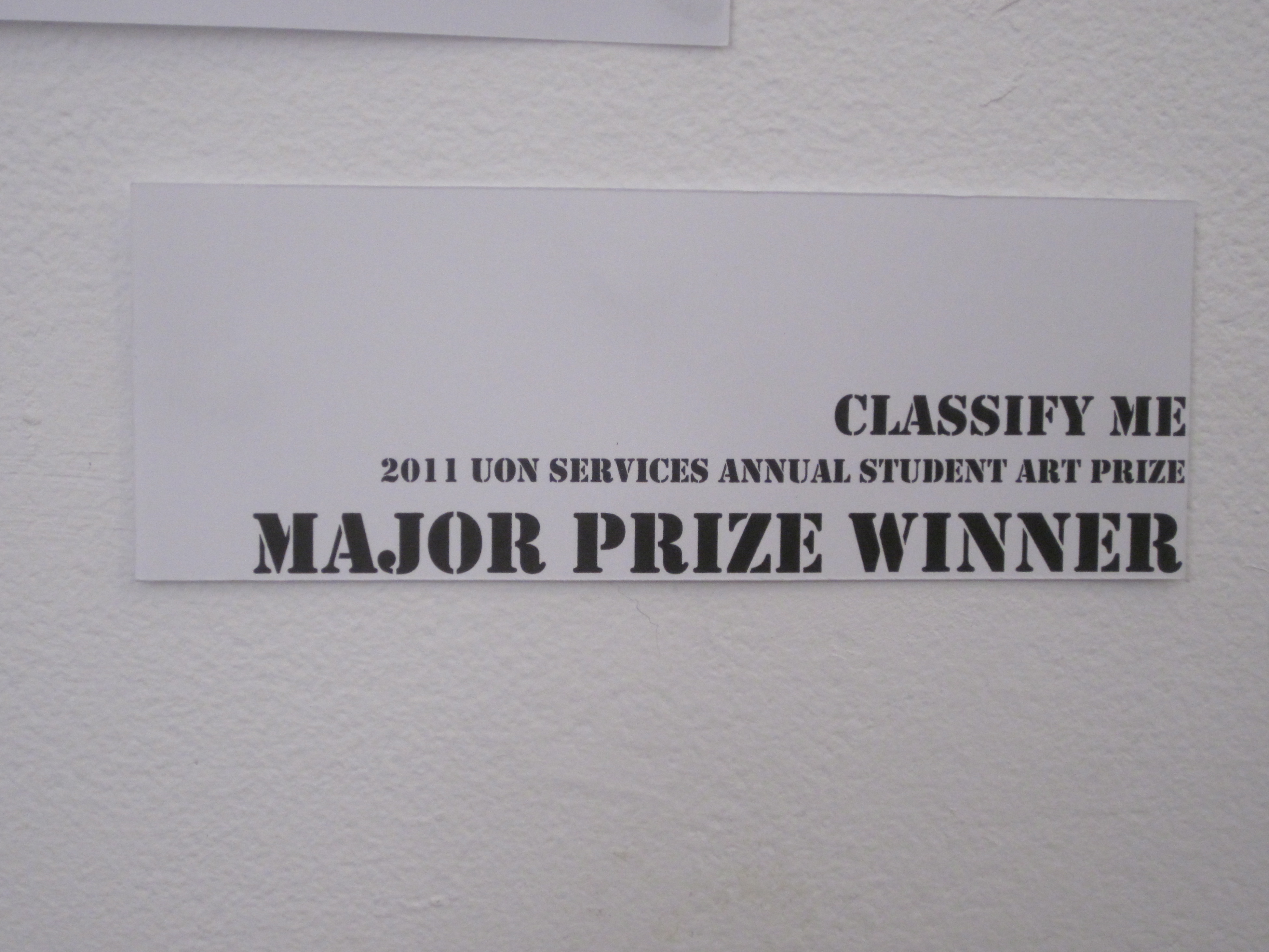
Regular readers will know that last week I made my first foray into ‘meta-museology’, entering and winning the 2011 UoN Ltd Annual Student Art Prize. This was the first art show I’d ever entered, so to win was super exciting. I missed the actual exhibition opening (stuck on the train from the Powerhouse Museum), so winning didn’t quite seem real until Cash Brown and Jason Wing, two of the judges, came into the Art Gallery where I work on Friday to meet me.

It was lovely to chat to both of them (albeit briefly), and to hear them talk about what they liked in the work. Both Cash and Jason were very encouraging, with Cash even suggesting I should look at trying to organise a work for the International Symposium of the Electronic-Arts in the coming years. That might be a slightly ambitious step, but it’s definitely something to think about.

The other thing that was a bit fun about their visit however was their mention that apparently my win shocked a few people and has been reasonably controversial, which is no great surprise. Just like a museum without objects, winning an art prize with a concept rather than an object – a ‘thing’ – challenges and questions the idea of what art is. After all, an idea does not necessarily require skill, unlike a painstakingly made painting or sculpture. There is a sense that anyone could have an idea, whereas only an ‘artist’ can create a masterpiece. Again, we find ourselves facing an issue of classification and whether simply calling something art makes it so.

Additionally, it is very hard to put a price on an idea, and even harder to accumulate wealth by investing in concepts. The art market is driven in part by the sense that art is an investment that over time will bring financial gains. Similarly, museum objects have a quantifiable “thingness” that justifies their existence, and so a museum without objects is a difficult thing to argue for – particularly when public funding is at stake, and many multiple projects/institutions are competing for limited money.

“Things” have weight, value, and a tangibility. They are something we can hold onto, and that solidness makes them seem more ‘real’, more concrete. Concepts, stories and ideas have no weight to them. There is nothing that pins them down and ties them to the world. They are difficult to catch and trust, and cannot be expected to tell the same story into the future (though the same doubts can actually be cast on all objects, since meaning is constantly remade and reconstructed by context). In much the same way as we trust that photographs capture something that really happened (even knowing how easily they can be manipulated), objects have a claim to truth simply because we can feel them, and trust that bodily reaction to them. And that’s probably something something worth keeping in mind when creating in-museum displays too… after all, no matter how complete the concept behind my work of art in this exhibition, the actual display is pretty uncharismatic to say the least. It’s no wonder that my win caused a bit of a stir.


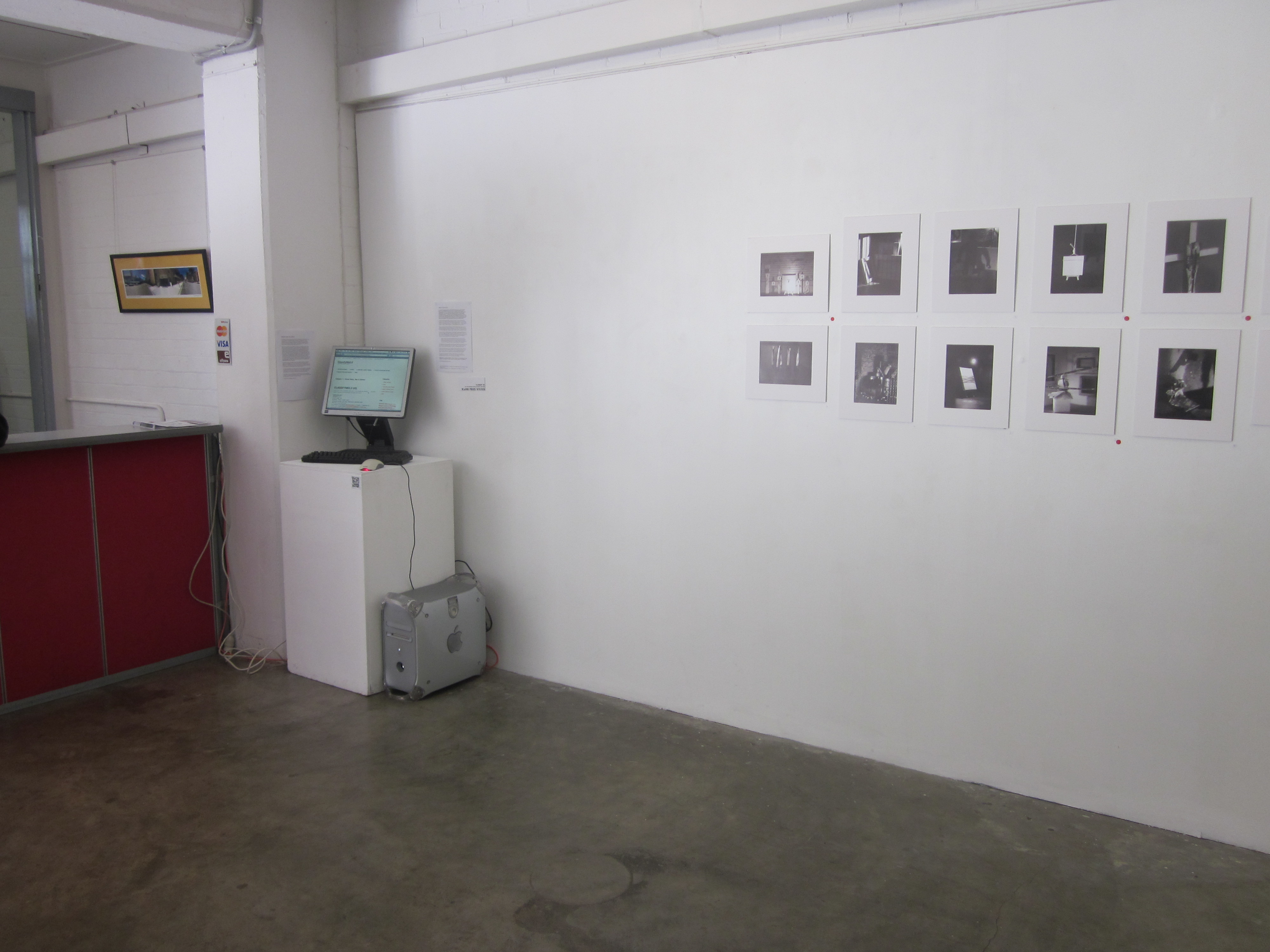
My thoroughly uncharismatic museum display for ClassifyMe2.0
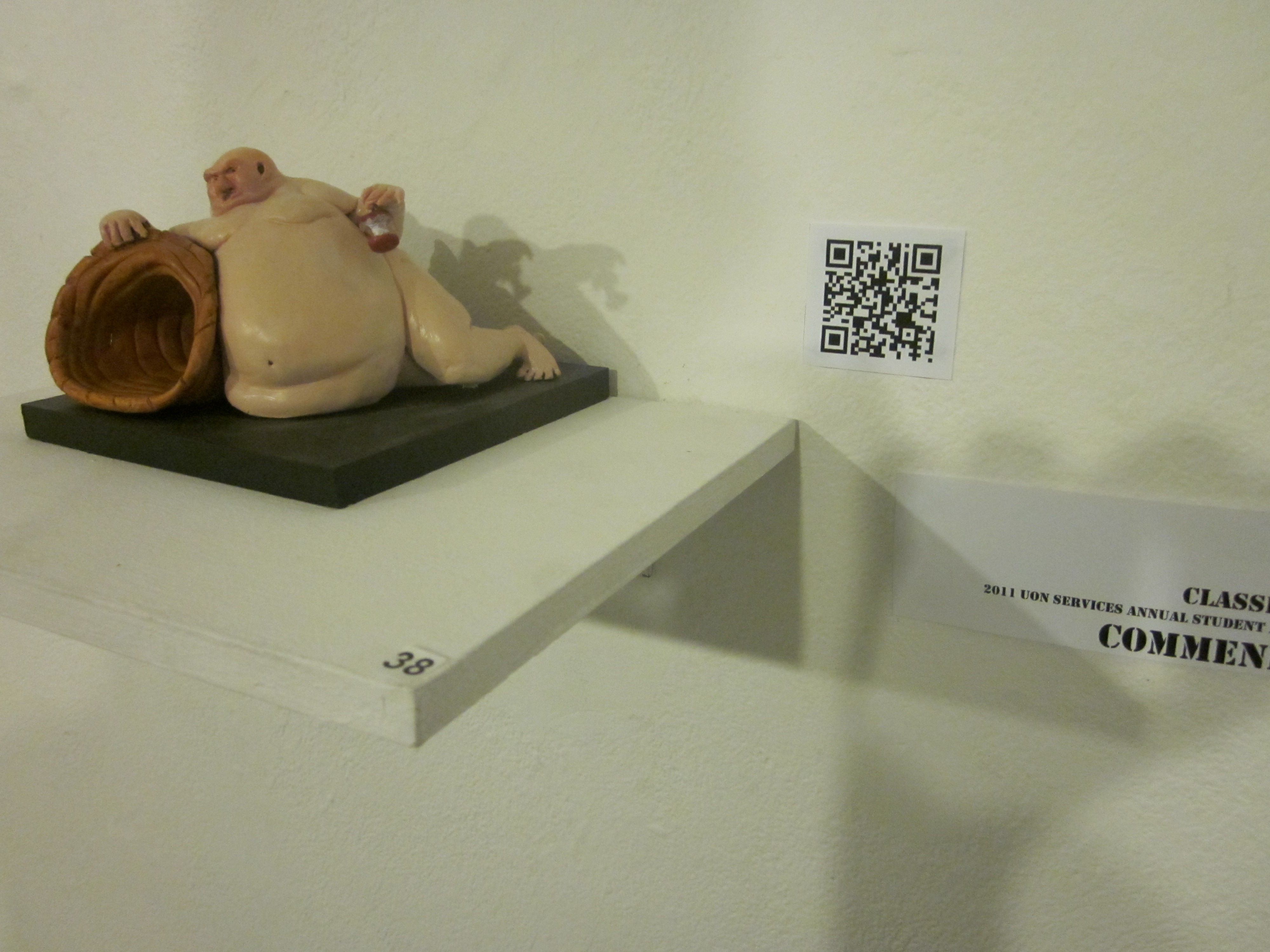
A QR code next to Too Much is Barely Enough by Theresa Purnell
And my favourite (unexpected) thing.

mining the museumgeek – meta-museology in the art show

You museumers have something to answer for! You’ve started getting into my head and disturbing my otherwise sane thoughts and now I’ve spent the last three days installing my first “meta-museological” experiment in my local student gallery.

Every year, my University Art Gallery holds an art prize focussed around a central theme. The exhibition usually passes me by, but this year the theme – Classify Me – caught my attention. The exhibition was premised on a political discussion that took place in Australia earlier this year, when a Senator called for all art to be classified prior to exhibition, in order that age limits (similar to restrictions placed on television) could be imposed. Tantamount to a call for censorship of the arts, it was something that Amy Hill – curator of the 2011 Prize – thought would make a great subject.

And she was right! The topic has garnered some great responses. However, my take on the subject was very different from that of the other participants.

Calling my work Classify Me2.0, I conducted a museological exercise in which I “classified” every work of art in the exhibition according to the ICONCLASS classification system, and through tagging. I then uploaded all of my classifications to a website (the first I’d created!), which could be accessed via either a computer in the Gallery, or utilising proximate QR codes in situ with the works of art themselves.

It has been an incredibly interesting experiment.

First of all, I am not an expert at classification, and so my categorisation of works has been inexact at best. I was armed with very little information about the works themselves. I had not read any artist statements, and so I was only able to make the classification based on the appearance of the work, and its name. In some ways, this is different from the way objects would be classified within a museum – although it did reflect a situation in which a politically driven classification system might work, including some of the difficulties that might be encountered.

I expected that I would find the process of classification interesting, but I didn’t realise that it would significantly affect me. Classifying objects into categories that in no way reflected my feelings about the works was strangely emotive. Of particular note was a small bronze sculpture of a pregnant girl, with one foot shod in a ballet shoe (in a nod to Degas), and the other limb a silver prosthesis. It’s a beautiful sculpture – gentle and delicate. However, the prosthetic limb is the most outstanding element of the piece, which placed the work in the category 31AA4 disabilities, deformations and monstrosities; diseases – AA – female human figure.

It shocked me that something so lovely could be associated with such ugly concepts. Similarly stunning was the fact that disability was, and is, classed as a monstrosity in the classification system. The system is obviously derived from a particular historical art paradigm, but given that it is still used, the grouping together of such concepts is pretty dismal. More than anything else, classifying this work really brought home the fact that classification has no room for nuance.

The second aspect of this experiment that has been fascinating is the conversations that it has started.

During the classification process, the curatorial and installation team in the Gallery (mostly artists) would talk about what I was doing. Until I started classifying works actively in their presence, many had only ever thought about classification in context of censorship. Few were cognisant of the fact that museum objects are always categorised – whether by genre, materiality or era. They had never considered that classifications create proximal relationships between works that might be completely unrelated, and give works different meanings from those originally intended.

One member of the installation team was even concerned for me, worried that in creating this piece and categorising works like the dancer in particular ways (as honestly and fairly as possible) I would be opening myself up to hate in the local arts scene. Although it had crossed my mind that this piece could provoke some small reaction, I had not really considered that Classify Me2.0 could be really controversial.

And is still might not be. Most likely no one will blink. But even these conversations demonstrate that the classification of works of art – in public – has the potential to be very powerful.

Yesterday, too, I chatted to some exhibiting artists and discovered that a painting I had classified as 25G21(+1) fruits (+ plants used symbolically) based on first impressions was both that… and something else. What looked initially like a giant purple apple hanging upside down was also a painting of a well-disguised-but-instantly-obvious-once-you-know-it’s-there vulva. My classification of the object as a fruit was both accurate, and not. Yet to someone with access only to the ICONCLASS classification, this plurality of meanings would be lost.

So Classify Me2.0 has proved to be a great experiment. As a piece of art, it’s terrible. The in-gallery QR codes are inaccessible to audiences who don’t know what they are, or what to do with them (or who don’t own a smart phone). Because I’ve entered the work as part of a competitive art prize, I was not allowed to give too much explanation about the codes in the space (as it was thought to be disadvantageous to the other artists). Additionally, the computer upon which the Classify Me2.0 website is accessible is in an odd place in the Gallery, and people don’t seem to know how to interact with it. The website, too, has faults since it’s my first one. The design isn’t ideal, and the works of art are mis-ordered (because many works changed location between me classifying them and the final hang).

Yet as a conversation piece, and an experiment on the nature of classification, Classify Me2.0 has been incredibly successful. I’ve had rich and deep discussions with people about art and Museology – something that I hope will continue (I’ve approached the Curator and Director to see whether we can organise some kind of forum on classification in the Gallery within the coming weeks). And I’ve learned heaps from putting my ideas into practice in the real world.

The exhibition opens formally tonight, so I will keep you posted on any updates. But regardless, I hold you all accountable for starting me on this path.

Visit Classify Me2.0.
UPDATE: Well, apparently it turns out that Classify Me2.0 actually won the art prize. I wasn’t at the exhibition opening as I was on the train home from the Powerhouse Museum, but I just received a text from the curator, telling me I came first. I think the first prize is a $1500 travel scholarship – which will nicely pay for some of my flights to MCN2011. Um, I’m in a little shock right now.

geek speak with Neal Stimler

Ok, it’s time for geek speak – my regular guest blog series, in which I ask fellow culture geeks to write about their journey to museum tech. Looking back at the first couple of editions, it would be fair to say that neither Jasper Visser nor Lori Phillips knew they wanted to be in museums when they started their career journeys. Neal’s story is somewhat different, in that he had his mind set on working in museums from the very beginning.

Neal and I are both volunteering with the marketing committee for MCN2011, and we’ve connected via the Internet over the last few months. We had a Skype chat a little while ago, in which he recounted to me his days growing up in Ohio, and his time studying abroad writing German poetry and visiting museums. It was cool stuff, and I thought it would be nice to hear from someone whose path to museums has followed a far more traditional route of interning and persistence.


“What is to be done?” – geek speak with Neal Stimler

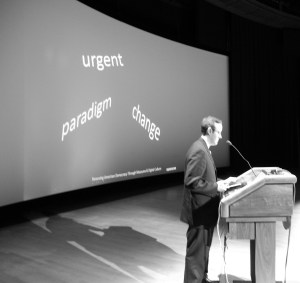
Neal Stimler: Renewing American Democracy Through Museums & Digital Culture. From Ignite Smithsonian, 11 April 2011 at the Smithsonian Institution in Washington, D.C. Photograph by Michael Edson

Note: The remarks herein are the personal views of Neal Stimler and do not necessarily reflect the views of The Metropolitan Museum of Art.

I grew up on the summit of the majestic Cuyahoga River Valley, the son of two fair-minded attorneys and the great-grandson of farmers and factory workers.  My parents, from an early age, instilled in me a love for the arts.  Other beloved mentors nurtured interests in history, literature, music and poetry.  I have been a scholar as long as I can remember.  Museums have always been the place where I felt empowered to reflect upon my place in the world.

I began my museum career as an intern at Stan Hywet Hall and Gardens in Akron, Ohio during my last year at Walsh Jesuit High School.  Stan Hywet was the home of the founder of the Goodyear Tire and Rubber Company, F. A. Seiberling and his family.  I believe the family’s motto, “Not For Us Alone,” defines the vocation of the museum profession.  During my first summer in college, I was an intern at the Akron Art Museum.  While working at the Akron Art Museum, I gained practical museum skills cataloging collections records, taking digital photographs and preparing for exhibitions.  I also participated in an arts program for teenagers through the City of Akron’s Lock 3 Summer Arts Experience.  The most enlightening part of this program was dialoguing with young people struggling through a transformational period in their lives.  I recognized after working at the Akron Art Museum that museums are critical sites for community engagement.

I continued to develop my skills working as the curatorial assistant at the Miami University Art Museum in Oxford, Ohio.  In this intimate university museum setting, I experienced all aspects of museum work and studied a collection of domestic and international significance.  The hours spent with my colleagues and students at the Miami University Art Museum were surely the happiest and most instructive of my college days.  My study of art and culture was greatly augmented by my summer study abroad in Germany and the Czech Republic, where I visited over fifty-museums.  After my undergraduate thesis on the Zen humanist artist Frederick Franck, I made a personal commitment to make social justice and humanistic principles the core of my scholarly practice.

The summer following my return from Europe, I was selected to be a Summer Intern at The Metropolitan Museum of Art.  Working at The Metropolitan Museum of Art had been a dream of mine since the early days of my studies.  As a Summer Intern, I had the opportunity to learn first-hand from museum professionals in one of the world’s greatest cultural institutions.  During the summer of 2005, I assisted visitors at the museum’s central information desk, gave public tours and worked in the Department of Drawings and Prints cataloging German Expressionist prints.  It was a life changing experience.

Upon graduation from Miami University in 2006, I returned to the Department of Drawings and Prints at The Metropolitan Museum of Art to research American prints made under the auspices of the Works Progress Administration’s Federal Art Projects.  The projects were part of Franklin Delano Roosevelt’s New Deal measures to create jobs and reinvigorate American life through the arts, thereby lifting the nation from the devastating Great Depression.  I was deeply impressed by the diversity, technical skill and moving expressions documented in the Federal Art Project prints.  I became especially inspired by the writings of Holger Cahill, the director of the Federal Art Projects, who championed the democratizing ethic of teacher and cultural philosopher, John Dewey.  I believe the art made during Works Progress Administration to be among the greatest achievements in the history of American culture.

Since 2007, I’ve been the Associate Coordinator of Images in The Image Library at The Metropolitan Museum of Art.  In this capacity, I assist scholars seeking images for their study and publication of works from The Metropolitan Museum of Art’s collections and coordinate the distribution of images to partners such as ARTstor.

Through a mentoring program sponsored by the American Association of Museums, I was introduced to Nik Honeysett, Head of Administration of The J. Paul Getty Museum.  My conversations with Nik inspired me to further explore the implications of digital technology for museum practice as the chief focus of my scholarly pursuits.  Nik’s guidance continues to influence my work in ways that constantly offer me new perspectives and directions.  Nik is a significant role model in my life.  His foresight into the field always amazes me.  I remain ever grateful for his devotion to my personal and professional development.

While attending The 2009 American Association of Museum’s Annual Meeting in Philadelphia as a Media and Technology Committee Fellow, I met Nancy Proctor, Head of Mobile Strategy and Initiatives at The Smithsonian Institution.  Nancy too has been a stalwart supporter of my immersion into the museum technology community.  Nancy’s welcoming spirit brings so many new voices into the field.  Her visionary efforts with mobile technology and activities in support of Michael Edson’s Smithsonian Commons are critical to building an enlightening, engaging and empowering museum experience through digital technology.

I learn so much from the generosity and open hearts of mentors and colleagues.  I stress to any student or emerging professional the importance of fostering nurturing relationships with the leaders you most admire.  I believe the best way to learn is from self-directed study and apprenticeship to the greatest minds of the day.  This manner of learning cultivates a life-long devotion to critical scholarly practice and awareness that one’s labor in life should be dedicated to the compassionate service of others.  My work for the Museum Computer Network, a volunteer professional organization advocating for museum technologists, constantly reminds me of the importance of collegially working together for benefit of others.

The camaraderie so freely shared with me from friends and teachers alike, affirms my conviction that museum workers have a duty to work for democratic reform within their institutions that encourages greater access for and participation with the public.  Digital technology plays an essential role in this process by transforming observers into persons whose actions meaningfully contribute to our cultural institutions.  Museums are the protectors of our shared cultural heritage, but they must not lock-away the beauty, inspiration and wisdom that are the right of all humanity.

Fear of the public’s use of content or that traditional power structures will be transformed are not just reasons for limiting the inherent freedoms of citizens to utilize the full resources of human creativity.  If museums desire to be part of today’s digital culture, they must reduce the obstructions to their collections and content that the Internet, mobile technology and social media have already opened.  It is time now to use the powerful tools of digital technology to increase communication with the public, and encourage their involvement in the fundamental operations of museums.

I have the utmost confidence that my colleagues in the field will present new platforms and tools to bring about the urgent transformation of the museum community that I have described.  I entrust the work of technological innovation to those whose curiosity and talents will lead them to success in such endeavors.  My work is committed to helping museums better serve their constituents by empowering the public to live the Vision Statement of the Smithsonian, which requires its staff “to shape the future by preserving our heritage, discover new knowledge and share our resources with the world.”  The future of museums will be determined by our willingness not only to utilize new technologies, but by museums and museum workers ability to make sacrifices that serve altruistic, humanistic and social values.

To this end, I have been searching for past wisdom that can offer insights into a new course of action for museum technologists in the 21st century.  At this time of continued global crisis, I turn to Franklin Delano Roosevelt’s First Inaugural Address delivered on March 4, 1933.  Roosevelt shared this insightful observation with a depressed and desperate multitude on that inauguration day:

The measure of the restoration lies in the extent to which we apply social values more noble than mere monetary profit.  Happiness lies not in the mere possession of money; it lies in the joy of achievement, in the thrill of creative effort. The joy and the moral stimulation of work no longer must be forgotten in the mad chase of evanescent profits. These dark days, my friends, will be worth all they cost us if they teach us that our true destiny is not to be ministered unto but to minister to ourselves and to our fellow men.

Roosevelt’s call was not only for ethical reform, but for immediate action to improve the conditions of citizens.  Museums too are bound to perform this earnest duty as civic institutions at the very center of cultural life.  Museum technologists, with their democratic ethos, are the instruments of hope for the future of an open, free and shareable digital culture.  Let us consecrate our purpose, as museum technologists, to work earnestly in concert with the public for a more compassionate and loving cultural paradigm through the use of digital tools.

Neal Stimler is the Associate Coordinator of Images in The Image Library at The Metropolitan Museum of Art.  Neal was a Media and Technology Committee Fellow at the 2009 American Association of Museums Annual Meeting in Philadelphia, and his article titled, “‘Ferry Me O’er’: Musing on the Future of Museum Culture,” was published in the July 2010 issue of Curator Journal. He gave a paper, “Fostering A Democratic Museum Culture,” at the 2010 Museum Computer Network Conference in Austin, Texas and participated in the first Ignite Smithsonian Conference in April 2011 with his lecture, “Renewing American Democracy Through Museums and Digital Culture.”  Neal graduated with honors and was a Provost Award recipient from Miami University in Oxford, Ohio.  Neal takes an interdisciplinary approach to humanistic scholarship that is informed by art history, cultural studies, digital technology and sociology.

Groupthink vs diversity (It’s the dorks that give it a real go)

When I was growing up, we moved around a lot. I was perpetually the new kid, and being an only child, this meant that I was also a bit of a loner. It wasn’t so much that I wanted to do things alone – I just struggled to meet people with whom I connected.

It’s a pretty common experience. Lots of kids, particularly those with a creative bent, struggle to find their niche. It is all too easy for children who didn’t grow up with the rest of the gang, or who don’t instantly gel with the group, to feel completely isolated – the freaks and geeks of society. This is not entirely a bad thing however. After all, as put so eloquently by Australian band TISM, in their ode to cricketer Glenn McGrath, “There’s never been a popular teenager yet who’s done rat’s with their life. Its the fucking dorks that give it a real go.” (Apologies for the swearing.) There is actually a lot to be gained by being an outlier; by being one of the kids who never fit in and who survived despite not running with the cool kids. You develop a bit of moxie.

Having said that, one of the coolest things about the Internet is its ability to connect us with like-minded folks. No longer do the dorks of the world need to exist in social isolation. Instead, they can find a community to belong to no matter where they are located. After all, prior to MW2011 I had never met a single person who cared about museum tech. Now, my life is filled with them.

But the thing is, when you only talk to people like yourself, your thoughts are never challenged. No one pulls you out of the crowd, and makes you back your opinions. No one teases you for being the freak disturbing the status quo.

And if we lose that, then who is going to come up with the amazing ideas and the paradigm-changing insights that only come from being the sole geek or the black sheep that never fit in???

This post from Michael Michalko on Psychologytoday.com outlines common thinking strategies of genius… and unsurprisingly, groupthink is not one. Instead Michalko notes that geniuses make novel combinations and force relationships; they think in opposites and prepare themselves for change – all of which is much more likely to occur if your knowledge is drawn from diverse sources. After all, many of the researchers – like Michel Foucault or Marshall McLuhan – whose work has made huge impact upon museum thinking have not been museologists, and it is their diversity of opinion and external insight that has forced new thoughts and considerations within the field.

So if we are now self-curating our worlds into smaller and smaller circles of like-minded people online, where will these innovative and often provocative thoughts come from?!?

One answer is the museum itself. Modern museums exist at least in part to educate the public, a role that equips them perfectly to take up the challenge of exploring contrasting ideas, and bringing novel combinations into effect. Rather than simply reinforcing people’s existing beliefs, curators and exhibitions coordinators can work to ensure the museum is a safe environment in which views can be presented that might clash with the visitor’s own assumptions. After all, simply coming into the museum space indicates that a visitor is open to new and potentially uncomfortable experiences, and that receptivity is an ideal starting place for the exploration of new thoughts.

But it would be great to be able to do the same thing online too, so that visitors to the museum website were not only able to find what they were looking for, but also enticed to look further at something that might challenge them. Can museum websites encourage creativity and new discovery, and get people to think about ideas that they would not normally be confronted with? Can a museum website actually stand in place for a physical museum as an affective device?

I’m don’t know the answers, but I do know that our lives are richer when we do not cushion ourselves away from difference simply because it’s uncomfortable. And with that in mind, I’m off to find someone new to follow on Twitter whose experiences and opinions do not match my own…

NB – This post was in part inspired by a conversation I had with Seb Chan the other day. Thanks Seb!

Newcastle Museum: A quick review

"Anti-war protestors" at the Newcastle Museum opening

Last week, my local museum reopened in a brand new location. The old museum had closed about 4 years ago in preparation of the redevelopment, so I was very exited to see the new museum. The new building, which cost $23.5 million and is the biggest project undertaken by Council in recent years, will house three permanent exhibitions as well as semi-permanent displays.

First impressions:
On opening weekend, the new museum was teaming with life. It’s located in some refurbished woolsheds only a couple of hundred metres back from the harbour, in an area that’s undergone significant new development in the past decade. The area is filled with restaurants, gyms, apartment complexes and people, and the new museum fits into its new home incredibly well – integrating the past and the future.

The museum had hired young actors to dress in historical garments for the opening, which instantly connected the new with the old, affirming the museum context. These living displays brought a very lively presence into the museum, which made for a great first impression.

My favourite caption!

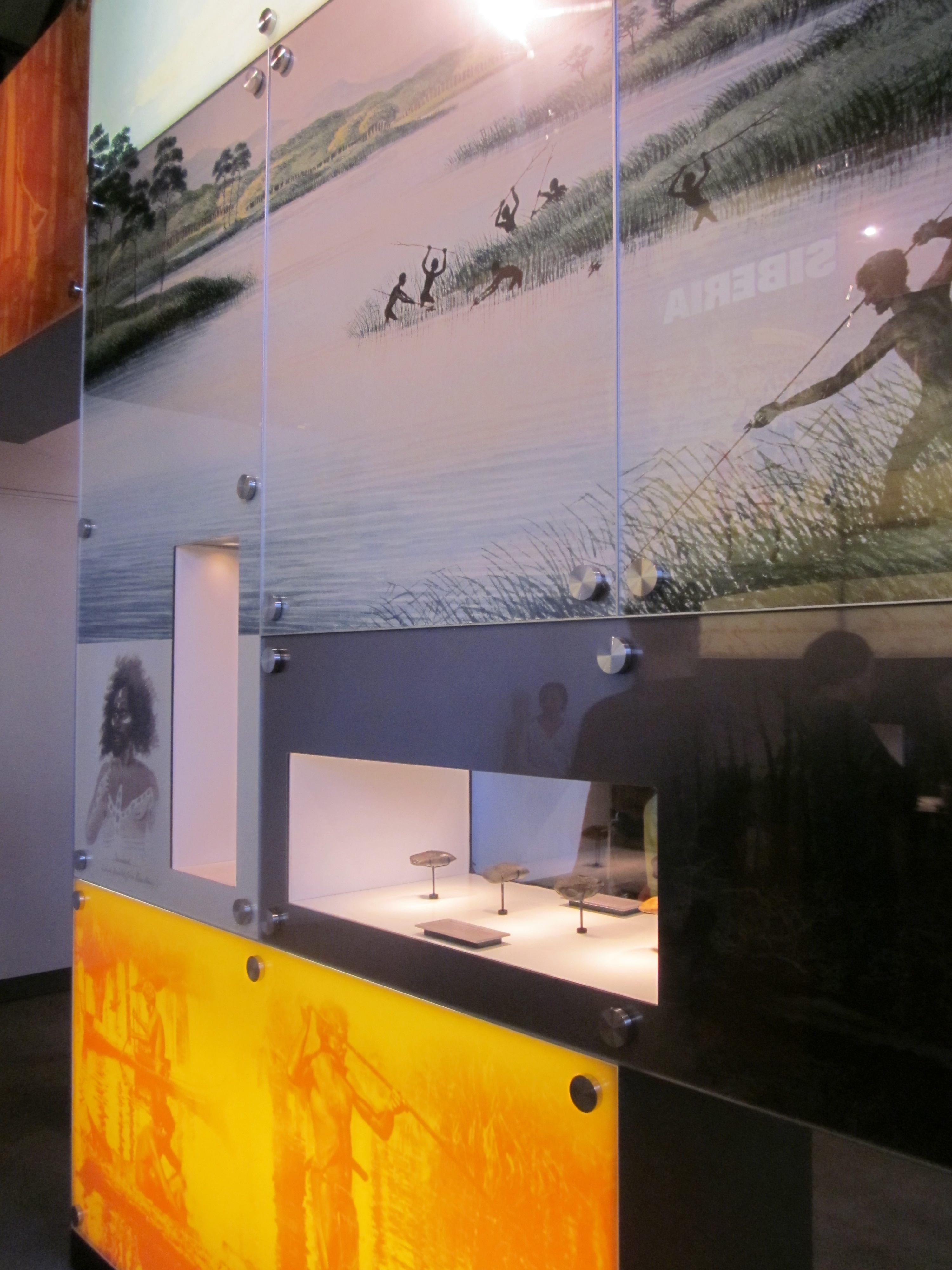
The new museum has a lot going for it. It uses colourful inbuilt wall displays to show images that give context to artefacts without requiring long periods of reading. It has a huge interactive kids exhibition as one of the three permanent spaces (the predecessor of which was my favourite thing at the old museum when I was a kid). TV screens have been incorporated into displays to show changing historical images, though I didn’t see any other real use of technology. I was only aware of one interactive display outside the kid’s area (and it was for kids too). There were no hands-on experiences for adults, which is a shame since I still want to touch things in the museum just as much as I did as a kid.

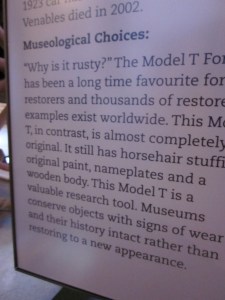
The museum has some cool objects – including an the old rusted Model T Ford, which was given contextualisation by text panel that explained a number of different interpretive premises for the object’s inclusion in the “Newcastle Story” exhibition (including one paragraph on ‘museological choices’, which is a little more meta and self-reflexive than most museum panels). The old car had wooden spokes for wheels, and still had a hand-written message scrawled in the dust on the dash. To me, it spoke of the history of technology and human nature all tied up in one artefact.

My other favourite object was a biscuit wrapped in cloth that had survived from the trenches of World War II. It was a hugely affective piece for me, because my mouth could immediately taste the biscuits, and my imagination grappled with thoughts of what living through the way might have been like. The bodily sensations that I experienced looking at that one object really affected me far more than other objects, which were simply pretty or interesting. My PhD supervisor Dr Kit Messham-Muir has done work on affect in museums, and wrote about this in a 2008 exhibition essay. He writes:

The physicality of objects and sites, their smells, tastes, textures and presence can trigger intense sensory memories. Importantly, sensory memory is different from the remembering of linear narratives; sensory memory involuntarily conjures vivid past events into the present.

This is absolutely what I felt when seeing the WWII biscuit.

Having said that, although some of the objects were pretty cool, there didn’t seem to be a lot of objects. Both my husband and I walked away feeling that we hadn’t really seen much. There was a big space, and it seemed like we should have had lots of exploring to do… but in a short time, we felt like we’d seen everything. Now, maybe that was the busy atmosphere, so we didn’t really take time to read all the panels and look at the displays with the depth we would have with fewer people in the museum. However, for all the prettiness of the displays, I wonder if there wasn’t a conscious choice on some level to use images instead of objects. If so, I would love to know the reason why. The large colour wall displays were great – but not at the expense of more tangible objects and stories. Pictures might seem more self-explanatory, and they can certainly add context… but I’m not sure that I respond to them as a replacement, instead of an addition.

Image-driven displays - pretty, but sadly lacking in objects

The new museum does have a very large external space that looks perfect for family outings and activities, and on the weekend it was brimming with laughing kids – so that’s a great start. Having chatted to the museum’s public programs officer a couple of weeks ago, I think they have grand plans for building the space into a very active part of Newcastle’s cultural life, which will be fantastic. But it will be interesting to see whether the museum’s emphasis on events can sustain it when its objects are fairly sparse.

How do you guys feel about museums that (seem to) put an emphasis on events/displays over objects? Are they sustainable? Effective? It seems to me that this will be able to bring a sense of life to history – but maybe not the same sense of connection… But that’s an intuitive answer, and I’d love to hear of people’s actual experiences of this split between the two.

And you never know – when I go back to the museum on a day that’s less frantic, I might have a different impression. But my first sense of the place is that it’s fresh and active – just with fewer artefacts than I expected, and maybe that I would have liked. The experience has made me realise just how much I do love/want objects in my museums.

‘Knowledge is power, but secret knowledge is also power.’

I came across the title for this post in the comments section of an article discussing the recent releasing of JSTOR academic documents by Aaron Swartz, where fred_bauder writes: Knowledge is power, but secret knowledge is also power.

It’s an interesting sentiment. Around the time of the wikileaks US diplomatic cables leak I remember reading an article about privacy in this age where the author asserted that the only way that people could now guarantee that secrets would be kept secret was to ensure they were never recorded or written down; that governments, businesses and individuals could all now be called accountable for everything ever committed to paper/email/device. In some ways, this has always been true… people have always been held accountable by what was recorded – be it on paper or tape – but things are publishable now with renewed vigor and ease, and that changes the game somewhat. The relationship between secrecy and power seems to be shifting.

Shortly after the wikileaks scandal, I had a conversation with a psychiatrist about the implications of the above, and he mentioned that for similar reasons he no longer records (non-critical) material in someone’s files that could one day be used against them. He no longer trusts in the sanctity of the files, because there is the possibility that with time, anything recorded could become public (if in doubt, check out this article about the Mug-Shot Industry [That] Will Dig Up Your Past, Charge You to Bury It Again).

Knowledge is power, but secret knowledge is also power…

So why do I think this is important for museums? As museums put their collections online, they may be held newly accountable for what is and is not recorded within them. The public may (if they choose to look) become aware of ways in which museum records are incomplete, or even contain information that has been shown to be false since it was initially written down. This is not necessarily a negative thing. As Seb Chan noted in his MW2007 paper Tagging and Searching – Serendipity and museum collection databases on the Powerhouse Museum’s OPAC2:

the exposure of these records, and their increased searchability, especially through Google, has led to the Museum receiving additional contextual information about objects, or corrections to research. Sometimes this additional information comes from international experts, collectors and researchers, but at other times, as was the case with a convict love token, it comes through community members researching their family histories – and simply searching for a series of family names in Google.

But it is indicative of the fact that as museum collection documentation becomes available online, it is open to new scrutiny.

Paradoxically, this openness does little to challenge the fact that museums are, and have always been, secret societies filled with people who have special knowledge about the objects in the collection that not everyone is privy to. In their earliest iterations, museums were places for philosophical societies to meet, serving as a locus for research about the world. Even once museums became public institutions, the aim was to teach those without knowledge about the world and the collection. However, there is always a power imbalance between those with knowledge (and power) and those without it. All knowledge is secret knowledge if it is not freely and fairly available to all parties, and to some extent this is precisely where museum power is drawn from.

Museum knowledge is stored not only in our artefacts and documentation but importantly also in our people. We speak in secret languages (taxonomies) and have often-silent rules of accepted and acceptable behaviour that can be daunting to the ‘uninitiated’ (a term which is itself loaded with implications). Museum power is not in the things that have been committed to print – it’s in the knowledge of staff and their intuitive understanding of objects and collections. It’s in the judgements made when curating exhibitions. It’s in all the silent things that can never be fully recorded.

Julia Noordegraaf, in her book Strategies of Display: Museum Presentation in Nineteenth- and Twentieth-Century Visual Culture, writes about a similar schism that occurred in museum display in the nineteenth century. She writes (emphasis mine):

There is a paradox in the fact that most nineteenth-century museums were designed to accommodate large groups of visitors, while at the same time provided little information about the objects on display. Whereas the museum was thought to be a civilising and cultivating institution, its presentation was aimed at people who could find their own way through it and could interpret the objects on display by themselves. According to James Sheehan, this tension between the general and the exclusive lay at the code of nineteenth-century culture and society, ‘[…] the tension between the aspiration to have institutions that would be open to everyone and the structural inequalities that made these institutions inaccessible to all but a minority of the population.’

The paradox can perhaps be explained from the fact that in the nineteenth century, museums were conceived as places as much for the research or the advancement of knowledge as for popular instruction or the diffusion of knowledge. Until the end of the century, when museum innovators like Henry Flower recognised the need for different types of display for these different aims, museums were trying to fulfil both aims with one and the same type of display. It seems that in the nineteenth century, museum managers designed the script of museum presentation from the idea that educating the people simply meant opening the museum doors to everyone.[1]

Museums may be opening the virtual doors to their collections to everyone. However, this doesn’t mean that the audience is equipped with the same knowledge as the museum curator or educator. Even with digital openness, museums still have secret knowledge – and secret knowledge is also power.


[1] Julia Noordegraaf, “Strategies of Display: Museum Presentation in Nineteenth- and Twentieth-Century Visual Culture,” ed. Museum Boijmans Van Beuningen Rotterdam (Rotterdam: NAI Publishers, 2004). 80. Noordegraaf quotes from Sheehan: Museums in the German Art World 2000: 115.

Finding funding for MCN2011

Regular readers will know that I’m volunteering with the MCN marketing committee in the lead up to the 2011 conference. The conference is on in Atlanta, GA 16-19 November – and I am mad keen to get along for a couple of reasons. The main one is because Koven Smith has asked me to be a panellist on his panel asking “What’s the point of a museum website?“, which will pick up where his Ignite Smithsonian speech left off. This is an awesome discussion, and I can’t believe I’ve been asked to be part of it. Having said that, being a poor PhD student whose already been to the States once this year, my ability to attend is going to rely on more than just wishing.

To that end, I’ve put in an application for one of the MCN2011 scholarships, of which there are 15 (plus a further 4 scholarship funded by Kress Foundation and THATCamp). The closing date is next Monday, 1 August and full details are available on the website. I must confess I’m a little bit torn between wanting to promote them as is my role as vollie, and wanting to minimise competition so I actually get one. Ha.

I’m also applying for an ArtsNSW quick response grant, which is funding “available for professional individuals, groups and small- to medium-sized organisations who have received an unexpected invitation to participate in a recognised national or international arts and cultural event/activity.” I’ve never applied for a grant before, so I’m not sure how I’ll go with that… but hopefully they will recognise that this is a pretty awesome and unexpected opportunity and will give me enough to cover the flights over. My fingers are firmly crossed.

It’s all a bit exciting even at this stage… but it will be much more so if I can actually secure funding in order to make it over to the conference. I’ve had a sneak peak at the program, and it looks great. I’ll post more about it once the program goes live (which shouldn’t be too far away now).