Public Sphere: Museums 2022

This post is the first in a series over the coming weeks that will address some of the questions/issues being raised as part of the Digital Culture Public Sphere. This public consultation process is seeking input from the GLAM community in creating a vision for a long term sustainable vision for the sector, and so I am going to use my blog as a bit of an open thinking space in which to develop my own ideas (ultimately leading to comment/submissions in the online discussion). These are particularly interesting questions to be addressing now, given how quickly the world and technology are both changing.

These formative thoughts are not yet fully developed, but hopefully by writing – and inviting comment from you lovely readers – I will be able to clarify my own position.

So… what would I like to see for Australia’s digital culture ten years into the future?

Well, to start with, I’d like to see a lot more of Australia’s digital heritage online. As more and more information/communication/knowledge becomes based online, those things that are not online are at risk of being written out of history and becoming irrelevant. Obviously, museums and galleries will still have the physical objects in their collections – but what use are those things if no one knows they are there (after all, who are you collecting for?)? Already, many GLAM organisations have undertaken digitisation projects, but for others – particularly smaller institutions – time and resources have ensured that this is not a high priority (or, if it is a priority in intention, it does not always eventuate). I worry that if we leave our collection knowledge offline, it will lose its meaning. As Jennifer Trant writes, in Curating Collections Knowledge: Museums on the Cyberinfrastructure (p289, in Marty & Burton Jones, Museum Informatics: people, information and technology in museums 2008), “The vitality of collections derives from their use, interpretation, and re-interpretation.” I’ve asked previously whether a collection have any impact if no one interacts with it, and I think this issue will continue to be important for cultural institutions.

In the same book, Trant (p289) further argues that museum collection documentation should be curated just as museum objects are curated. She writes:

Reconceptualizing the role of museum documentation as active curation of collections knowledge created inside and outside the institution enables museums to fulfill a broader role in society… The museum information curator’s selection, arrangement, and care have as their object the cultural memory of the institution, a legacy to be guarded along with the physical preservation of objects themselves.

I agree with this. I think that for Australia to excel in this sector, we need to make the curation of collections knowledge a priority. However, this is something that would probably require the creation of new positions within our museums (which obviously takes funds).

Having said that, I’m not sure that simply putting collections online is enough to make them relevant to anyone… We need to find new models for our online collections to make them meaningful and easy to interact with for broader audiences than just those trained in museum language and conventions. If we do want people to interact with our collections online, then we need to lower barriers to entry and maybe even think of new ways of visualising collection knowledge, and I think that’s only something that can be done from inside the industry. That’s not something that can be done with better cultural policy, but is what the success of any movement towards digitising culture hinges on.

Similarly, we need to find a way to put our collections online in a way that allows others to find meaning in them, but also allows the museum to maintain its authority. I have spoken to curators who mention that they don’t use collection websites for authoritative information, since they are often inaccurate and untrustworthy. If we don’t trust the information from our own sector, how can we expect anyone else to do so? So in the coming decade, I’d like us to find a way to have online collection knowledge become something that’s useable, relevant and trustworthy – not a small task, I know.

There will no doubt continue to be difficulties associated with copyright in displaying/uploading images of works of art and certain other museum artefacts which cannot be resolved within the field, with the international legal implications involved (particularly since things shared online have no physical borders to prevent their spread). But these are issues that will impact the ability of many cultural organisations to make their collections available online in a meaningful way.

Internally, as a sector, we need to continue to confront the fact that opening our collections up to interaction will challenge the museum to reexamine the role it – and the role audiences/visitors/users – play in constructing collection knowledge, and that doing so may change the institution itself. It is these changes that I am exploring, at least philosophically, in my PhD research, but the sector as a whole will likely need to focus on and address what these changes mean on both a practical and theoretical level in the coming years. While there certainly are many in the field doing so already, there remain others for whom this is merely background noise, and who have not yet come to accept that museum websites in the information age might need to be about more than marketing. And I don’t think we as a sector will be truly relevant to anyone in the digital age until our online place is not simply to tell people how to find our offline presence.

What do you think? Where would you like to see digital culture – in any country – be in ten years time? How can we make it happen?
If a tree falls in a museum, and no one is there to hear it…

Australian IT policy advisor Pia Waugh has just posted the first of a series of four posts on online culture. This one, titled Unicorns and Doom, investigates some of the ways that the Internet is changing mainstream culture. As she writes

Using the Internet changes your expectations of the world around you, and importantly your expectations of how you can interact with the world.

The entire post is compelling, and I would recommend that everyone should read it. However, I am going to pull out a few of her key points now and dissect them a little bit for what they mean for museums.

Waugh argues that there are four expectations/behaviours that we develop when we engage online. These are the expectation that we can route around damage – or find new paths around any form of artificial interference; healthy skepticism – that we can examine and question information, particularly official information that doesn’t necessarily gel with other evidence; an expectation of transparency and accountability; and an expectation that through “do-ocracy” or people power, it really is possible to make significant changes to the world.

In her post, Pia expands on each of these ideas considerably. However, I’ll now just grab a couple of her ideas in brief for closer examination. She writes:

When we want to know about something, we automatically look it up online. We expect to be able to get information on any subject we choose and when information is not forthcoming we ask why.

This is one of the very real and compelling reasons why I do think that museum collections do need to be online… When Koven asked what’s the point of a museum website at MW2011, and again in his Ignite speech, my first answer was (and continues to be) that as we become more and more reliant on the Internet as the storage space for the sum of human knowledge and information (as seems to be happening) then if something is not online it will almost be as if it doesn’t exist. It’s the tree falling in the woods argument reframed… if you have objects in your collection that could be useful to human society – whether to a researcher or someone else – and they can’t find or access that information (even just at a basic level to know that the object is in your collection), does that object have any purpose? How can it tell us anything about ourselves/our past/culture if we don’t even know it exists?

Now this is a very different question of how we make that information useful and useable – and I think that is an entirely unresolved problem (see Mia Ridge’s post on death by aggregation). But as our social expectations regarding information change, it really is becoming the case that if information about something is not accessible online, then we look for other information. Even as a researcher, I will look online at my library’s collection to see what books they have that I might be able to use well before I make the trip into the physical location. That’s not to say that serendipity won’t guide my search once I’m there, but the initial impulse usually occurs when I’m not in situ – and my future actions are predicated on the information that I find online.

Waugh’s post continues:

The Internet has democratised both access to and “publishing” of knowledge. The control of knowledge has always been a power mechanism, and we are now seeing a significant struggle as traditional knowledge and power brokers find themselves continually flanked by individuals and communities.

This is something I’ve wanted to write about for a little while now. The publishing of knowledge, and control over information, is something that has obviously been important for museums historically. It was a key aspect of how museums maintained their authority, by making some claim to control over the objects of our past and the information about those objects, and therefore about our past.

However, authority online comes from (appearing to have) visibility of process, rather than from hiding behind safe institutional walls. This means that organisations need to be work harder to ensure consistency between what they say they do and what they actually do, since they will be called to account if people notice gaps between the rhetoric and the action.

Pia argues that the ease with which we can access, engage with and hold accountable anyone online makes it easier for people to make informed choices, and I would agree. This article by Richard Smith from the Journal of Financial Transformation provides an interesting perspective into transparency and trust in the ‘post-Gutenberg era’, or the era of social media (although focussed on business institutions and brands). He writes:

In the Gutenberg world, trust was institutionalized. Organizations worked to establish reputations such that people would trust anything and everything they did without feeling the need to interrogate it for themselves. This worked because it was efficient, from the organization’s perspective, and because individuals recognized that they could not (or could not be bothered to) comprehensively interrogate all the organizations they dealt with. They would accept an organization’s ‘institutionalized representation’ of itself (its brand) — provided they could have a level of reassurance that this representation was reasonably accurate.

Trust within social media is not vested in institutions, it is vested within visible processes. The best way to explain this is to look further at the Wikipedia example and its battle with Encyclopaedia Britannica. The Encyclopaedia Britannica is a classic example of institutionalized trust. You trust its entries based on your knowledge of the reputation for accuracy it has established and carefully nurtured over the years. You do not feel the need to look behind or interrogate this reputation in any way. Wikipedia is totally different. You trust its entries purely on the fact that it has made visible the way that entry was produced and refined. Even if you do not choose to examine the history of every entry, the simple fact that you can do this and there is a process in place which means somebody is doing this, gives you a level of trust. Critically, an element of this trust is based around the need for you to make your own assessment of the process and how much trust you will decide to allocate to it.

It is not that people are going to reject institutionalized trust, but the task of sustaining it is going to become much harder in the world of transparency brought about by social media. Organizations will, therefore, find that ultimately the only efficient way to maintain trust is to switch to a model based on process, which will mean creating the ability to see in much greater detail how an organization goes about its business.

As Pia’s post indicates, mainstream culture is changing as a result of the Internet. What this means for museums – particularly online – is still open to significant debate. But it is important to look at the significant and apparently lasting trends occurring within technology and the ways society is changing as a result to get a sense of how and where the museum website fits.

A very quick post on practising what you preach

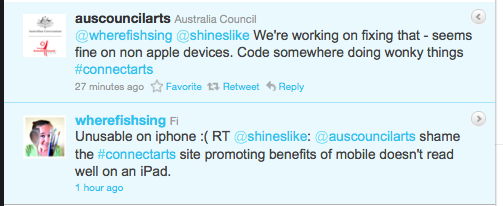
The Australia Council has just reached their new research report called Connecting:// art audiences online. I haven’t had a chance to have a full read of the report in depth just yet, but one thing leaped out at me this morning when I started looking through the website… The website, which contains pieces of advice like this:

The internet – and in particular, mobile technology, provides a range of opportunities for arts organisations to make it easy. Already, there’s strong adoption of mobile apps in relation to arts events, with strong interest in apps to support ticket purchases, program customisation, interaction and content sharing, to name just a few.

cannot be read fully on my iPad. I was flicking through the site first thing this morning, and was pretty frustrated to find that the text on the site would not scroll so that it could be read in its entirety. I could see the start of bar graphs, but not the important information at the other end of them. I thought the report was relevant enough that I would actually try to access it again from my laptop… but very easily I could have just dismissed it as inconvenient and not looked again.

If you are going to talk about the importance of mobile technology, then please consider how mobile audiences will access your information when designing your site.

FOLLOW UP: But here’s the nice thing about social media, and a demonstration of how to use it well…  OZCO responding to the problems mentioned above.

Who owns the virtual space in your museum?

Yesterday I crashed my first ever ARDevCamp @ the Powerhouse Museum. Despite being late (buses do not replace trains very effectively) and missing some of the morning talks, the afternoon provided plenty of inspiration and lots of think about. True to form, I used my spidey senses to find some incredibly interesting people to sit next to, and got into some great conversations – some of which will no doubt inform this blog over the next few days.

One of the most interesting questions that arose at the Camp was about digital space and augmented reality (AR). Rob Manson from Mob Labs spoke a bit about the question of who owns the digital space – an issue that will no doubt become more important as more companies and individuals start tapping into the AR potential, particularly for advertising (if this stuff interests you, it’s worth reading this article on Mashable). But it’s also an interesting question for museums to think about.

Last October Sander Veenhof and Mark Skwarek staged a guerrilla AR intervention at MoMA as part of the Conflux Psychogeoraphy festival. The exhibition not only took over the current six floors of MoMA, it created an AR sculpture garden on the “seventh” floor. Check out the video for a sense of the event.

WeARinMoMA seems more akin to performance art than anything else, in part because of the time-limited nature of the performance. But I’m interested in how museums – and I’m probably thinking about art museums in particular – would deal with more of these kinds of interventions. What if Sander Veenhof and Mark Skwarek decided that they wanted their exhibition to be permanent?

The Stuckists (talking about the Tate) argue that:

An act by an individual which interferes with an existing artwork is termed an “intervention” and the individual termed an “artist” if they are endorsed by a Tate curator or are dead. The same, or similar, act by an individual interfering with the same artwork (or even interfering with the interference to the artwork), if they are alive and are not endorsed by a Tate curator, is termed “vandalism”, and the individual termed a “criminal”.

So what would happen if someone painted an AR beard on the Mona Lisa? Would the Louvre try to prevent the intervention for being vandalism? It does not harm or interfere with the actual work, although may impact upon its interpretation. Could an artist be prosecuted for digital vandalism?

Or conversely, would the AR addition to the painting be recognised as an important part of the painting’s provenance? Could visitors delight in seeing the painting through another artist’s eyes, and comparing that to the original then and there? Would the interpretation be documented and preserved in the artist file? And how would it be done? Would there simply be videos and photos as per a performance, or would the documentation include recording lines of code as well? Could the AR art be collected, and if so, how? Does the long tail of this end with a curator of AR in the museum?

This guy floated over the Powerhouse @ ARDevCampSyd

The AR might not only take place within the Gallery. Yesterday a giant virtual Lego man stood above the Powerhouse Museum, welcoming visitors to ARDevCamp. This could be a great way for museums seeking redevelopment funding to get people enthused about the project, by projecting the architectural models over the physical building.

But what if the layer had been promoting a commercial product instead? While I can see all kinds of awesome applications for this for artists seeking a little notoriety (like emblazoning their own name on the wall of a Gallery), they might not be the only ones interested in claiming the digital space around museums and galleries. What if Coke decided to as well? Or a political party?

Of course, these are all hypothetical situations and will likely never eventuate. The questions that arise out of real world AR interventions in digital space are likely to be far more nuanced – and far more interesting. But these questions demonstrate just how little we can prepare to respond to technology until we know how it’s actually utilised. While the legal and ethical debates around these issues might be fun to think about, it won’t be until there are cases actually in the courts that the actual implications will become clear. After all, laws are made in response to actual events not hypothetical ones, and individual cases often require individual responses. But until then, it’s interesting to consider just who owns the virtual space in your museum – and around it.

Deaccessioning friends and Intel’s “Museum of Me”

A glib exchange on Twitter this morning left a far greater impression on me than it should have when Bruce Wyman tweeted about Intel’s new Museum of Me. In what was almost certainly trolling, Bruce mentioned his appreciation for the MoM and I couldn’t help but take the bait. My reply touched on the fact that the MoM makes poor choices in deciding which friends to highlight in it’s so-called “journey of a visualization that explores who I am”, to which Bruce replied:

This response, strangely reminiscent of something from The Importance of Being Earnest, stuck with me and gnawed at the edges of my brain. Was Bruce right? Should I start deaccessioning my friends until the MoM became more accurate? The Museum’s multimedia display was strangely lacking too where I’d failed to input data about my favourite tv shows and movies. Should I work harder to fill in the gaps in the digital collection of my life, to ensure that my exhibition stayed up-to-date with all the latest trends? I started to consider that maybe I needed a collections management policy for the digital me.

I’m sure by now you can see why I was concerned. It’s not that the MoM is a soulless and narcissistic paean to the culture of me-ism. It’s that its ‘me’ is wrong. It’s cobbled together from the leftover remnants of digital interactions, the little communicative gifts bestowed on my facebook page. And in some ways, that means that it’s just like a real museum collection. After all, museums frequently begin with an act of benefaction – a gift to a city or a university from a private citizen whose personal collecting biases inform that collection for perpetuity. Further gifts will continue to shape the collection, and so-called gaps are often only filled when their absence becomes prominent. And so although I can probably shape the message of the MoM to make it more indicative of who I am, it will take quite a bit work and there are limitations… after all, explaining to my friends that I have to deaccession them so that my MoM collection more fully reflects who I am might be a little tough. Though they might understand the problem because no doubt they all have their own MoM too.

Of course, if I was to look at each of their MoM, I’d probably be in for a fairly cold experience. By necessity (let’s be honest, it is just a quirky marketing ploy) the MoM takes a one-size-fits all approach to exhibition design and collection management. The gallery space isn’t exactly tailored to different people with different interests, needs and wants, so it’s no surprise that it can’t be all things to all people. And even more critically, without the memories and stories of my friends to animate their MoM, any pleasure that could be derived from the experience would be superficial at best.

The whole MoM experience reminds me of this post on the Interactive blog. Regan Forrest writes of her experiences preparing design proposals, and says that many of the stock portfolio images:

depicted beautifully finished, perfectly lit, crisp, clean . . . empty spaces. This wasn’t necessarily a bad thing for projects where the aesthetic was a big part of the whole point (fine art exhibitions for instance). But I felt they really sold interactive spaces short – even the most interactive and engaging exhibition in the world looks sterile and passive without visitors there to breathe life into it.

Which is the very point. The MoM ultimately fails for me because it is nothing more than a sterile approximation at representation, but it’s still worth thinking about for the perspective it brings.

Speaking trumpets: blowing the museum’s horn

I am reading Ken Arnold’s Cabinets for the Curious: Looking Back at Early English Museums at the moment. Arnold uses a comparative approach to consider contemporary museums in context of the founding principles of museums of the 17th century.

He discusses “three dominant strategies for knowledge creation in museums… the telling of stories, the use of objects, and the imposition of order upon them” (Arnold 2006, 4). As I’ve been reading the book, it has really struck me that, online at least, museums seem to be renegotiating these key strategies – moving away from both the use of objects to construct knowledge and away from strict taxonomies (since the Internet is much more rhizomatic than hierarchical). Instead there seems to be a renewed interest (also here, and here too) in the telling of stories as a primary driving force for knowledge creation online, and in making that relationship dialogic, rather than unidirectional.

Therefore, it was with interest that I read this paragraph in Arnold’s (2006, 90) book (emphasis mine):

The urge to tell stories in museums can only be understood once the role of people as well as the object within them has been fully grasped, and this is crucially on both sides of the collector/curator – visitor/audience divide. Museums have always been places for people’s discursive lives: spaces for teaching and learning, but also quite simply for sounding off. This is why it was quite natural for the sixteenth-century naturalist Athanasius Kircher to equip his museum with speaking trumpets, ensuring that curators and visitors were audible to each other – as if the significance of the spoken word was too great simply to be left to the vagaries of the unaided voice.

I love that almost 500 years ago the creators of museums were grappling with – and finding solutions to – the same questions that we ponder today.

Kircher’s speaking trumpets, from the Special Collections and University Archives of Stanford University Libraries

For a more contemporary take on Kircher’s speaking trumpets, the Scapes exhibition/app created by sound artist Halsey Burgund for deCordova Sculpture Park and Museum in Massachusetts seems like a pretty cool way of inviting interactivity and story-telling into the museum environment. From the description, Scapes:

creates a two-way audio experience for museum visitors influenced significantly by their physical location on deCordova grounds. Participants will use handheld wireless devices and headphones to listen to audio and also to make their own recordings which will be immediately assimilated into the piece for everyone to hear.

Check out the below video to get a better sense of it, or read reviews by Nancy Proctor and Ed Rodley.  


Scapes Intro from Halsey Burgund on Vimeo.

Girls: get coding.

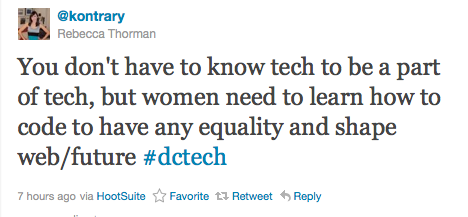
Nancy Proctor RT’d this Tweet yesterday, and it caught my attention for a couple of reasons. The first is that at MW2011 (maybe the first place I’d been where awesome tech nerds convened en masse), I’d come to realise just how much of the technical side of the web passes me by completely. And that meant that when people would talk about how something did or didn’t work (rather than simply the ideas behind it), I couldn’t participate in those discussions at all… which I think is problematic if I want to spend my career working in digital heritage.

The second reason it caught my attention is that it suddenly struck me that being able to code is the modern day equivalent of being able to fix your own car – or at least change your own tyre. And as the original Tweet says – if women want to have any opportunity to shape the world and even just to be self-reliant in a world that is built on code – then we need to learn that language. This is maybe even where the next feminist battle should be taught – in equipping women to participate fully online.

I wasn’t the only one whose imagination was similarly captured by the idea of organising a “girls get coding” space, or some workshops. There are obviously a bunch of us who have felt this yearning to get in on the conversations, so I think this is something that will progress beyond here.

In the last couple of moments, a few excellent fellas have been sending us links to great places to begin – so I’m going to post their recommendations here, and will drop back into the blog with more info as this develops. Very exciting.

PHP 101: PHP For the Absolute Beginner
Learn to Program: A Place to Start for the Future Programmer

Processing.org

http://scratch.mit.edu/

Thanks to Bruce Wyman and Matt Popke for their useful first links. And to Mia Ridge for volunteering to teach some handholding for webpage languages.

Girls – stay tuned for more updates, and let’s get coding!

The end of scarcity and the economics of everything (including knowledge)

Earlier today I read an interesting piece by James L. McQuivey on Mashable.com titled Why the End of Scarcity Will Change the Economics of Everything [OPINION]. In it, he asks:

what happens if the economics of scarcity are exchanged for the economics of plenty? For those industries that provide information or experience as a primary good, scarcity is rapidly evaporating. The media business is undergoing a similar change with the rise of citizen journalists, bloggers, and YouTube performers — all of which circumvent the traditional systems that once dictated production norms and processes. Most of these companies have sought to restore order by reinstating scarcity rather than celebrating its passing. It’s not a good sign of things to come.

McQuivey argues that companies like Facebook, Google and Twitter have staked their territories online precisely because they have given their product away. By creating unlimited potential for people to become invested in the product, these companies are renegotiating the rules on the economics of plenty. As he writes, “In their world, the costs to exploit scale revert to zero. The best ideas, no matter how small or underfunded, have the largest potential impact, and a company that gives its value away may stand to gain more value in return.”

Following on from this, McQuivey delivers a fairly bleak outlook for those industries like education that deal primarily in information in the context of an economy of plenty (emphasis added):

Education reformers have long predicted a world where top professors spread their knowledge across the globe through electronic tools. But the knowledge students need is not only located in those few professors’ minds. Once we digitize not just the distribution of knowledge but the production of it, the existing university system loses its raison d’etre. Why would people come to a single physical location at higher and higher costs when the knowledge it houses is no longer scarce?

Now, whether McQuivey’s predictions on the growing economy of plenty come to pass in the way he is imagining or not, it’s still something we should be considering as online museums in the twenty first century. Why would someone visit the Louvre’s website to find out about the Mona Lisa, when they could just click on the first link to pop up in Google? Even assuming they knew that the Mona Lisa was at the Louvre, what would compel them to invest time in learning how an unfamiliar site works, instead of just visiting Wikipedia?

Legona Lisa

In other words, what are we offering to our digital visitors that they can’t get elsewhere on the web? Is it expertise (or access to expertise)? Is it the curation of culture? In an economy that relies on scarcity, museums in their current format make a lot of sense. But what about one that doesn’t?

Examining the Rosetta Stone

As I was writing this post, Jasper Visser from the Dutch Museum of National History sent me a copy of the museum’s vision. The opening page simply states: THE NATIONAL HISTORY MUSEUM STIRS THE HISTORICAL IMAGINATION. Now that’s a pretty awesome goal, and might be just the sort of thinking that can translate to compelling digital content and context in the online museum. Maybe the goal of the digital museum in a content of plenty is not simply to provide content and information – which can indeed be gathered from almost everywhere – but to stir the historical (or scientific or artistic) imagination. Maybe rather than relying on the scarcity of their product, museums online can find a way to do what arguably they have always done extraordinarily well and get people to ask questions, instead of seeking simply to provide answers.

Addendum: I was thinking about this on the cycle home, and I started wondering about whether any museums do include information about what is still unknown about their collections, as well as providing known information. What I mean is, surely there are works of art or objects in the museum that still raise questions. And if so, would providing those questions in context with the work and the associated text give people a compelling reason to invest in museum collection websites? I am guessing that one reason Wikipedia became so popular is that it asked of investment of people’s knowledge, and gave them opportunity to contribute to the collected intelligence of the world. Maybe museums need to do a bit more of the same. Rather than simply allowing people to tag works of art etc, we should actively seek new expertise by opening up about the gaps in our collections, and in our knowledge. Solving puzzles is a pretty addictive thing to do. No doubt that’s why Google have just started their A Google A Day page… The difference is the puzzles on their pages have known answers. Maybe one of the sweet things about museums is that the answers to our puzzles have not yet been found. Just a thought…