Public Sphere: Museums 2022

This post is the first in a series over the coming weeks that will address some of the questions/issues being raised as part of the Digital Culture Public Sphere. This public consultation process is seeking input from the GLAM community in creating a vision for a long term sustainable vision for the sector, and so I am going to use my blog as a bit of an open thinking space in which to develop my own ideas (ultimately leading to comment/submissions in the online discussion). These are particularly interesting questions to be addressing now, given how quickly the world and technology are both changing.

These formative thoughts are not yet fully developed, but hopefully by writing – and inviting comment from you lovely readers – I will be able to clarify my own position.

So… what would I like to see for Australia’s digital culture ten years into the future?

Well, to start with, I’d like to see a lot more of Australia’s digital heritage online. As more and more information/communication/knowledge becomes based online, those things that are not online are at risk of being written out of history and becoming irrelevant. Obviously, museums and galleries will still have the physical objects in their collections – but what use are those things if no one knows they are there (after all, who are you collecting for?)? Already, many GLAM organisations have undertaken digitisation projects, but for others – particularly smaller institutions – time and resources have ensured that this is not a high priority (or, if it is a priority in intention, it does not always eventuate). I worry that if we leave our collection knowledge offline, it will lose its meaning. As Jennifer Trant writes, in Curating Collections Knowledge: Museums on the Cyberinfrastructure (p289, in Marty & Burton Jones, Museum Informatics: people, information and technology in museums 2008), “The vitality of collections derives from their use, interpretation, and re-interpretation.” I’ve asked previously whether a collection have any impact if no one interacts with it, and I think this issue will continue to be important for cultural institutions.

In the same book, Trant (p289) further argues that museum collection documentation should be curated just as museum objects are curated. She writes:

Reconceptualizing the role of museum documentation as active curation of collections knowledge created inside and outside the institution enables museums to fulfill a broader role in society… The museum information curator’s selection, arrangement, and care have as their object the cultural memory of the institution, a legacy to be guarded along with the physical preservation of objects themselves.

I agree with this. I think that for Australia to excel in this sector, we need to make the curation of collections knowledge a priority. However, this is something that would probably require the creation of new positions within our museums (which obviously takes funds).

Having said that, I’m not sure that simply putting collections online is enough to make them relevant to anyone… We need to find new models for our online collections to make them meaningful and easy to interact with for broader audiences than just those trained in museum language and conventions. If we do want people to interact with our collections online, then we need to lower barriers to entry and maybe even think of new ways of visualising collection knowledge, and I think that’s only something that can be done from inside the industry. That’s not something that can be done with better cultural policy, but is what the success of any movement towards digitising culture hinges on.

Similarly, we need to find a way to put our collections online in a way that allows others to find meaning in them, but also allows the museum to maintain its authority. I have spoken to curators who mention that they don’t use collection websites for authoritative information, since they are often inaccurate and untrustworthy. If we don’t trust the information from our own sector, how can we expect anyone else to do so? So in the coming decade, I’d like us to find a way to have online collection knowledge become something that’s useable, relevant and trustworthy – not a small task, I know.

There will no doubt continue to be difficulties associated with copyright in displaying/uploading images of works of art and certain other museum artefacts which cannot be resolved within the field, with the international legal implications involved (particularly since things shared online have no physical borders to prevent their spread). But these are issues that will impact the ability of many cultural organisations to make their collections available online in a meaningful way.

Internally, as a sector, we need to continue to confront the fact that opening our collections up to interaction will challenge the museum to reexamine the role it – and the role audiences/visitors/users – play in constructing collection knowledge, and that doing so may change the institution itself. It is these changes that I am exploring, at least philosophically, in my PhD research, but the sector as a whole will likely need to focus on and address what these changes mean on both a practical and theoretical level in the coming years. While there certainly are many in the field doing so already, there remain others for whom this is merely background noise, and who have not yet come to accept that museum websites in the information age might need to be about more than marketing. And I don’t think we as a sector will be truly relevant to anyone in the digital age until our online place is not simply to tell people how to find our offline presence.

What do you think? Where would you like to see digital culture – in any country – be in ten years time? How can we make it happen?
Money for nothing; or how to win an art prize without making a thing

Regular readers will know that last week I made my first foray into ‘meta-museology’, entering and winning the 2011 UoN Ltd Annual Student Art Prize. This was the first art show I’d ever entered, so to win was super exciting. I missed the actual exhibition opening (stuck on the train from the Powerhouse Museum), so winning didn’t quite seem real until Cash Brown and Jason Wing, two of the judges, came into the Art Gallery where I work on Friday to meet me.

It was lovely to chat to both of them (albeit briefly), and to hear them talk about what they liked in the work. Both Cash and Jason were very encouraging, with Cash even suggesting I should look at trying to organise a work for the International Symposium of the Electronic-Arts in the coming years. That might be a slightly ambitious step, but it’s definitely something to think about.

The other thing that was a bit fun about their visit however was their mention that apparently my win shocked a few people and has been reasonably controversial, which is no great surprise. Just like a museum without objects, winning an art prize with a concept rather than an object – a ‘thing’ – challenges and questions the idea of what art is. After all, an idea does not necessarily require skill, unlike a painstakingly made painting or sculpture. There is a sense that anyone could have an idea, whereas only an ‘artist’ can create a masterpiece. Again, we find ourselves facing an issue of classification and whether simply calling something art makes it so.

Additionally, it is very hard to put a price on an idea, and even harder to accumulate wealth by investing in concepts. The art market is driven in part by the sense that art is an investment that over time will bring financial gains. Similarly, museum objects have a quantifiable “thingness” that justifies their existence, and so a museum without objects is a difficult thing to argue for – particularly when public funding is at stake, and many multiple projects/institutions are competing for limited money.

“Things” have weight, value, and a tangibility. They are something we can hold onto, and that solidness makes them seem more ‘real’, more concrete. Concepts, stories and ideas have no weight to them. There is nothing that pins them down and ties them to the world. They are difficult to catch and trust, and cannot be expected to tell the same story into the future (though the same doubts can actually be cast on all objects, since meaning is constantly remade and reconstructed by context). In much the same way as we trust that photographs capture something that really happened (even knowing how easily they can be manipulated), objects have a claim to truth simply because we can feel them, and trust that bodily reaction to them. And that’s probably something something worth keeping in mind when creating in-museum displays too… after all, no matter how complete the concept behind my work of art in this exhibition, the actual display is pretty uncharismatic to say the least. It’s no wonder that my win caused a bit of a stir.


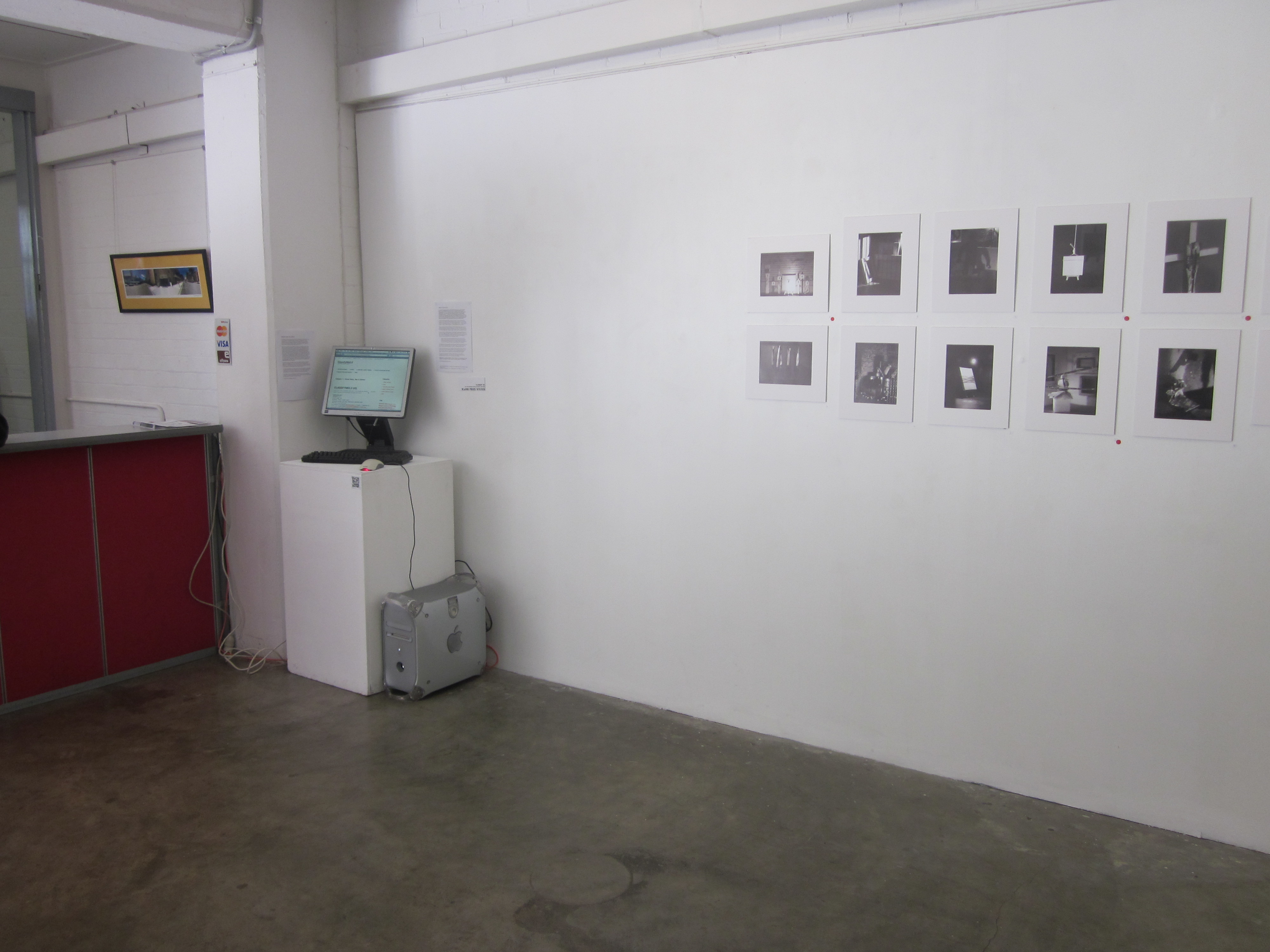
My thoroughly uncharismatic museum display for ClassifyMe2.0
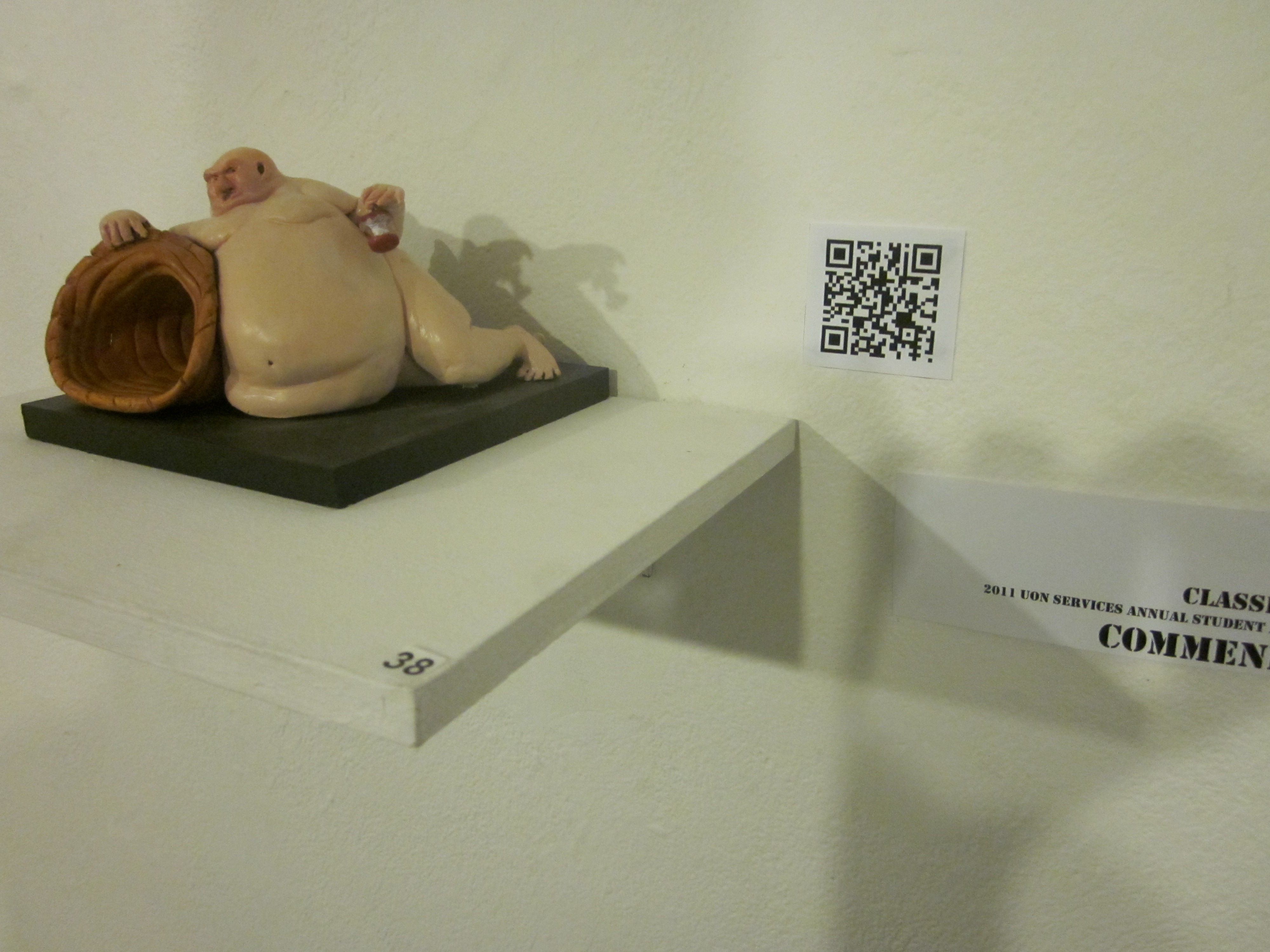
A QR code next to Too Much is Barely Enough by Theresa Purnell
And my favourite (unexpected) thing.

mining the museumgeek – meta-museology in the art show

You museumers have something to answer for! You’ve started getting into my head and disturbing my otherwise sane thoughts and now I’ve spent the last three days installing my first “meta-museological” experiment in my local student gallery.

Every year, my University Art Gallery holds an art prize focussed around a central theme. The exhibition usually passes me by, but this year the theme – Classify Me – caught my attention. The exhibition was premised on a political discussion that took place in Australia earlier this year, when a Senator called for all art to be classified prior to exhibition, in order that age limits (similar to restrictions placed on television) could be imposed. Tantamount to a call for censorship of the arts, it was something that Amy Hill – curator of the 2011 Prize – thought would make a great subject.

And she was right! The topic has garnered some great responses. However, my take on the subject was very different from that of the other participants.

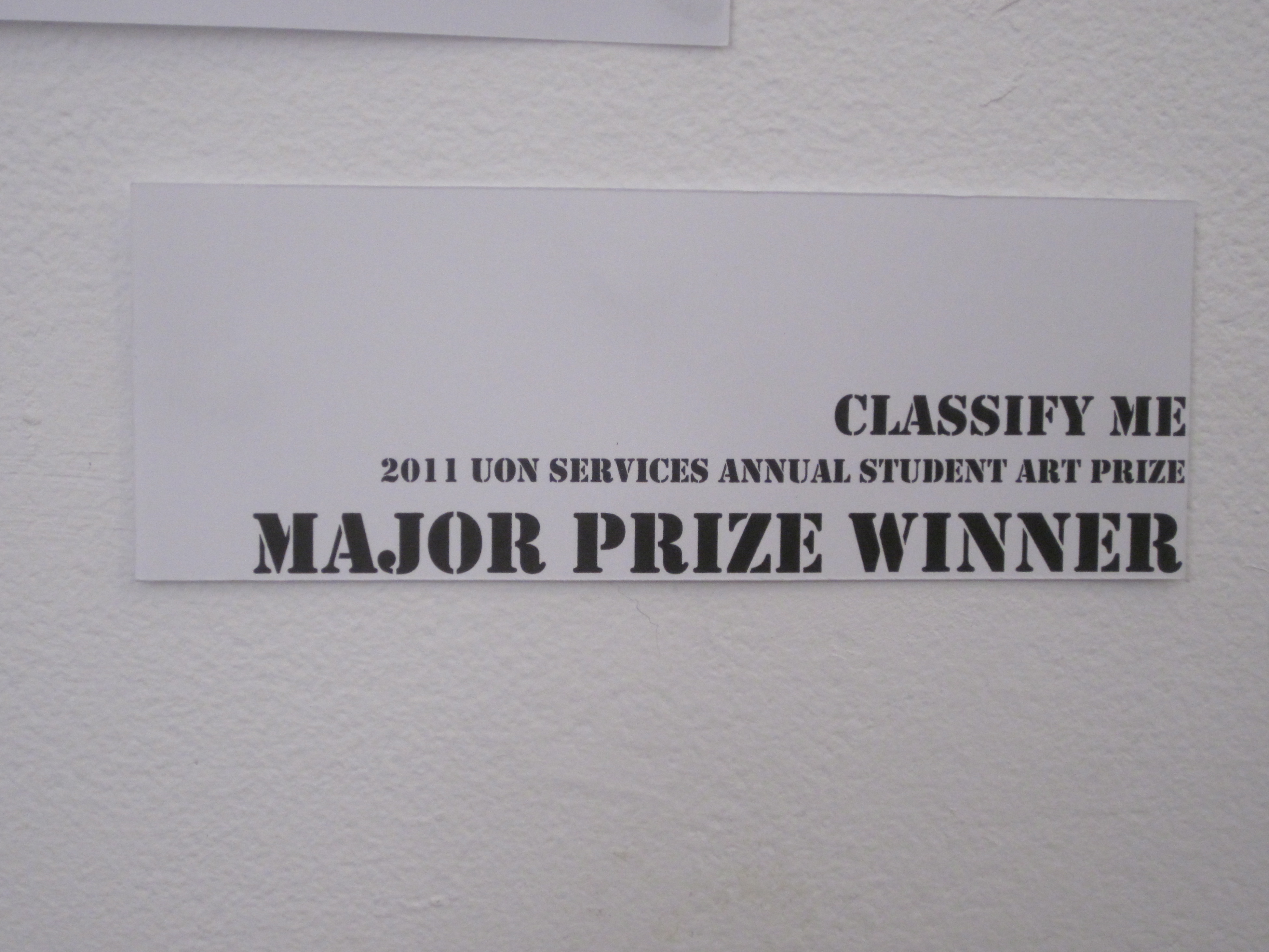
Calling my work Classify Me2.0, I conducted a museological exercise in which I “classified” every work of art in the exhibition according to the ICONCLASS classification system, and through tagging. I then uploaded all of my classifications to a website (the first I’d created!), which could be accessed via either a computer in the Gallery, or utilising proximate QR codes in situ with the works of art themselves.

It has been an incredibly interesting experiment.

First of all, I am not an expert at classification, and so my categorisation of works has been inexact at best. I was armed with very little information about the works themselves. I had not read any artist statements, and so I was only able to make the classification based on the appearance of the work, and its name. In some ways, this is different from the way objects would be classified within a museum – although it did reflect a situation in which a politically driven classification system might work, including some of the difficulties that might be encountered.

I expected that I would find the process of classification interesting, but I didn’t realise that it would significantly affect me. Classifying objects into categories that in no way reflected my feelings about the works was strangely emotive. Of particular note was a small bronze sculpture of a pregnant girl, with one foot shod in a ballet shoe (in a nod to Degas), and the other limb a silver prosthesis. It’s a beautiful sculpture – gentle and delicate. However, the prosthetic limb is the most outstanding element of the piece, which placed the work in the category 31AA4 disabilities, deformations and monstrosities; diseases – AA – female human figure.

It shocked me that something so lovely could be associated with such ugly concepts. Similarly stunning was the fact that disability was, and is, classed as a monstrosity in the classification system. The system is obviously derived from a particular historical art paradigm, but given that it is still used, the grouping together of such concepts is pretty dismal. More than anything else, classifying this work really brought home the fact that classification has no room for nuance.

The second aspect of this experiment that has been fascinating is the conversations that it has started.

During the classification process, the curatorial and installation team in the Gallery (mostly artists) would talk about what I was doing. Until I started classifying works actively in their presence, many had only ever thought about classification in context of censorship. Few were cognisant of the fact that museum objects are always categorised – whether by genre, materiality or era. They had never considered that classifications create proximal relationships between works that might be completely unrelated, and give works different meanings from those originally intended.

One member of the installation team was even concerned for me, worried that in creating this piece and categorising works like the dancer in particular ways (as honestly and fairly as possible) I would be opening myself up to hate in the local arts scene. Although it had crossed my mind that this piece could provoke some small reaction, I had not really considered that Classify Me2.0 could be really controversial.

And is still might not be. Most likely no one will blink. But even these conversations demonstrate that the classification of works of art – in public – has the potential to be very powerful.

Yesterday, too, I chatted to some exhibiting artists and discovered that a painting I had classified as 25G21(+1) fruits (+ plants used symbolically) based on first impressions was both that… and something else. What looked initially like a giant purple apple hanging upside down was also a painting of a well-disguised-but-instantly-obvious-once-you-know-it’s-there vulva. My classification of the object as a fruit was both accurate, and not. Yet to someone with access only to the ICONCLASS classification, this plurality of meanings would be lost.

So Classify Me2.0 has proved to be a great experiment. As a piece of art, it’s terrible. The in-gallery QR codes are inaccessible to audiences who don’t know what they are, or what to do with them (or who don’t own a smart phone). Because I’ve entered the work as part of a competitive art prize, I was not allowed to give too much explanation about the codes in the space (as it was thought to be disadvantageous to the other artists). Additionally, the computer upon which the Classify Me2.0 website is accessible is in an odd place in the Gallery, and people don’t seem to know how to interact with it. The website, too, has faults since it’s my first one. The design isn’t ideal, and the works of art are mis-ordered (because many works changed location between me classifying them and the final hang).

Yet as a conversation piece, and an experiment on the nature of classification, Classify Me2.0 has been incredibly successful. I’ve had rich and deep discussions with people about art and Museology – something that I hope will continue (I’ve approached the Curator and Director to see whether we can organise some kind of forum on classification in the Gallery within the coming weeks). And I’ve learned heaps from putting my ideas into practice in the real world.

The exhibition opens formally tonight, so I will keep you posted on any updates. But regardless, I hold you all accountable for starting me on this path.

Visit Classify Me2.0.
UPDATE: Well, apparently it turns out that Classify Me2.0 actually won the art prize. I wasn’t at the exhibition opening as I was on the train home from the Powerhouse Museum, but I just received a text from the curator, telling me I came first. I think the first prize is a $1500 travel scholarship – which will nicely pay for some of my flights to MCN2011. Um, I’m in a little shock right now.

Groupthink vs diversity (It’s the dorks that give it a real go)

When I was growing up, we moved around a lot. I was perpetually the new kid, and being an only child, this meant that I was also a bit of a loner. It wasn’t so much that I wanted to do things alone – I just struggled to meet people with whom I connected.

It’s a pretty common experience. Lots of kids, particularly those with a creative bent, struggle to find their niche. It is all too easy for children who didn’t grow up with the rest of the gang, or who don’t instantly gel with the group, to feel completely isolated – the freaks and geeks of society. This is not entirely a bad thing however. After all, as put so eloquently by Australian band TISM, in their ode to cricketer Glenn McGrath, “There’s never been a popular teenager yet who’s done rat’s with their life. Its the fucking dorks that give it a real go.” (Apologies for the swearing.) There is actually a lot to be gained by being an outlier; by being one of the kids who never fit in and who survived despite not running with the cool kids. You develop a bit of moxie.

Having said that, one of the coolest things about the Internet is its ability to connect us with like-minded folks. No longer do the dorks of the world need to exist in social isolation. Instead, they can find a community to belong to no matter where they are located. After all, prior to MW2011 I had never met a single person who cared about museum tech. Now, my life is filled with them.

But the thing is, when you only talk to people like yourself, your thoughts are never challenged. No one pulls you out of the crowd, and makes you back your opinions. No one teases you for being the freak disturbing the status quo.

And if we lose that, then who is going to come up with the amazing ideas and the paradigm-changing insights that only come from being the sole geek or the black sheep that never fit in???

This post from Michael Michalko on Psychologytoday.com outlines common thinking strategies of genius… and unsurprisingly, groupthink is not one. Instead Michalko notes that geniuses make novel combinations and force relationships; they think in opposites and prepare themselves for change – all of which is much more likely to occur if your knowledge is drawn from diverse sources. After all, many of the researchers – like Michel Foucault or Marshall McLuhan – whose work has made huge impact upon museum thinking have not been museologists, and it is their diversity of opinion and external insight that has forced new thoughts and considerations within the field.

So if we are now self-curating our worlds into smaller and smaller circles of like-minded people online, where will these innovative and often provocative thoughts come from?!?

One answer is the museum itself. Modern museums exist at least in part to educate the public, a role that equips them perfectly to take up the challenge of exploring contrasting ideas, and bringing novel combinations into effect. Rather than simply reinforcing people’s existing beliefs, curators and exhibitions coordinators can work to ensure the museum is a safe environment in which views can be presented that might clash with the visitor’s own assumptions. After all, simply coming into the museum space indicates that a visitor is open to new and potentially uncomfortable experiences, and that receptivity is an ideal starting place for the exploration of new thoughts.

But it would be great to be able to do the same thing online too, so that visitors to the museum website were not only able to find what they were looking for, but also enticed to look further at something that might challenge them. Can museum websites encourage creativity and new discovery, and get people to think about ideas that they would not normally be confronted with? Can a museum website actually stand in place for a physical museum as an affective device?

I’m don’t know the answers, but I do know that our lives are richer when we do not cushion ourselves away from difference simply because it’s uncomfortable. And with that in mind, I’m off to find someone new to follow on Twitter whose experiences and opinions do not match my own…

NB – This post was in part inspired by a conversation I had with Seb Chan the other day. Thanks Seb!

Newcastle Museum: A quick review

"Anti-war protestors" at the Newcastle Museum opening

Last week, my local museum reopened in a brand new location. The old museum had closed about 4 years ago in preparation of the redevelopment, so I was very exited to see the new museum. The new building, which cost $23.5 million and is the biggest project undertaken by Council in recent years, will house three permanent exhibitions as well as semi-permanent displays.

First impressions:
On opening weekend, the new museum was teaming with life. It’s located in some refurbished woolsheds only a couple of hundred metres back from the harbour, in an area that’s undergone significant new development in the past decade. The area is filled with restaurants, gyms, apartment complexes and people, and the new museum fits into its new home incredibly well – integrating the past and the future.

The museum had hired young actors to dress in historical garments for the opening, which instantly connected the new with the old, affirming the museum context. These living displays brought a very lively presence into the museum, which made for a great first impression.

My favourite caption!

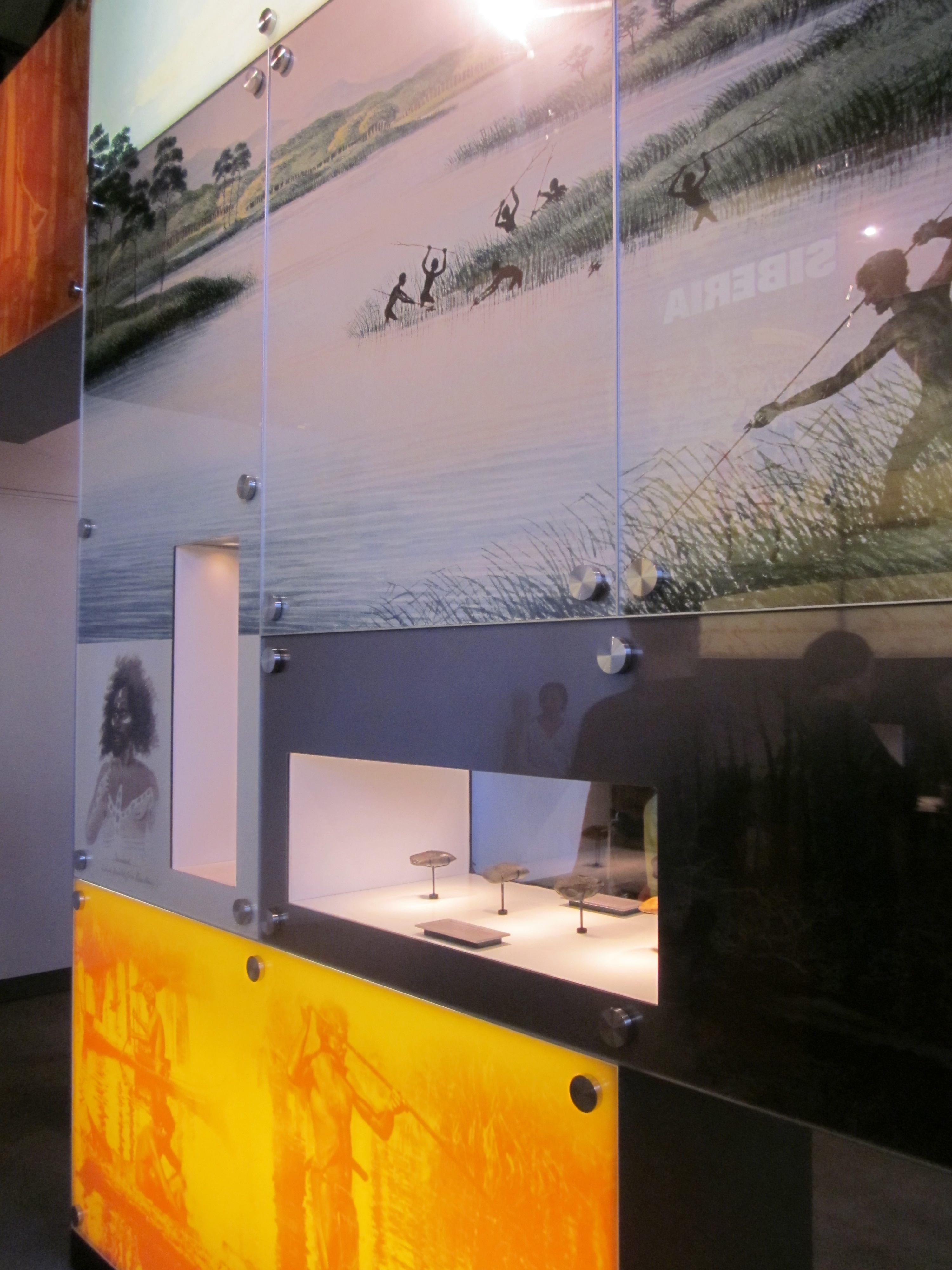
The new museum has a lot going for it. It uses colourful inbuilt wall displays to show images that give context to artefacts without requiring long periods of reading. It has a huge interactive kids exhibition as one of the three permanent spaces (the predecessor of which was my favourite thing at the old museum when I was a kid). TV screens have been incorporated into displays to show changing historical images, though I didn’t see any other real use of technology. I was only aware of one interactive display outside the kid’s area (and it was for kids too). There were no hands-on experiences for adults, which is a shame since I still want to touch things in the museum just as much as I did as a kid.

The museum has some cool objects – including an the old rusted Model T Ford, which was given contextualisation by text panel that explained a number of different interpretive premises for the object’s inclusion in the “Newcastle Story” exhibition (including one paragraph on ‘museological choices’, which is a little more meta and self-reflexive than most museum panels). The old car had wooden spokes for wheels, and still had a hand-written message scrawled in the dust on the dash. To me, it spoke of the history of technology and human nature all tied up in one artefact.

My other favourite object was a biscuit wrapped in cloth that had survived from the trenches of World War II. It was a hugely affective piece for me, because my mouth could immediately taste the biscuits, and my imagination grappled with thoughts of what living through the way might have been like. The bodily sensations that I experienced looking at that one object really affected me far more than other objects, which were simply pretty or interesting. My PhD supervisor Dr Kit Messham-Muir has done work on affect in museums, and wrote about this in a 2008 exhibition essay. He writes:

The physicality of objects and sites, their smells, tastes, textures and presence can trigger intense sensory memories. Importantly, sensory memory is different from the remembering of linear narratives; sensory memory involuntarily conjures vivid past events into the present.

This is absolutely what I felt when seeing the WWII biscuit.

Having said that, although some of the objects were pretty cool, there didn’t seem to be a lot of objects. Both my husband and I walked away feeling that we hadn’t really seen much. There was a big space, and it seemed like we should have had lots of exploring to do… but in a short time, we felt like we’d seen everything. Now, maybe that was the busy atmosphere, so we didn’t really take time to read all the panels and look at the displays with the depth we would have with fewer people in the museum. However, for all the prettiness of the displays, I wonder if there wasn’t a conscious choice on some level to use images instead of objects. If so, I would love to know the reason why. The large colour wall displays were great – but not at the expense of more tangible objects and stories. Pictures might seem more self-explanatory, and they can certainly add context… but I’m not sure that I respond to them as a replacement, instead of an addition.

Image-driven displays - pretty, but sadly lacking in objects

The new museum does have a very large external space that looks perfect for family outings and activities, and on the weekend it was brimming with laughing kids – so that’s a great start. Having chatted to the museum’s public programs officer a couple of weeks ago, I think they have grand plans for building the space into a very active part of Newcastle’s cultural life, which will be fantastic. But it will be interesting to see whether the museum’s emphasis on events can sustain it when its objects are fairly sparse.

How do you guys feel about museums that (seem to) put an emphasis on events/displays over objects? Are they sustainable? Effective? It seems to me that this will be able to bring a sense of life to history – but maybe not the same sense of connection… But that’s an intuitive answer, and I’d love to hear of people’s actual experiences of this split between the two.

And you never know – when I go back to the museum on a day that’s less frantic, I might have a different impression. But my first sense of the place is that it’s fresh and active – just with fewer artefacts than I expected, and maybe that I would have liked. The experience has made me realise just how much I do love/want objects in my museums.

‘Knowledge is power, but secret knowledge is also power.’

I came across the title for this post in the comments section of an article discussing the recent releasing of JSTOR academic documents by Aaron Swartz, where fred_bauder writes: Knowledge is power, but secret knowledge is also power.

It’s an interesting sentiment. Around the time of the wikileaks US diplomatic cables leak I remember reading an article about privacy in this age where the author asserted that the only way that people could now guarantee that secrets would be kept secret was to ensure they were never recorded or written down; that governments, businesses and individuals could all now be called accountable for everything ever committed to paper/email/device. In some ways, this has always been true… people have always been held accountable by what was recorded – be it on paper or tape – but things are publishable now with renewed vigor and ease, and that changes the game somewhat. The relationship between secrecy and power seems to be shifting.

Shortly after the wikileaks scandal, I had a conversation with a psychiatrist about the implications of the above, and he mentioned that for similar reasons he no longer records (non-critical) material in someone’s files that could one day be used against them. He no longer trusts in the sanctity of the files, because there is the possibility that with time, anything recorded could become public (if in doubt, check out this article about the Mug-Shot Industry [That] Will Dig Up Your Past, Charge You to Bury It Again).

Knowledge is power, but secret knowledge is also power…

So why do I think this is important for museums? As museums put their collections online, they may be held newly accountable for what is and is not recorded within them. The public may (if they choose to look) become aware of ways in which museum records are incomplete, or even contain information that has been shown to be false since it was initially written down. This is not necessarily a negative thing. As Seb Chan noted in his MW2007 paper Tagging and Searching – Serendipity and museum collection databases on the Powerhouse Museum’s OPAC2:

the exposure of these records, and their increased searchability, especially through Google, has led to the Museum receiving additional contextual information about objects, or corrections to research. Sometimes this additional information comes from international experts, collectors and researchers, but at other times, as was the case with a convict love token, it comes through community members researching their family histories – and simply searching for a series of family names in Google.

But it is indicative of the fact that as museum collection documentation becomes available online, it is open to new scrutiny.

Paradoxically, this openness does little to challenge the fact that museums are, and have always been, secret societies filled with people who have special knowledge about the objects in the collection that not everyone is privy to. In their earliest iterations, museums were places for philosophical societies to meet, serving as a locus for research about the world. Even once museums became public institutions, the aim was to teach those without knowledge about the world and the collection. However, there is always a power imbalance between those with knowledge (and power) and those without it. All knowledge is secret knowledge if it is not freely and fairly available to all parties, and to some extent this is precisely where museum power is drawn from.

Museum knowledge is stored not only in our artefacts and documentation but importantly also in our people. We speak in secret languages (taxonomies) and have often-silent rules of accepted and acceptable behaviour that can be daunting to the ‘uninitiated’ (a term which is itself loaded with implications). Museum power is not in the things that have been committed to print – it’s in the knowledge of staff and their intuitive understanding of objects and collections. It’s in the judgements made when curating exhibitions. It’s in all the silent things that can never be fully recorded.

Julia Noordegraaf, in her book Strategies of Display: Museum Presentation in Nineteenth- and Twentieth-Century Visual Culture, writes about a similar schism that occurred in museum display in the nineteenth century. She writes (emphasis mine):

There is a paradox in the fact that most nineteenth-century museums were designed to accommodate large groups of visitors, while at the same time provided little information about the objects on display. Whereas the museum was thought to be a civilising and cultivating institution, its presentation was aimed at people who could find their own way through it and could interpret the objects on display by themselves. According to James Sheehan, this tension between the general and the exclusive lay at the code of nineteenth-century culture and society, ‘[…] the tension between the aspiration to have institutions that would be open to everyone and the structural inequalities that made these institutions inaccessible to all but a minority of the population.’

The paradox can perhaps be explained from the fact that in the nineteenth century, museums were conceived as places as much for the research or the advancement of knowledge as for popular instruction or the diffusion of knowledge. Until the end of the century, when museum innovators like Henry Flower recognised the need for different types of display for these different aims, museums were trying to fulfil both aims with one and the same type of display. It seems that in the nineteenth century, museum managers designed the script of museum presentation from the idea that educating the people simply meant opening the museum doors to everyone.[1]

Museums may be opening the virtual doors to their collections to everyone. However, this doesn’t mean that the audience is equipped with the same knowledge as the museum curator or educator. Even with digital openness, museums still have secret knowledge – and secret knowledge is also power.


[1] Julia Noordegraaf, “Strategies of Display: Museum Presentation in Nineteenth- and Twentieth-Century Visual Culture,” ed. Museum Boijmans Van Beuningen Rotterdam (Rotterdam: NAI Publishers, 2004). 80. Noordegraaf quotes from Sheehan: Museums in the German Art World 2000: 115.

There is a man behind the curtain

In a couple of weeks, I’m giving one of my first ever lectures. The subject is Museums, Galleries and the Politics of Institutions, which is a thoroughly juicy and exciting topic. Colour me excited!

I’ve just started ‘building’ my lecture, but already I’ve had an unexpected realisation about both teaching and museums. Until now, it’s never really occurred to me the extent to which every class I’ve ever attended, and every museum I’ve ever visited, constructs the information and stories within. The message is not just built around what is important to say, but also on what will fit within the limitations of time and space; on what will make a compelling story; and on the personal whims and preferences of the information architect.

This observation is so obvious, I don’t quite understand how it hasn’t smacked me square in the jaw before. As much as I’ve ‘known’ that museums can never tell ‘truth’ since every story has innumerable sides, the reality of that situation had never occurred to me so starkly until I had to create a lecture on the subject.

You see, I want to give the students insight into the historical development of museums; to educate them about (some of) the myriad of ways that the choices made in museums are political; to equip them to start seeing museums and exhibitions through critical eyes; and, ideally, to inspire them and capture their imaginations. And I’ve only got an hour in which to achieve all this.

It’s a big ask. Due to the time limits, I will obviously have to leave out far more than I can include, and the things that I do decide to include will be those that are both relevant/important and that reinforce the narrative direction I decide to construct.

And that’s the kicker. The information that makes the cut will be the information that best helps me tell a compelling story – one that is logical, and memorable, and in which the whole is greater than the sum of its parts. The examples I use in the lecture will not necessarily be the most critical – they will be the ones that best help make my argument. I’ve looked at the examples used by the lecturer who gave the course last year, and they are entirely different from my choices. He and I used the same subject as a starting point, but each of us constructed a very different lecture – and a different story.

Yet most students will probably hear my lecture and believe that the information I give them is the canonical stuff that they need to know, simply because of the forum in which it is presented. In choosing works of art to focus on, I will be privileging those works and artists simply by drawing attention to them in the context of a lecture. It is a great responsibility. If I choose (intentionally or by neglect) only to talk about works of art by men, or European artists, or painters and sculptors but leave out video artists, then I too am guilty of neglecting to present a whole perspective about the subject… and yet I will have to make said choices because of the limitations of time. Therefore, my lecture is every bit as political as its focus.

Curators too are faced with these difficult choices. It is never possible to include everything when constructing an exhibition. Doing so would probably make the exhibition less clear and less impactful. But visitors don’t necessarily consider this. Most visitors will accept at face value that what is included is there because it was the most deserving – not because it best illustrated a point, or was the only appropriate work in the museum collection. This is precisely why museums are such political institutions.

I have known this at some theoretical level for years. I’ve taken dozens of courses at University and worked in museums for a little while. But it was not until constructing my own lecture on a subject that is so open-ended, with many possible paths that the journey could take, that I gained real insight into the extent that my own knowledge has been constructed around the ‘curatorial’ choices of my teachers. It’s been fascinating.

I think we have a responsibility when teaching people about history – or anything – to provide them with a story that is clear and legible. Without that, they are unlikely to learn at all. But I also think that we as teachers – whether in universities or in museums – have a responsibility to remind people that what we select for such a purpose is not the be all and end all of knowledge, and that the lecture or the exhibition is a great starting point but it should not be the final destination.

And I think this is the ultimate message that I am hope to get across to the students. I am going to use the process of constructing a lecture as a metaphor for the process of constructing an exhibition, and show them that there is a real person behind the choices that get made – and that those choices have real meaning. Thus, I think I will finish my lecture with a statement like this:

This lecture, like a museum exhibition and like every lecture you’ve ever sat in, does not tell the truth, the whole truth and nothing but the truth.
It weaves one story of the history of museums. It leaves out more than it includes.
It is not neutral. It is never neutral.

I hope they get the point.

Thoughts on the closure of the Dutch Museum of National History

My first guest geek Jasper Visser (don’t worry – there’s another geek speak coming soon) has just announced on his blog that his museum – the Dutch Museum of National History (INNL) – will no longer operate from 1 January 2012, following the announcement of funding cuts by Netherlands’ secretary of state responsible for culture.

This is a terribly disappointing – although not entirely surprising – thing to have happened. When I first met Jasper at MW2011, I spoke to him a little bit about the INNL network – the museum website that won the Best of the Web award for innovation – and at the time, he mentioned that it was possible that his institution could close at any time. I dismissed the possibility… coming from Australia, where our politicians are generally fairly centrist in action if not always in rhetoric, I didn’t really take seriously the threat that someone might close such an interesting and innovative project for seemingly political reasons.** And yet only months later, here we are.

A few weeks ago, I was talking to Seb about the INNL and he remarked how vulnerable it was, being a national museum in a politically unstable country, and moreso being a museum without objects. And its true. After all, our very concept of what a museum is and should be is grounded in the fact that museums are the places that house objects. In Cabinets for the Curious: Looking Back at Early English Museums, Ken Arnold writes (p4) that early museums had three strategies for creating knowledge, being “the telling of stories, the use of objects, and the imposition of order upon them.” The INNL did use objects – like the National Vending Machine, or selected objects through which stories could be told – but it did not house a permanent collection. Instead, it sought to excite people about Dutch national history through stories and projects. And with concepts like “The ‘Land of What If’, a room with alternative Dutch histories”, no wonder it was vulnerable at a time when cultural institutions were threatened by politics.

Despite – and possibly because of – its short life, the INNL raises lots of questions for me about the nature of museums, and what a museum is and should be. Can a museum preserve the past without objects? Does the provenance of a museum come from the provenance of its objects, or its people?

As much as I love and am captured by the ideas behind the INNL, I wonder whether it was always going to be a time-limited project. Reading the vision of the project, I always feel inspired – but without objects, a museum of this nature can only ever be as successful as the people who are behind it, and it is likely that with time and staff changes, a sense of inertia would gain hold.

Yet the fact that it was (or appeared to be) successful during its short life should absolutely inspire those of us working in museums with exhibits to consider how we too could excite people about what we do if we didn’t have our objects to rely on – if we were forced to find new and more creative ways to tell stories.

In the mean time, I’m not sure what Jasper plans to do – or if he will stick around in this field… He has something of the entrepreneurial/world changing spirit about him and I imagine he might want to move on. But I look forward to seeing what he turns his hand to next.

**NB: I’ve recently learned that funding has been cut for This is Not Art – an arts festival that runs annually in my home town. This year might be the first year in over a decade that it doesn’t run, and I am fairly sure that the reasons behind this are political as well… so maybe even in Aust, culture is never safe from politics.

New(castle) directions

My local museum has been closed for the last couple of years whilst undertaking a major move to a new site. Excitingly, it is almost ready to reopen in a new location, with new permanent exhibitions that should better showcase the region’s local history.

As a result, there have been a number of new positions advertised at the museum, but the most interesting one has just been announced… the museum needs a new Director! The current Director is retiring, and so Newcastle City Council is advertising for “an experienced operator to lead and guide the direction of the New Museum. Not just anyone, we need an ideas person. Someone who can visualise and implement. Someone who understands how a Museum operates at all levels.”

So first up, if you are (or know) someone amazing who would be great at this job, then (get them to) apply! With a new museum to play with, this could be a really interesting opportunity for the right person.

Having said that, I’m guessing that the right person is not going to be from Newcastle. One of the biggest challenges about living in this city (and I would guess, in any regional town) is that opportunities for career growth in the arts are pretty limited – and so most of the people who end up in high-end positions in our cultural institutions generally come from outside the city (and vice versa – most people have to leave to build their arts careers). Even the position selection criteria seems to imply for this, stating that applicants should have “Substantial experience in a Museum leadership capacity and demonstrated capacity to lead a small multidisciplinary Museum team” – something next to impossible to get within local area.

Yet today I was reading the AAM’s 2002 publication Mastering Civic Engagement: A Challenge to Museums. Ellen Hirzy’s report (p9) opens with the statement:

Every museum has a deeply rooted connection with its community that is uniquely its own. However far reaching its collections and scholarship or the diversity of its audiences, a museum’s particular community context anchors it, revitalizes its mission and sense of purpose, and enriches its understanding of what is possible to accomplish.

I can’t help thinking about how challenging the first months must be for a new director at a museum – particularly a local history museum – as an outsider. Not only does he or she have to try to establish him/herself in a new position, possibly within a new town, but he/she must also try to negotiate the ‘deeply rooted connection’ that the museum has with its community. Sounds like a big ask – but an interesting one. So here’s hoping that someone out there wants to come and lead at our New(castle) museum.

Who owns the virtual space in your museum?

Yesterday I crashed my first ever ARDevCamp @ the Powerhouse Museum. Despite being late (buses do not replace trains very effectively) and missing some of the morning talks, the afternoon provided plenty of inspiration and lots of think about. True to form, I used my spidey senses to find some incredibly interesting people to sit next to, and got into some great conversations – some of which will no doubt inform this blog over the next few days.

One of the most interesting questions that arose at the Camp was about digital space and augmented reality (AR). Rob Manson from Mob Labs spoke a bit about the question of who owns the digital space – an issue that will no doubt become more important as more companies and individuals start tapping into the AR potential, particularly for advertising (if this stuff interests you, it’s worth reading this article on Mashable). But it’s also an interesting question for museums to think about.

Last October Sander Veenhof and Mark Skwarek staged a guerrilla AR intervention at MoMA as part of the Conflux Psychogeoraphy festival. The exhibition not only took over the current six floors of MoMA, it created an AR sculpture garden on the “seventh” floor. Check out the video for a sense of the event.

WeARinMoMA seems more akin to performance art than anything else, in part because of the time-limited nature of the performance. But I’m interested in how museums – and I’m probably thinking about art museums in particular – would deal with more of these kinds of interventions. What if Sander Veenhof and Mark Skwarek decided that they wanted their exhibition to be permanent?

The Stuckists (talking about the Tate) argue that:

An act by an individual which interferes with an existing artwork is termed an “intervention” and the individual termed an “artist” if they are endorsed by a Tate curator or are dead. The same, or similar, act by an individual interfering with the same artwork (or even interfering with the interference to the artwork), if they are alive and are not endorsed by a Tate curator, is termed “vandalism”, and the individual termed a “criminal”.

So what would happen if someone painted an AR beard on the Mona Lisa? Would the Louvre try to prevent the intervention for being vandalism? It does not harm or interfere with the actual work, although may impact upon its interpretation. Could an artist be prosecuted for digital vandalism?

Or conversely, would the AR addition to the painting be recognised as an important part of the painting’s provenance? Could visitors delight in seeing the painting through another artist’s eyes, and comparing that to the original then and there? Would the interpretation be documented and preserved in the artist file? And how would it be done? Would there simply be videos and photos as per a performance, or would the documentation include recording lines of code as well? Could the AR art be collected, and if so, how? Does the long tail of this end with a curator of AR in the museum?

This guy floated over the Powerhouse @ ARDevCampSyd

The AR might not only take place within the Gallery. Yesterday a giant virtual Lego man stood above the Powerhouse Museum, welcoming visitors to ARDevCamp. This could be a great way for museums seeking redevelopment funding to get people enthused about the project, by projecting the architectural models over the physical building.

But what if the layer had been promoting a commercial product instead? While I can see all kinds of awesome applications for this for artists seeking a little notoriety (like emblazoning their own name on the wall of a Gallery), they might not be the only ones interested in claiming the digital space around museums and galleries. What if Coke decided to as well? Or a political party?

Of course, these are all hypothetical situations and will likely never eventuate. The questions that arise out of real world AR interventions in digital space are likely to be far more nuanced – and far more interesting. But these questions demonstrate just how little we can prepare to respond to technology until we know how it’s actually utilised. While the legal and ethical debates around these issues might be fun to think about, it won’t be until there are cases actually in the courts that the actual implications will become clear. After all, laws are made in response to actual events not hypothetical ones, and individual cases often require individual responses. But until then, it’s interesting to consider just who owns the virtual space in your museum – and around it.