Museum objects and complexity

Being in the first six months of my PhD, I am still in the reading/learning/planning stages of my research. This means that I’m spending a lot of time looking at how other people have been approaching the field, and I’ve noticed a number of people working in the museum technology area are utilising complexity theory to inform their work (see Fiona Cameron and Sarah Mengler Complexity, Transdisciplinarity and Museum Collections Documentation: Emergent Metaphors for a Complex World from the Journal of Material Culture 2009 for an example).

My initial reading into the area has led me to some interesting thoughts. According to John H. Miller and Scott E. Page, one of the things that makes a system complex, rather than merely complicated, is that the system cannot be reduced to a simple form for study. They illustrate the point, using the following example:

When a scientist faces a complicated world, traditional tools that rely on reducing the system to its atomic elements allow us to gain insight. Unfortunately, using these same tools to understand complex worlds fails, because it becomes impossible to reduce the system without killing it. The ability to collect and pin to a board all of the insects that live in the garden does little to lend insight into the ecosystem contained therein.
Miller, John H. & Scott E. Page (2007), Complex Adaptive Systems: An Introduction to Computational Models of Social Life, Princeton University Press. p10.

It strikes me that this is an interesting metaphor for the museum collection too. Early museum collections were precisely about reducing things to their elements, so that they could be better studied and understood. Ken Arnold succinctly makes this point in his book Cabinets for the Curious: Looking Back at Early English Museums, when he writes: “… it was the museum’s walls that signalled their defining function: they kept the objects in, whilst simultaneously keeping out other distractions” (Arnold, 5). The museum utilised its walls to isolate, so that the objects held within were able to be studied in a very limited and controlled context. They were liberated from the complex systems within which they originally functioned so we could better understand them as objects.

This might seem almost self-evident when thinking about natural history or science museums, but it’s equally true of art museums. When we remove a work of art from its social environment – from the political and cultural context in which it was created – we isolate that work of art, and put it into a very limited and prescribed context, based on a fairly limited view of art history. Curatorial statements attempt to describe some of the context within which the work was created, but we have still removed the art from its complex system, and isolated it for preservation and study. In doing so, we remove some of the plurality of the work’s meaning, but make it more directly comparable with other collected works within the museum taxonomy. Arnold writes, “taxonomy and classification have for almost three centuries been the most powerful way by which knowledge has been created and then reinterpreted within museums” (Arnold, 243) and this isolation for comparative purposes has been a key aspect of this.

Conversely, the Internet is a complex adaptive system. Therefore when we upload museum collections and allow people to interact with them in new ways, we are actually trying to reinsert our previously isolated objects back into a highly complex system. This is a critical reversal in the way we think about our objects and collections. For possibly the first time, the objects in our collection are not being sequestered away from the world and hidden within the safe space of the museum. Instead, we must now try to reposition those objects and collections within the broad context of the Internet, and indeed, the whole world. No wonder the sector is struggling with how best to cope with this change. Not only are we inviting the public to interact with our collections in ways that have previously been impossible, we are asking the objects in our collection to take their place in a complex environment from which they have previously been quarantined.

Deaccessioning friends and Intel’s “Museum of Me”

A glib exchange on Twitter this morning left a far greater impression on me than it should have when Bruce Wyman tweeted about Intel’s new Museum of Me. In what was almost certainly trolling, Bruce mentioned his appreciation for the MoM and I couldn’t help but take the bait. My reply touched on the fact that the MoM makes poor choices in deciding which friends to highlight in it’s so-called “journey of a visualization that explores who I am”, to which Bruce replied:

This response, strangely reminiscent of something from The Importance of Being Earnest, stuck with me and gnawed at the edges of my brain. Was Bruce right? Should I start deaccessioning my friends until the MoM became more accurate? The Museum’s multimedia display was strangely lacking too where I’d failed to input data about my favourite tv shows and movies. Should I work harder to fill in the gaps in the digital collection of my life, to ensure that my exhibition stayed up-to-date with all the latest trends? I started to consider that maybe I needed a collections management policy for the digital me.

I’m sure by now you can see why I was concerned. It’s not that the MoM is a soulless and narcissistic paean to the culture of me-ism. It’s that its ‘me’ is wrong. It’s cobbled together from the leftover remnants of digital interactions, the little communicative gifts bestowed on my facebook page. And in some ways, that means that it’s just like a real museum collection. After all, museums frequently begin with an act of benefaction – a gift to a city or a university from a private citizen whose personal collecting biases inform that collection for perpetuity. Further gifts will continue to shape the collection, and so-called gaps are often only filled when their absence becomes prominent. And so although I can probably shape the message of the MoM to make it more indicative of who I am, it will take quite a bit work and there are limitations… after all, explaining to my friends that I have to deaccession them so that my MoM collection more fully reflects who I am might be a little tough. Though they might understand the problem because no doubt they all have their own MoM too.

Of course, if I was to look at each of their MoM, I’d probably be in for a fairly cold experience. By necessity (let’s be honest, it is just a quirky marketing ploy) the MoM takes a one-size-fits all approach to exhibition design and collection management. The gallery space isn’t exactly tailored to different people with different interests, needs and wants, so it’s no surprise that it can’t be all things to all people. And even more critically, without the memories and stories of my friends to animate their MoM, any pleasure that could be derived from the experience would be superficial at best.

The whole MoM experience reminds me of this post on the Interactive blog. Regan Forrest writes of her experiences preparing design proposals, and says that many of the stock portfolio images:

depicted beautifully finished, perfectly lit, crisp, clean . . . empty spaces. This wasn’t necessarily a bad thing for projects where the aesthetic was a big part of the whole point (fine art exhibitions for instance). But I felt they really sold interactive spaces short – even the most interactive and engaging exhibition in the world looks sterile and passive without visitors there to breathe life into it.

Which is the very point. The MoM ultimately fails for me because it is nothing more than a sterile approximation at representation, but it’s still worth thinking about for the perspective it brings.

geek speak with Jasper Visser

This is the first in a series of guest posts on museumgeek in which I’ll be asking fellow culturegeeks to share how they ended up working in museum tech.

Most people I’ve met in this sector have interesting – and divergent – backgrounds. I love hearing their stories, and thought it might be sweet to capture and share some of them. Doing so will hopefully give newcomers to the field a sense of the myriad of ways that they can break into it, and should also – over time – paint a pretty cool narrative about just who it is that museum tech attracts, and why.

Hopefully you’ll enjoy the series. We’re kicking off with a great story from Jasper Visser from the Museum of National History of the Netherlands that thoroughly captures what I was hoping to with the project. In the coming months I’ll try to get a variety of interesting people to contribute, but if there is someone you’d like to hear from, let me know and I’ll do what I can to track them down and persuade them to post.


How I got here – Jasper Visser

Jasper Visser at Museum Next 2011

Okay, so I’ve got one of the best jobs in the world. Probably the best job in the world. And when people ask me how I got this job, I usually summarize my answer as “luck”. I guess I’m lucky to be part of an ambitious team building a museum with the audacious goal to be truly innovative in every way. To be working on media and tech within this whirlwind of change, especially, is most exhilarating.

But I guess “luck” won’t do for an answer to Susan’s question of how I got to have this job.

My background is diverse. Around the age of 15 I spent entire days building video games with Klik and Play. Also, I took my first steps in web development. This was the time when frames were still totally OK and I had a blast building complex structures. Around 1997 I even built a sort of social network but gave up because I didn’t believe in the concept. If only…

Anyway, university was a drag. I studied a couple of things, but didn’t really like any of it. Only a minor in international development studies got me enthusiastic. So I worked for a while on designing workshops about energy, gender and the Millennium Development Goals for the bigger development organisations. I guess I could have would have (should have) gone to DC for the World Bank if I hadn’t spent a couple of months in the field and liked that better than air-conditioned offices.

Through a campaign for youth representative for the United Nations I met a great number of wonderful people working on social innovation. They changed my life and taught me that non-conformism is a strength, not a phase to get through (as society tends to think about it, “Ay, one day you’ll get a decent job, finish your studies and pop out 1.7 kids”). It resulted in me being rather poor for a while until I found a job as a project assistant for the social aspirations of a consultancy firm.

They introduced me to the books of Jim Collins, in particular Good to Great which has been a guiding book in my life ever since. Although it’s written for business, I think its lessons apply directly to people’s private lives as well. The book and the firm helped me to develop a view on what I want to achieve in my life. In short, I want to make a positive contribution to intercultural understanding and social innovation, using the skills I’ve been given as a connector, inspirator and (hard) worker. Whatever you want to be, if you want to live a life that’s more than just good, read Jim Collins’ book and translate it into action.

Late in 2007 life led me to Madrid, where I became a teacher of the English language and a freelance designer/web developer. Often I barely made ends meet but the experience of living abroad and truly trying to become part of another culture was wonderful. I spent almost two years in the city, becoming half Spanish and a great fan of everything from Rioja to bullfighting. Then, I moved back to the motherland and through a friend was introduced to the people working for the freshly started Museum of National History.

Job interview, enthusiasm, work. That’s how I came to work in museums and tech. It wasn’t planned, although upon leaving Spain I had put “museums” on my list as a place where I would like to work to gain experience. I added “e.g. communications” as I had no idea museums did tech. How quickly I learned… In university I used to call people with great jobs to ask how they got there. I wanted to know what I had to do. Their almost universal answer, “Grab every opportunity to learn and move forward.” I cannot but full-heartedly agree with that now.

Jasper is project manager new technology and media at the Museum of National History of the Netherlands. Together with the team he’s responsible for the new media strategy, (online) participation, community building and online communication. Jasper is passionate about connecting people with culture, society and each other and likes coffee, Spain and Lady Gaga. He writes about innovation in museums on his blog themuseumofthefuture.com.

On creative risks and PhD blogging

Nina Simon has just written a post entitled Empowering Staff to Take Creative Risks in which she asks “What are you willing to risk to pursue your dreams?” It’s a somewhat timely post for me, because I am stuck deliberating on the role of blogging for me in the PhD process.

Yesterday I drafted a new blog post which I think poses an interesting perspective on moving museum collections to the Internet. Only in its fledgling stage, the idea is probably not particularly groundbreaking – but I think it has the potential to be developed further and it could be relevant to my PhD. And suddenly I find myself stuck as to whether to put it – and other PhD thoughts – online or not.

I’ve asked my supervisors for their thoughts, as well as asking an open question on Facebook and Twitter about what academics think of the issue. The responses have been mixed. Some have said they couldn’t imagine it being a problem, some have warned against the risk that someone would steal my ideas, and one friend pointed out the possible intricacies involved with people posting ideas in comments, and how difficult attribution might be if my ideas were later informed by discussion that took place online.

And so when I read Nina Simon’s post, it made me question precisely what I am willing to risk in the pursuit of my ideas and my career. This blog has become an interesting vehicle for me. Although it has only been up and running for a few weeks, I’ve had quite a few people contact me because of it, and have started some interesting conversations as a result. It is letting me make some interesting new professional (and personal) contacts, and has helped ensure that my mind never completely switches off thinking about the field, because I’m always on the look out for something new to post about.

But until now I have never actually wanted to post thoughts that might later be important to my research. Doing so could be a risk. Someone could indeed steal my ideas without attribution. Having said that, just starting a public blog and putting my ideas – mostly half-formed and in need of work around the edges – into the blogosphere carries with it certain risks. But ultimately, I think that hiding away from criticism and the opportunity to fall flat on my face would be worse. After all, the things that appear safe in life often aren’t. Seth Godin wrote recently on ‘exceptional’ brands, and why they fail:

The problem with brand exceptionalism is that once you believe it, it’s almost impossible to innovate. Innovation involves failure, which an exceptional brand shouldn’t do, and the only reason to endure failure is to get ahead, which you don’t need to do. Because you’re exceptional.

The take home message from both Seth’s and Nina’s posts is that pursuing big things – like dreams, careers and in the case of museums, innovation – is risky, and that risks bring with them real opportunities for failure. But that it’s only by being open to failure that really interesting things happen.

Does this mean that I will upload the post I drafted yesterday? I haven’t yet decided, and will seek further advice first. Though unless anyone can give me a compelling reason not to, I probably will. If someone steals my ideas, at least that means they were worth stealing (is this a Web2.0 attitude?).

In the mean time, I’d love to hear from anyone else who is or has been in a similar situation on what they decided to do. I know that a lot of museum bloggers are also research students, so surely this is something other people have grappled with too.

The New West: Museum frontier towns

As I watched the MuseumNext tweets roll through this week, it occurred to me that one of the things that draws me to this profession is the optimism and idealism that seem to exist within it. Every conversation, every 140-word tweet, seems to ask how we can encourage innovation, participation and the opening up and expanding of knowledge. When I read blogs from the field, I feel that I read the words of visionaries, explorers and philosophers.

Given that we are setting out to conquer previously unexplored territory, this is probably not surprising (nb: I’d be interested in whether some key personality types – maybe adventurers/explorers – are disproportionately found this field… something to consider further). I wonder if this same sense of cooperation and excitement is true across all areas of technological development… the Internet has brought with it so many opportunities for connecting like-minded souls and bringing minds together in conversation that this sense of community and common purpose cannot be unique to this sector. After all, who doesn’t love discovering that they aren’t the only person obsessed with knitting sweaters for their cat?!? In this climate, it truly doesn’t surprise me that now is when the privately-funded space race is taking off.

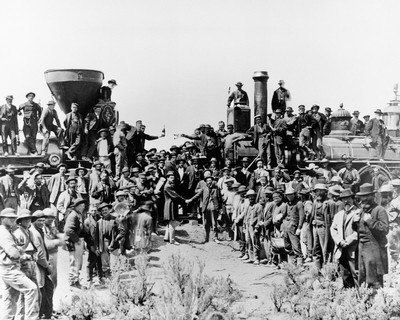
Koven’s Ignite speech likened museum websites to Conestoga wagons in an age of the automobile. Yet in many ways we are still living in technological frontier towns. We don’t have cars yet because we haven’t yet built the paved roads that could accommodate them. But when I read about the innovations that are already happening in our field, I am sure that it won’t be too long before we have created the equivalent of the transcontinental railroad. People in the field seem willing to share both their successes and their hard-won lessons and there is an almost ennobling sense of purpose in the pursuit of new and better ways forward.

Having said that, as exciting as these movements forward are for those of us exploring this undiscovered territory, we have to ensure that we don’t forget to communicate our journey to those back home in the ‘old country’. Being on the precipice of a new and unshaped world might be exciting, but for those who aren’t part of the journey uncertainty breeds fear. It’s no surprise that in many museums, this interactive world of digital technology might cause consternation. Any adventure into undiscovered territory brings with it a sense of risk and fear. And so it is the responsibility of those who are making new paths through the digital wilderness to map those paths, and show the people who will follow that the way ahead is safe.

The Transcontinental Railroad comes together

Visualising the museum collection

I’ve been thinking today about how we visualise knowledge and information.

Since 1735 – when Carolus Linneas first published Systema Naturae  – we have relied on tree-like hierarchical classification schemes to define and enunciate the similarities and differences between things. These strict binary classifications provide us with an incredibly useful and logical way of relating objects to one another, and organising that information.

But in 2005, David Weinberger asked (PDF) (emphasis mine):

Without trees, how would we organize college curricula, business org charts, the local library, and the order of species? How will we organize knowledge itself?

It’s an interesting question. Weinberger’s piece, entitled Taxonomies to Tags: From trees to piles of leaves, examined social tagging and suggested that it provided the possibility of a new form of classification (one that is, it must be noted, unsystematic). He wrote:

Tags are a break from previous ways of categorizing. Both trees and faceted systems specify the categories, or facets, ahead of time. They both present users with tree-like structures for navigation, letting us climb down branches to get to the leaf we’re looking for. Tagging instead creates piles of leaves in the hope that someone will figure out ways of putting them to use – perhaps by hanging them on trees, but perhaps creating other useful ways of sorting, categorizing and arranging them.

Weinberger’s way of looking at the descriptions we attach to objects acknowledges that there can be multiple relationships between things, each of which can be meaningful in their interpretation. At first glance, it seems much more akin to the information experience online, into which people can jump in at any single point, and follow an unfixed and continually unfolding journey to any other point. But while we can dive straight into a pile of leaves and reconfigure them in countless ways, it probably still helps to know what trees they fell from to understand whether you are rolling around in a pile of poison ivy.

However, where Weinberger’s piece is interesting to me is that it starts me thinking about new ways to organise knowledge.

Over the last week or so, I’ve come across a couple interesting conversations happening in the blogosphere, where other people are also thinking about the metaphors we use to describe our music and our museums.

Ed Rodley’s post on Apps as data visualizations reviews two recent apps – Planetary, a data visualisation app for music; and Biblion, the New York City Public Library’s newest app. Planetary is a data visualisation app that uses the metaphor of the galaxy to describe relationships within your music library. But what really captured me in Ed’s post (and ultimately inspired this response) is the challenge that he throws out, to “Substitute your museum’s CMS for your iTunes library and imagine the possibilities.”

Last week, Mia Ridge proposed that we open conversation on new metaphors for museums. She asks,

…what if we were Amazon? A local newspaper? A specialist version of Wikipedia? A local pub? A student blog? A festival, a series of lectures, or a film group? A pub quiz? Should a museum be at the heart of village life, a meeting place for art snobs, a drop-in centre, a café, a study space, a mobile showroom?

These discussions got me thinking about the very question that started this post. How do we visualise knowledge and information? And how could we? Are there new metaphors that have emerged out of the World Wide Web that could provide us with new ways to see the relationships between things? And finally, how could these new metaphors apply to museums, and only museum collections?

If Planetary can imagine music as the dance of the planets, could we visualise museum collections as a subway network with innumerate nodes where people can choose a direction to begin looking (ie American Modern Art), and travel along that line, stopping as frequently as they want or choosing an express past the objects until they reach their desired location; or until they choose to diverge to a side track (Kandinsky’s greatest hits) with new and spontaneous tracks able to be created in a moment.
(BTW – is it obvious I wrote this post on the train)

Or instead, can we imagine a museum as a city, whose buildings are filled with the markers of those who have come before? Peter M Allen, in his paper from the Complexity Theories of Cities Conference 2009 titled Cities: the Visible Expression of Co-evolving Complexity, argues that:

Towns and cities are the visible external evidence of the complex, historical co-evolution of the knowledge, desires and technology of the multiple agents that have inhabited them. The buildings are monuments, some short lived some long, to the activities and identities of successive individuals whose efforts have been guided by the emerging patterns of ‘demand and supply’ of various activities. Physical, psychological, environmental and technological factors have influenced the particular patterns and structures that have emerged that reflected the co-evolution of technology with our changing desires and aspirations.

I feel that this statement could be equally applied to museums, with museum collections seen as  “the visible external evidence of the complex, historical co-evolution of the knowledge, desires and technology of the multiple agents that have [created] them… Physical, psychological, environmental and technological factors have influenced the particular patterns and structures that have emerged that reflected the co-evolution of technology with our changing desires and aspirations.” Now, doesn’t that sound like the way museum collections evolve, pieced together by different people and influenced by different fashions and gifts to the museum?

And if that is the case, maybe the way we need to consider modelling the information within them requires a more complex metaphor than is provided by trees, or piles of leaves. But what do you think? How could you imagine a museum collection, metaphorically?

Volunteering with MCN2011

Following the awesome experience I had at MW2011, I have been keen to continue to build my exposure to, and understanding of, the museum technology sector. The more I can stay in touch with the conversations happening at the coalface of the field the stronger my research will be, and so I seem to be getting involved with everything that I can.

Having met a couple of the members of the Museum Computer Network board whilst at MW2011, I decided to check out their website, and noticed a call out for volunteers to help with the MCN2011 conference. It sounded like a perfect way to continue my involvement in the field, and so I’ve put my hand up to do some social networking and assist with promotions – two things that I should be able to do  pretty easily from Australia.

We just had an early morning (ok 7am… it’s still pretty early) Skype about the conference, and I think I’m really going to enjoy being involved. I don’t know whether I will be able to make it to the USA for the actual event (can my student budget spring to two international trips in one year?!?), but regardless, I am going to get as involved as possible. Excited!

So check it out:
Making Museums Work, Together: Innovation, Agility,and Collaboration
The 39th Annual MCN Conference: Nov 16-19, 2011 in Atlanta, GA!

Collecting [&] 1000 fans

Last week a post on Open Culture caught my attention. It proposes A New Way Forward for Museums and calls for museums to “get smart and get excited about culture, reach out and forge a new social contract with the public and a new economic contract with industry to create a new offer that is fit for a new generation of audiences.” It’s worth reading when you have time (it’s a longish post, and probably requires more than a quick glance).

But it’s the discussion in the comments that has me interested. Judith writes:

In many museums, such as natural history collections, we curators have difficulty explaining why digitized dead worms would be interesting to the general public and therefore worthy of the monetary layout to make the effort.

I responded to this comment myself, but wanted to explore the idea that I touched on there a little further by considering Kevin Kelly’s concept of 1000 true fans. For Kelly, a true fan is “someone who will purchase anything and everything you produce.” They are the people who are obsessed with what you do. For musicians and artists, these are the people who will follow you around the country to see you perform live, or who will buy (into) whatever you are doing, and talk to others about it etc.

Online, true fans can be spread all over the world, and connect with one another and with the artist (or company or whatever it is). These ‘communities of passion’ can unite and share ideas, expertise and passion despite distance in their physical proximity. And this same philosophy is something that I think that museums should be thinking about when putting their collections online. As I wrote on the Open Culture blog, rather than considering the general public when putting our collections online, we should:

Consider the 1000 people in the world who are absolutely fascinated by worms [or whatever is in your collection], and who know and understand more about worms than you of I ever could. And that those 1000 people might be spread all across the planet with no way to access the information that’s currently stored in your collection… but by putting it online, one of those worm-obsessed people might be able to see something in your worm collection that might prove to be a major breakthrough in ‘wormology’ that makes an impact on better ways of planning for environmental degradation or composting or … something (I’m not a worm expert, so I can’t tell you what it would be).

Ed Rodley agreed, continuing:

Every collection can’t appeal to the masses. They never have and never will. But there is an audience out there for just about any subject. Our challenge is to find ways to connect our content with those audiences.

If Ed is right, then maybe museums should consider trying to identify their target markets more specifically online, rather than trying to be all things to all people. Instead of putting our collections online and hoping someone finds them useful, we should be aiming to find ways to connect our content with the people who will use it best in the way that will most suit them. For a small museum or gallery, that might mean finding effective ways to connect to the local population. But not necessarily. As Owen Thomas at Mashable writes “When we talk about community, we talk about places and spaces. But online communities transcend geography.”

Passionate vermiculturalists are no doubt located all over the world. So how can a museum with a big collection of worms reach and connect with the 1000 true fans who would really care about that collection? What can museums – with our wealth of stored knowledge captured in objects and in our people – bring to this community that they can’t get anywhere else?

Imagine if we could even encourage these niche community to grow and interact on our websites so the the museum becomes a key destination for connection rather than simply a resource. Is the Semantic Web key in making this happen, bringing together disparate information sources into a single resource for a community (like the INNL website, which Jasper Visser describes as “a semantic network of history and heritage websites. Existing online collections and communities are connected in a meaningful way with each other and our website”)? Or can we even utilise a vehicle like online forums to bring passionate people together with experts and the objects that interest them?

Already museums are inviting more interaction with their audiences online through social networking (see what people want from museums on Facebook and Twitter). But these interactions still seek to speak to mass audience, when they might be more effective if we can find a way to service and even cultivate niche communities.

When James Davis launched the Tate’s beta collection at MW2011, he spoke of the three different types of users that they had made the website  to suit: researchers, explorers and dreamers. Each type of user required a different stylistic approach, because each type of user sought different things from their experience of an online collection. It would be interesting if museums could build on the idea of personalising the approach based on a user’s needs and refine it even further to give ‘communities of passion’ a meaningful user experience in context of the online museum.